You're Technically HOTTER Than The Sun (with XKCD!)
TL;DR
The impact of different chemical elements on planets in the solar system, with some resulting in increased brightness while others lead to catastrophic outcomes.
Transcript
Spoiler alert: this won't end well. There are five large worlds that share names with chemical elements: the planets Mercury, Uranus, and Neptune, and the dwarf planets Ceres and Pluto. What if - 2 have some fun - each world suddenly became composed of its corresponding element? Mercury and cerium are metals, so Mercury and Ceres would mo... Read More
Key Insights
- 🙂 Planets made of metals, such as mercury and cerium, would become slightly heavier and shinier.
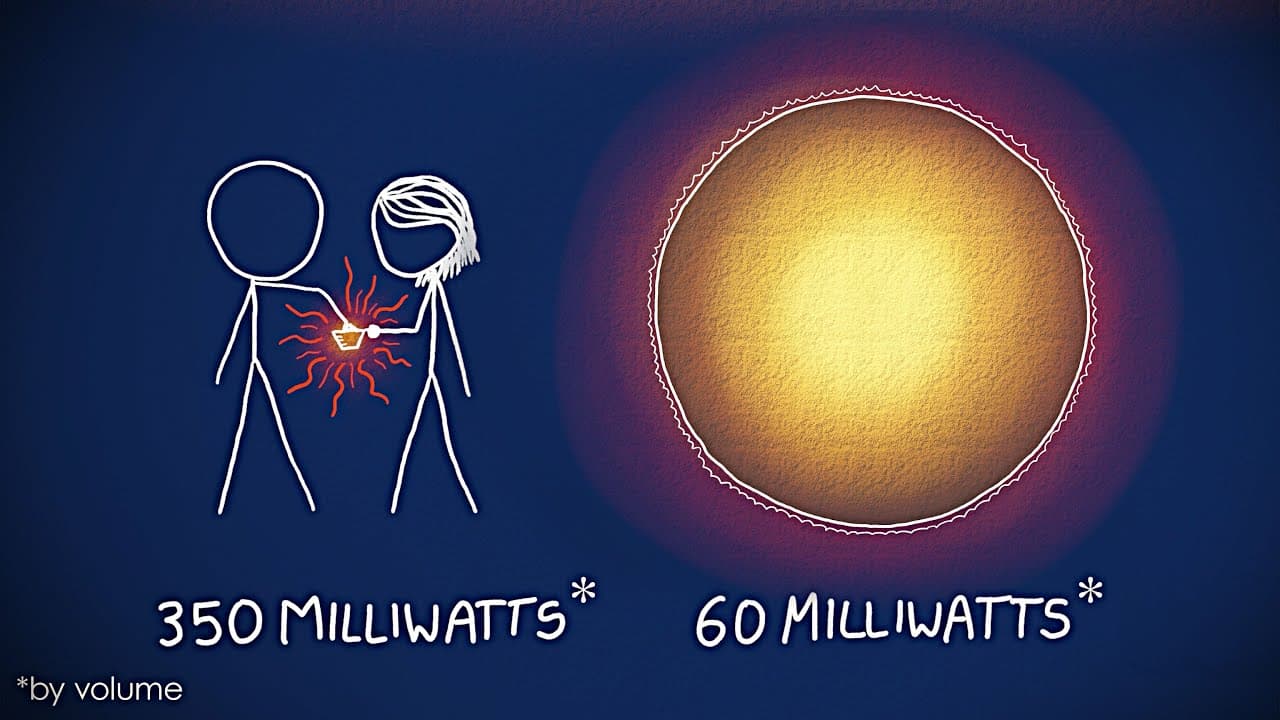
- 🥵 Uranium and plutonium, due to their radioactive nature, would generate significant heat when collected into a large mass.
- 🥵 The physics of radiating heat and thermodynamics explain why larger heat-producing objects become hotter.
- 🥺 Neptunium, being fissile, would lead to a catastrophic explosion and the destruction of the planet.
- 🗾 The book "What if 2" by Randall Munroe offers over 60 answers to intriguing "what if" questions, including the disappearance of Japan.
Install to Summarize YouTube Videos and Get Transcripts
Explore YouTube Video Summarizer or Get YouTube Transcript Extractor
Questions & Answers
Q: What would happen if Mercury and Ceres were composed of their corresponding element?
Mercury and Ceres would become slightly heavier and shinier, resulting in a brighter appearance in the night sky. Ceres would even become visible to the naked eye.
Q: Why would uranium and plutonium create immense heat if collected into a planet-size ball?
The heat produced by each part of uranium or plutonium would accumulate in the planet due to the physics of radiating heat. Larger heat-producing objects generate more heat than they can radiate away, causing the object to get extremely hot.
Q: What would be the visible effects if Pluto were made of plutonium?
Pluto would heat up and emit enough glow to be visible to the naked eye, although just barely. However, the increased heat would likely reduce the time spent observing the night sky due to other planets.
Q: Why should one avoid neptunium?
Neptunium, particularly the most stable isotope 237Neptune, is fissile. If neptunium were present in a planet, it would undergo a rapid fission chain reaction, resulting in a cataclysmic explosion that would obliterate the planet and eventually reach the Earth.
Summary & Key Takeaways
-
The planets Mercury and Ceres would become slightly heavier and shinier if they were composed of their corresponding metals, mercury and cerium.
-
Uranium and plutonium, being radioactive, would generate significant heat if collected into a planet-size ball, potentially reaching temperatures of thousands of degrees.
-
Neptunium, being a fissile isotope, would trigger a runaway fission chain reaction, obliterating the planet and eventually the Earth.
Read in Other Languages (beta)
Share This Summary 📚
Summarize YouTube Videos and Get Video Transcripts with 1-Click
Try YouTube Summary with ChatGPT & Claude or YouTube Transcript Generator
Explore More Summaries from minutephysics 📚




Summarize YouTube Videos and Get Video Transcripts with 1-Click
Try YouTube Summary with ChatGPT & Claude or YouTube Transcript Generator