Energy, Work & Power (23 of 31) Work from the Force vs. Displacement Graph, No. 2
TL;DR
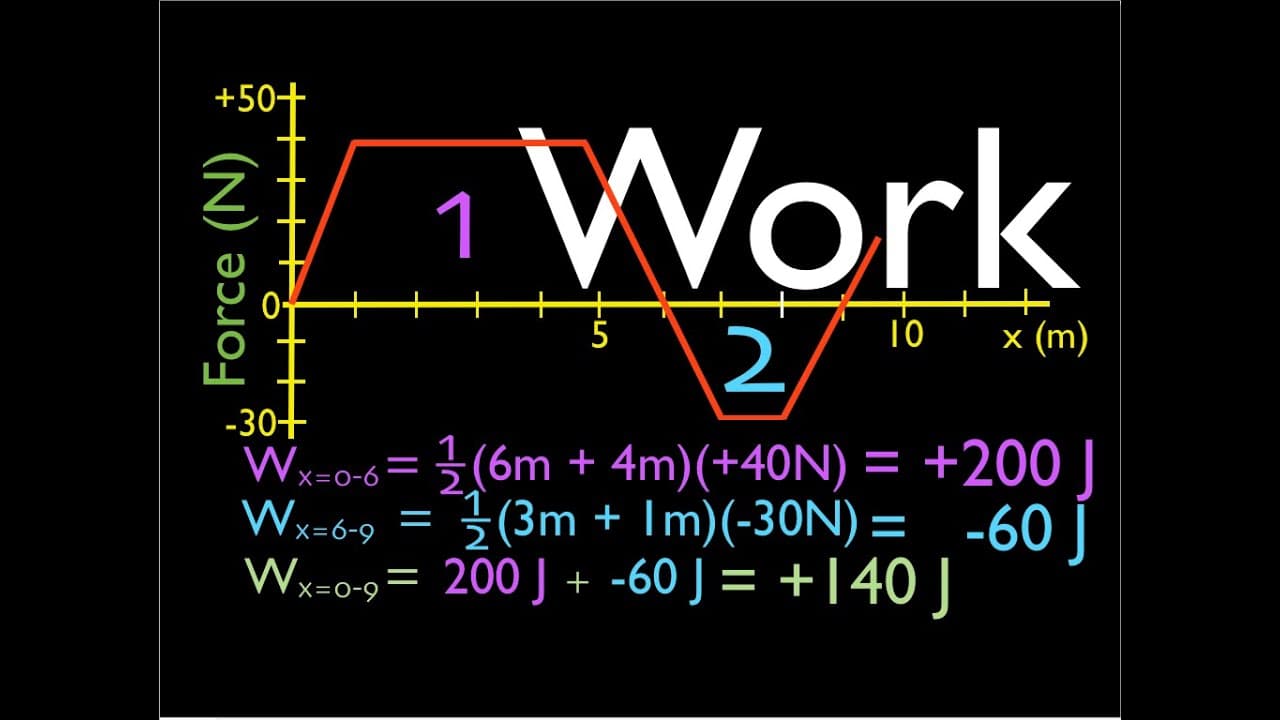
This video explains how to use the force vs. displacement graph to calculate the work done by a force.
Transcript
okay in today's video we are going to show you how to use the force versus displacement graph to determine the amount of work done by a force this is the graph we're going to use for our example this is example number two in the previous example we did a similar problem with a little simpler graph so you can link to that problem right here or you c... Read More
Key Insights
- 💦 The force vs. displacement graph is used to determine the work done on an object by finding the area under the curve.
- 📈 Changes in direction and magnitude of force are reflected in the graph, affecting the shape of the sections.
- 💦 Positive work occurs when the force aligns with the direction of motion, while negative work happens when the force opposes it.
- 🍹 The area under the graph can be calculated as the sum of trapezoidal sections.
- ⚾ The base lengths of the trapezoids represent the displacement values, while the height corresponds to the force.
- 💦 The total work done is the sum of the work done for each section of the graph.
- 💦 Positive and negative work values can be added together to determine the net work done on the object.
Install to Summarize YouTube Videos and Get Transcripts
Explore YouTube Video Summarizer or Get YouTube Transcript Extractor
Questions & Answers
Q: How is the force vs. displacement graph used to determine the work done?
The graph allows us to calculate the work done on an object by finding the area under the graph. This area represents the energy transferred to the object by the force.
Q: Why is the force on the graph not constant?
The force is not constant because it changes in magnitude and direction. This variability is reflected in the graph, with different sections indicating changes in the force acting on the object.
Q: How can the area under the graph be calculated for each section?
The area for each section can be calculated by considering them as trapezoids. The base lengths are determined by the displacement values, and the height is given by the force. Using the formula for the area of a trapezoid, the work done for each section can be found.
Q: What does positive and negative work indicate?
Positive work indicates that a force is acting in the direction of motion, transferring energy to the object. Negative work occurs when the net force opposes the direction of motion, resulting in the transfer of energy from the object.
Summary & Key Takeaways
-
The video demonstrates the use of a force vs. displacement graph to determine the work done by a variable force.
-
The graph shows the force acting on an object, with positive values above the x-axis and negative values below it.
-
The area under the graph represents the work done on the object, which can be calculated by finding the area of trapezoids formed between the graph and the x-axis for each section.
Read in Other Languages (beta)
Share This Summary 📚
Summarize YouTube Videos and Get Video Transcripts with 1-Click
Try YouTube Summary with ChatGPT & Claude or YouTube Transcript Generator
Explore More Summaries from Step by Step Science 📚
Summarize YouTube Videos and Get Video Transcripts with 1-Click
Try YouTube Summary with ChatGPT & Claude or YouTube Transcript Generator