Parallel & perpendicular lines from graph
TL;DR
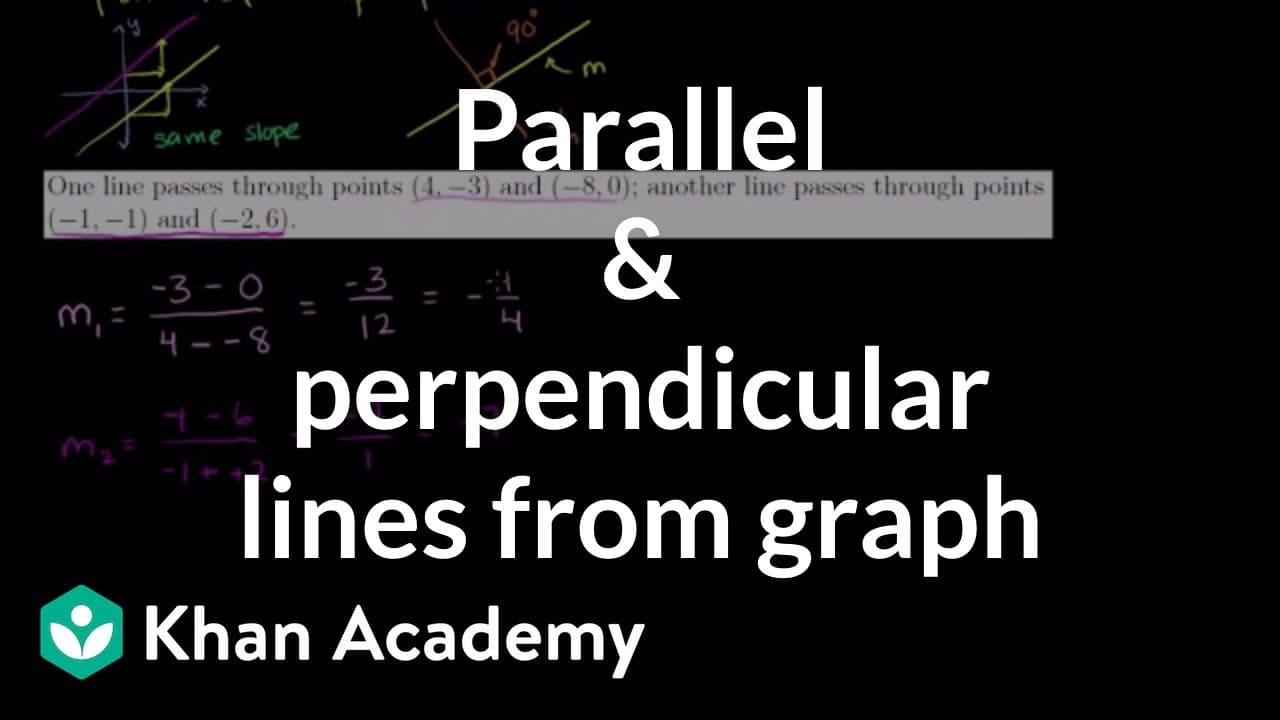
This video provides examples of parallel and perpendicular lines, explaining their slopes and how to determine if lines are parallel or perpendicular.
Transcript
- [Instructor] In this video, we're gonna do a couple of examples that deal with parallel and perpendicular lines. So you have parallel, you have perpendicular, and of course you have lines that are neither parallel nor perpendicular. And just as a bit of a review, if you've never seen this before, parallel lines they never intersect. So let me dra... Read More
Key Insights
- 🫥 Parallel lines have the same slope and do not intersect.
- 🫥 Perpendicular lines have slopes that are negative inverses of each other and intersect at a 90-degree angle.
- 🫥 To determine if lines are parallel or perpendicular, calculate their slopes and compare them.
- 🫥 By finding the slopes, the nature of lines can be determined without graphing them.
- 💱 Slopes can be obtained by calculating the change in Y over the change in X for each line.
- 🫥 Intersecting lines that are neither parallel nor perpendicular will have different slopes.
- 🫥 Finding the equations and graphing lines can be used to verify if they are parallel or perpendicular.
Install to Summarize YouTube Videos and Get Transcripts
Explore YouTube Video Summarizer or Get YouTube Transcript Extractor
Questions & Answers
Q: How are parallel lines defined?
Parallel lines are lines that never intersect and have the same slope. Their slopes will have the same ratio when expressed as change in Y over change in X.
Q: What characterizes perpendicular lines?
Perpendicular lines intersect at a 90-degree angle and have slopes that are negative inverses of each other. Their slopes are obtained by swapping the numerator and denominator and making them negative.
Q: How can we determine if two given lines are parallel?
Calculate the slopes of the two lines by finding the change in Y over the change in X for each line. If the slopes are equal, the lines are parallel.
Q: What if the slopes of two lines are negative inverses of each other?
If the slopes of two lines are negative inverses, the lines are perpendicular. The intersection of perpendicular lines will form a right angle.
Summary & Key Takeaways
-
Parallel lines have the same slope and never intersect, while perpendicular lines intersect at a 90-degree angle.
-
By calculating the slopes of given lines, we can determine if they are parallel, perpendicular, or neither.
-
The video demonstrates multiple examples of finding slopes and determining the nature of lines.
Read in Other Languages (beta)
Share This Summary 📚
Summarize YouTube Videos and Get Video Transcripts with 1-Click
Try YouTube Summary with ChatGPT & Claude or YouTube Transcript Generator
Explore More Summaries from Khan Academy 📚



Summarize YouTube Videos and Get Video Transcripts with 1-Click
Try YouTube Summary with ChatGPT & Claude or YouTube Transcript Generator