How Do You Teach a Robot to Walk Using Reinforcement Learning?
TL;DR
To teach a robot to walk using reinforcement learning, start by simplifying the problem with a bipedal walker environment. Researchers explore algorithms like DDPG and NEAT, where NEAT quickly learns simple tasks, while DDPG struggles with continuous control. Key to success is optimizing model size and hyperparameters to improve training outcomes.
Transcript
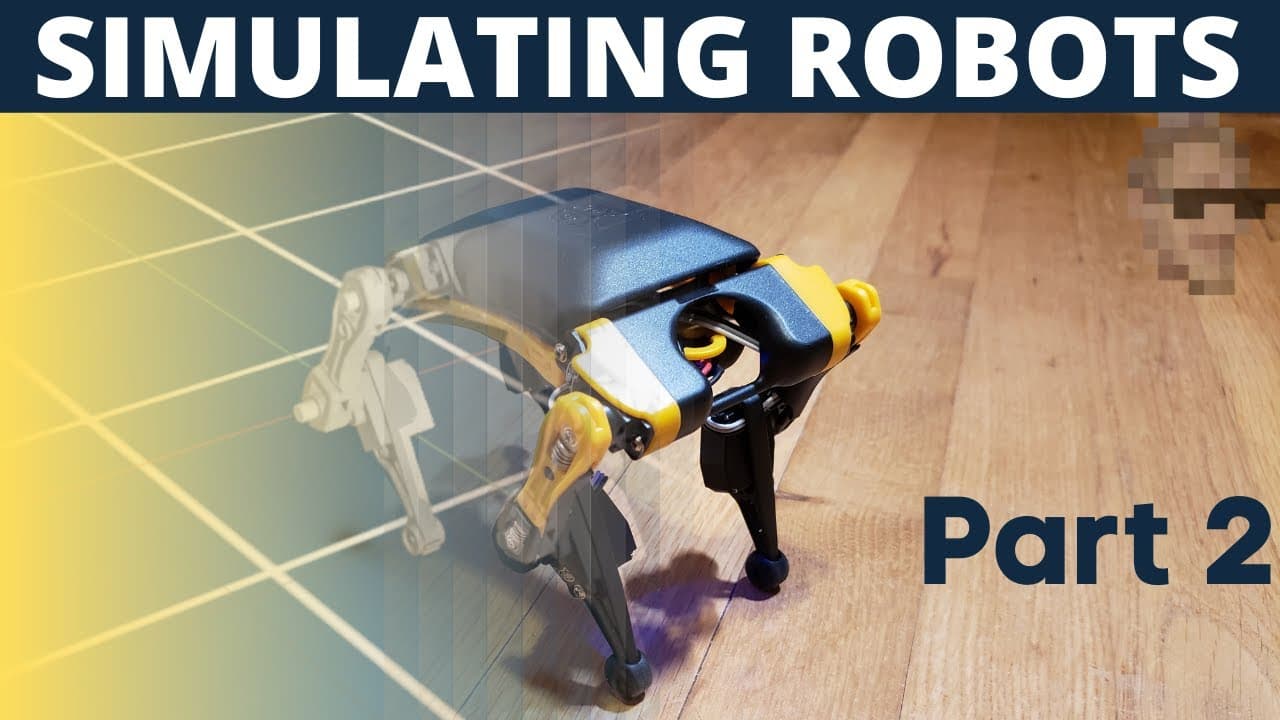
welcome everybody to the second robot simulations video using the isaac sim in nvidia's omniverse in this video i'll share my experiences with attempting to use various algorithms to train the biddle robot dog to walk while the stampede of biddles that you're seeing now is indeed a reinforcement learning algorithm that finally worked getting here w... Read More
Key Insights
- 🤖 Using machine learning algorithms for complex tasks like teaching a robot to walk requires extensive experimentation and exploration.
- 🤖 Reinforcement learning algorithms with continuous control, such as DDPG and NEAT, show potential for training robots to perform specific tasks.
- ❓ The NEAT algorithm is particularly useful for quickly learning simple problems, providing insights into whether a more complex deep learning algorithm can be successful.
- 🎮 Tackling the challenge of continuous control problems requires simplifying the problem and iterating quickly, as demonstrated with the bipedal walker environment from OpenAI Gym.
- ❓ The content creator experiments with different hyperparameters, model sizes, and reward systems to optimize the training process.
- 🛩️ The content creator obtains better results with a larger model size, despite initial expectations that a smaller model would suffice.
- 🤖 Challenges include determining the optimal input information for training the robot and dealing with the absence of certain sensors available in the physical robot.
- 😚 Issues with the DDPG algorithm, such as reaching a peak and then losing performance, highlight the complexity and trial-and-error nature of deep learning algorithms.
Install to Summarize YouTube Videos and Get Transcripts
Explore YouTube Video Summarizer or Get YouTube Transcript Extractor
Questions & Answers
Q: What is the main goal of the content creator in this video?
The main goal of the content creator is to train a Biddle robot dog to walk using machine learning algorithms and explore different approaches to achieve this behavior.
Q: What are some challenges faced in training the Biddle robot dog?
The content creator mentions challenges in determining the optimal inputs for the learning agent, dealing with continuous servo positions, and the absence of lidar and ground contact sensing, which are available in the physical Biddle robot.
Q: What algorithm shows the most promising results for training the robot to walk?
The NEAT (neural evolution of augmenting topologies) algorithm shows promising results, with the content creator achieving stable walking behavior within a few minutes to a few hours of training.
Q: How does the content creator address the issue of the algorithm losing progress?
The content creator explores different hyperparameters and model sizes, but finds limited success in preventing the algorithm from losing progress over time. They mention the need for further exploration and experimentation to find a more robust solution.
Summary & Key Takeaways
-
The content creator attempts to train a Biddle robot dog to walk using machine learning algorithms, specifically reinforcement learning.
-
They use the bipedal walker environment from OpenAI Gym to simplify the problem and iterate quickly.
-
The content creator explores algorithms like DDPG (deep deterministic policy gradient) and the NEAT (neural evolution of augmenting topologies) algorithm to achieve successful walking behavior.
Read in Other Languages (beta)
Share This Summary 📚
Summarize YouTube Videos and Get Video Transcripts with 1-Click
Try YouTube Summary with ChatGPT & Claude or YouTube Transcript Generator
Explore More Summaries from sentdex 📚
Summarize YouTube Videos and Get Video Transcripts with 1-Click
Try YouTube Summary with ChatGPT & Claude or YouTube Transcript Generator