What Are Carbohydrates and Their Functions?
TL;DR
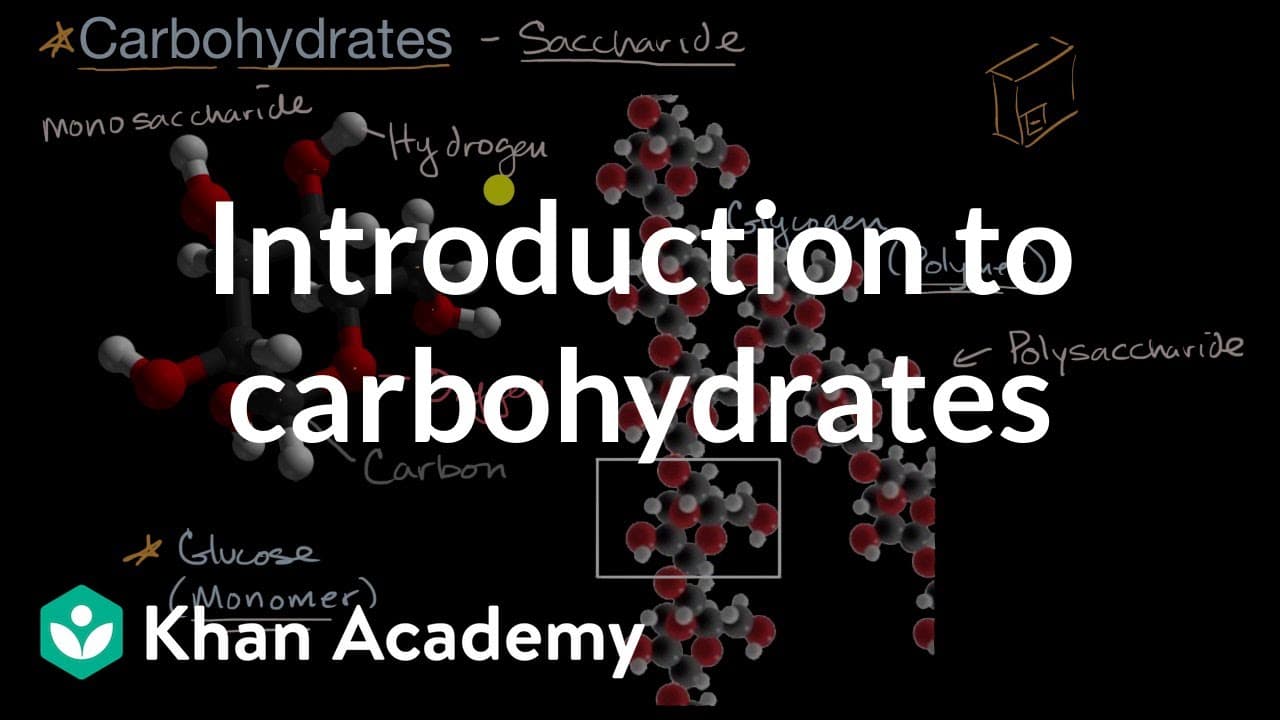
Carbohydrates are organic compounds made of carbon, hydrogen, and oxygen, essential for energy and structure in biological systems. Glucose serves as a primary energy source, while glycogen acts as energy storage in muscles and the liver. Additionally, polysaccharides like cellulose provide structural support, particularly in plants.
Transcript
- [Instructor] What we're going to do in this video is give ourselves a quick introduction to carbohydrates, and you might already be familiar with the notion. If you look at some packaged food, there's usually a nutritional label and will say carbohydrates. It will tell you a certain number of grams per serving. And not all carbohydrates are edibl... Read More
Key Insights
- 🥳 Carbohydrates consist of carbon, hydrogen, and oxygen atoms and have a similar ratio of oxygen to hydrogen as in water.
- 💁 Glucose is a simple sugar and can be used as a standalone molecule or as a building block to form larger carbohydrate molecules.
- ℹ️ Carbohydrates, especially monosaccharides like glucose, are a source of energy in biological systems.
- 💪 Glycogen is a polysaccharide that serves as a stored form of energy in the liver and muscles.
- 🌱 Besides energy storage, certain polysaccharides (e.g., cellulose) can have structural functions, particularly in plants.
- 🏛️ Monosaccharides are the building blocks (monomers) of larger carbohydrate molecules (polymers).
- 🤙 Carbohydrates are part of a group of large molecules called macromolecules.
Install to Summarize YouTube Videos and Get Transcripts
Explore YouTube Video Summarizer or Get YouTube Transcript Extractor
Questions & Answers
Q: What is the definition of a carbohydrate?
Carbohydrates are organic compounds that consist of carbon, hydrogen, and oxygen atoms and are a significant source of energy in biological systems. They can be found in various foods.
Q: How are carbohydrates classified based on their size and structure?
Carbohydrates can be classified as monosaccharides (simple sugars), disaccharides (two monosaccharides linked together), and polysaccharides (long chains of monosaccharides). Monosaccharides are the smallest unit, while polysaccharides are the largest.
Q: What is the function of glucose in biological cells?
Glucose can be converted quickly into energy in biological cells. It is a readily available source of energy and can be broken down from larger molecules like glycogen.
Q: Besides being a source of energy, what other roles do carbohydrates play in biological systems?
Carbohydrates, particularly polysaccharides, can have structural roles in plants (e.g., cellulose). They can provide support and strength to cell walls and other structures.
Summary & Key Takeaways
-
Carbohydrates are found in many foods and are listed on nutritional labels, indicating the grams of carbohydrates per serving.
-
The term "carbohydrate" refers to the presence of carbons and the same ratio of oxygen to hydrogen as in water.
-
Glucose is a simple carbohydrate, while glycogen is a complex carbohydrate made up of repeating glucose molecules.
Read in Other Languages (beta)
Share This Summary 📚
Summarize YouTube Videos and Get Video Transcripts with 1-Click
Try YouTube Summary with ChatGPT & Claude or YouTube Transcript Generator
Explore More Summaries from Khan Academy 📚



Summarize YouTube Videos and Get Video Transcripts with 1-Click
Try YouTube Summary with ChatGPT & Claude or YouTube Transcript Generator