Paper Chromatography Principle and Technique - Chemistry Class 11
TL;DR
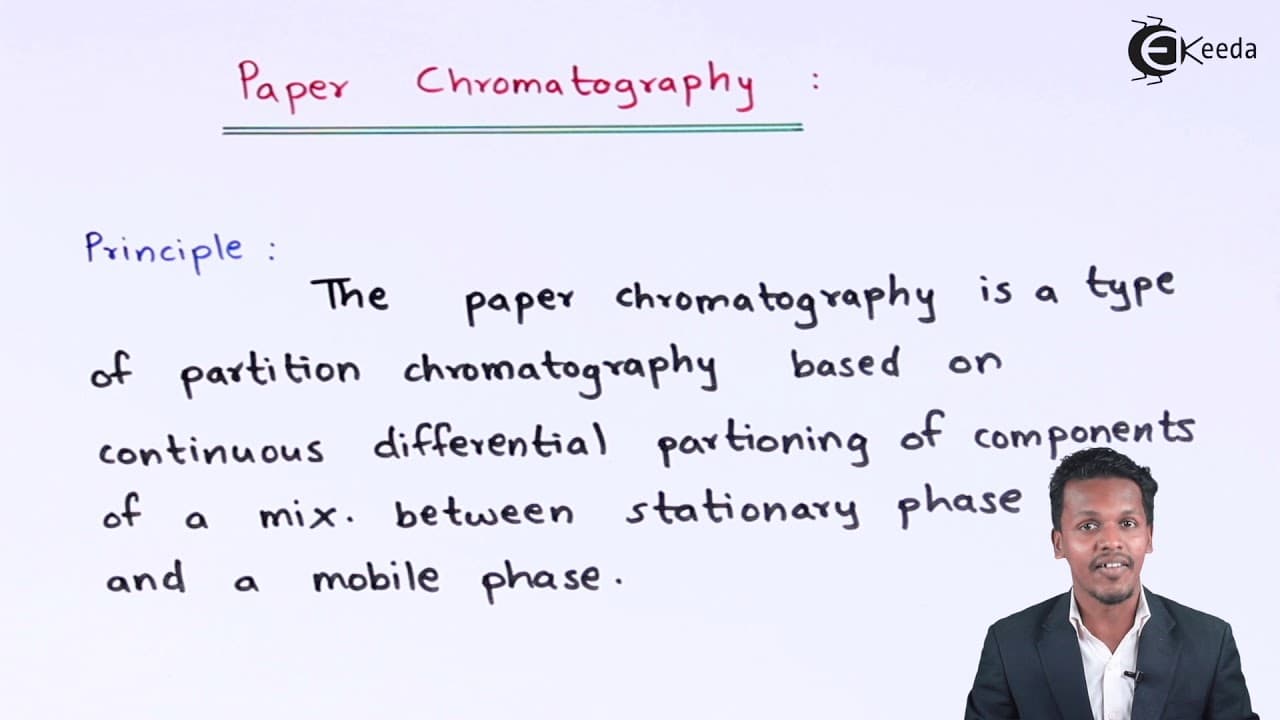
Paper chromatography is a technique based on the principle of partition chromatography, where components of a mixture are separated based on their ability to partition between a stationary phase and a mobile phase.
Transcript
click the bell icon to get latest videos from akira heavens in the previous section we have did the column chromatography we have studied about the thin layer chromatography and now in this topic BC you are going to talk about the people from photography so what is typically what is the principle behind and the technique behind the paper chromatogr... Read More
Key Insights
- 🚗 Paper chromatography is a type of partition chromatography where components of a mixture partition between a stationary phase and a mobile phase.
- 🏮 The principle behind paper chromatography is the differential partitioning of components between the chromatography paper and the solvent.
- 😮 The technique involves spotting the mixture on the paper, allowing the solvent to rise, and observing the separation of components based on their migration rates.
- 🏮 Paper chromatography is a simple and effective technique for separating and analyzing organic compounds in a mixture.
- 🧑🏭 Chromatography paper acts as the stationary phase, and the solvent acts as the mobile phase in paper chromatography.
- 😮 Capillary action is responsible for the solvent rising through the paper and carrying the components along.
- 👻 The separation of components in paper chromatography allows for the identification and analysis of different organic compounds in a mixture.
Install to Summarize YouTube Videos and Get Transcripts
Explore YouTube Video Summarizer or Get YouTube Transcript Extractor
Questions & Answers
Q: What is paper chromatography?
Paper chromatography is a technique that separates the components of a mixture based on their differential partitioning between a stationary phase (chromatography paper) and a mobile phase (solvent).
Q: What is the principle behind paper chromatography?
The principle behind paper chromatography is the continuous differential partitioning of components between the stationary phase (chromatography paper) and the mobile phase (solvent), allowing for the separation of the mixture.
Q: How is paper chromatography different from column chromatography?
Paper chromatography differs from column chromatography in terms of its technique and principle. While column chromatography involves separating components using a column packed with a solid stationary phase, paper chromatography uses chromatography paper as the stationary phase and a solvent as the mobile phase.
Q: How is a mixture separated using paper chromatography?
In paper chromatography, a mixture is separated by spotting it on the chromatography paper and allowing the solvent to rise through capillary action. The different components of the mixture will migrate at different rates and form separate spots on the paper.
Summary & Key Takeaways
-
Paper chromatography is a type of partition chromatography used to separate the components of a mixture.
-
It is based on the principle of differential partitioning between a stationary phase (chromatography paper) and a mobile phase (solvent).
-
The technique involves spotting the mixture on the paper, allowing the solvent to rise via capillary action, and observing the separation of the components.
Read in Other Languages (beta)
Share This Summary 📚
Summarize YouTube Videos and Get Video Transcripts with 1-Click
Try YouTube Summary with ChatGPT & Claude or YouTube Transcript Generator
Explore More Summaries from Ekeeda 📚



Summarize YouTube Videos and Get Video Transcripts with 1-Click
Try YouTube Summary with ChatGPT & Claude or YouTube Transcript Generator