Radius of observable universe | Scale of the universe | Cosmology & Astronomy | Khan Academy
TL;DR
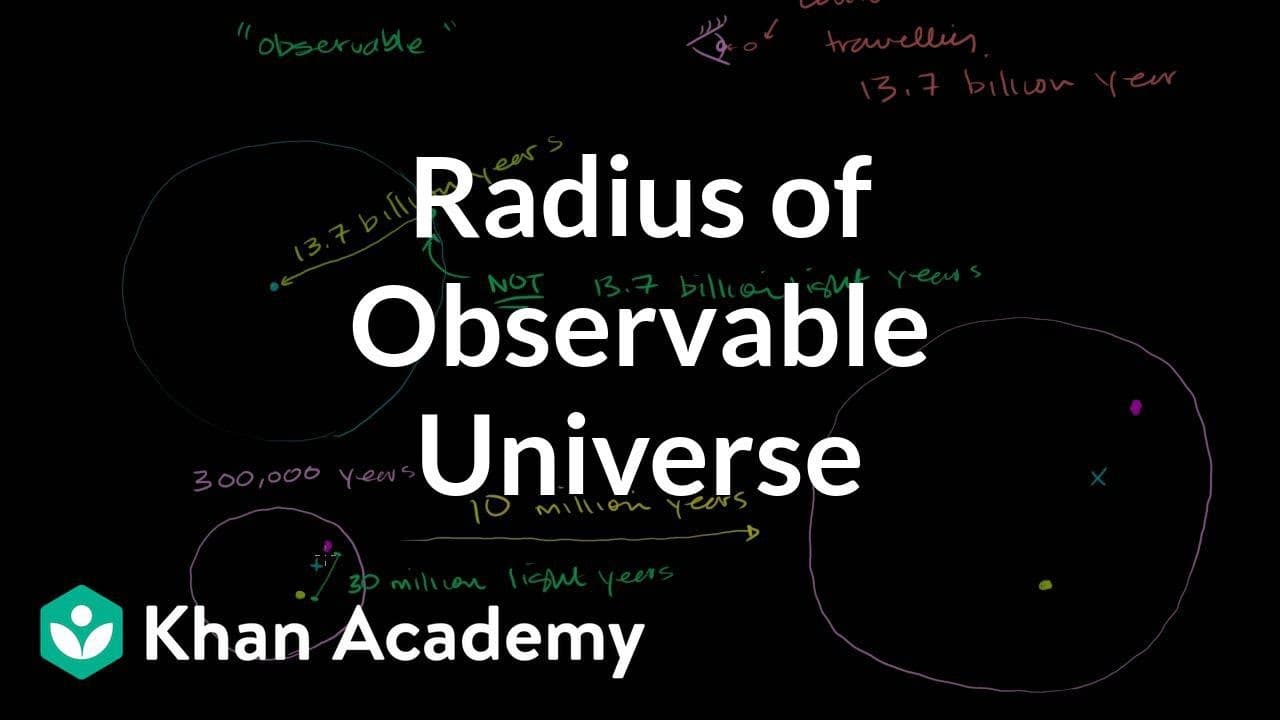
The universe started expanding from a singularity 13.7 billion years ago, and the observable universe is now estimated to be 46 billion light-years away.
Transcript
Right now, the best estimate of when the Big Bang occurred-- and once again, I don't like the term that much because it kind of implies some type of explosion. But what it really is is kind of an expansion of space, when space started to really start to expand from a singularity. But our best estimate of when this occurred is 13.7 billion years ago... Read More
Key Insights
- 👾 The term "Big Bang" refers to the expansion of space from a singularity, rather than an explosion.
- 🥶 The universe is estimated to be 13.7 billion years old, but this number may change in the future.
- 🙂 Light from distant objects takes a long time to reach us due to the expansion of space over billions of years.
- 🙂 The observable universe is now estimated to be 46 billion light-years away from us.
- 😅 Objects that are 46 billion light-years away would appear as they were in a primitive state of white-hot plasma.
- ❓ The cosmic microwave background radiation provides insight into the early stages of the universe.
- 👾 The expansion of space affects how we measure distances in the universe.
Install to Summarize YouTube Videos and Get Transcripts
Explore YouTube Video Summarizer or Get YouTube Transcript Extractor
Questions & Answers
Q: What is the age of the universe according to the best estimate?
The best estimate is that the universe is 13.7 billion years old, based on the expansion of space from the Big Bang.
Q: How far away is the observable universe from us?
The observable universe is estimated to be 46 billion light-years away, due to the expansion of space over time.
Q: Why does light from distant objects take billions of years to reach us?
It takes billions of years because the space itself is expanding, causing the distances between objects to increase gradually over time.
Q: What will we see when observing light from objects 46 billion light-years away?
We will see the objects as they were 13.4 billion years ago, when the universe was in its primitive state of white-hot plasma.
Summary & Key Takeaways
-
The Big Bang is the term used to describe the expansion of space from a singularity 13.7 billion years ago.
-
The observable universe is all the space we can see, and it has expanded to be 46 billion light-years away.
-
Light from distant objects takes billions of years to reach us, showing us what the universe looked like in its early stages.
Read in Other Languages (beta)
Share This Summary 📚
Summarize YouTube Videos and Get Video Transcripts with 1-Click
Try YouTube Summary with ChatGPT & Claude or YouTube Transcript Generator
Explore More Summaries from Khan Academy 📚



Summarize YouTube Videos and Get Video Transcripts with 1-Click
Try YouTube Summary with ChatGPT & Claude or YouTube Transcript Generator