Later stages of the Civil War part 3
TL;DR
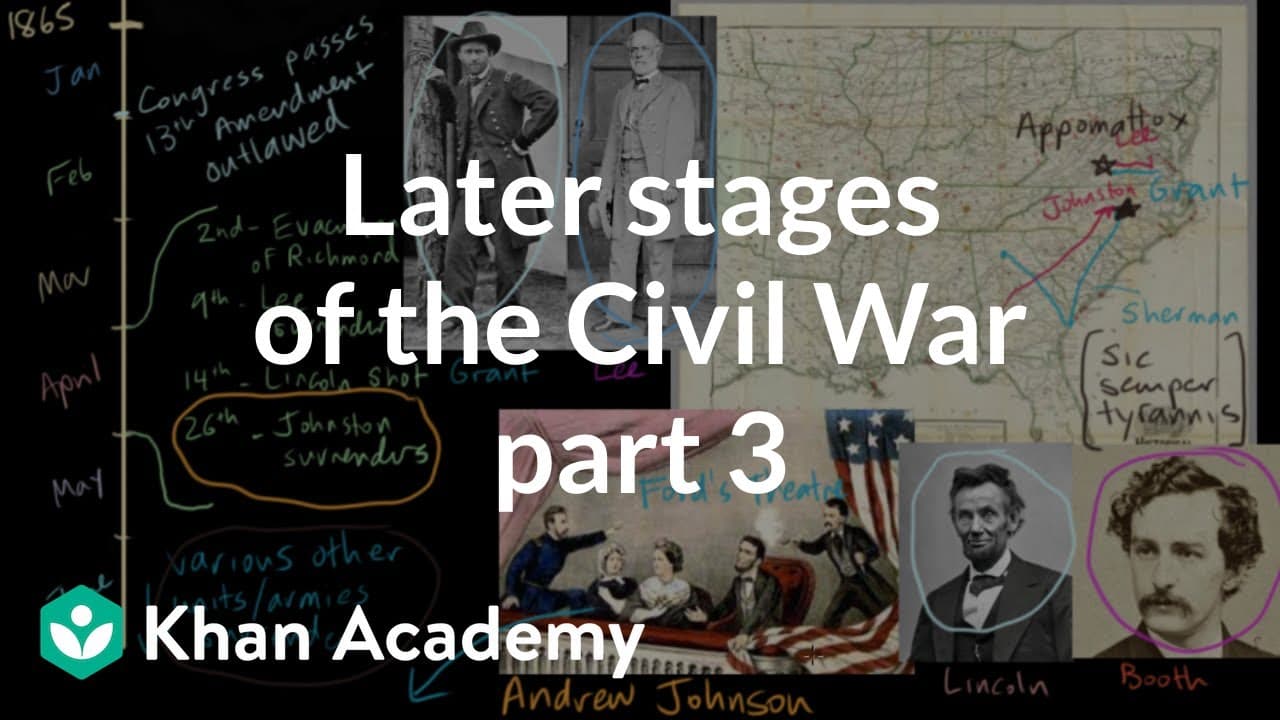
The American Civil War comes to an end as General Robert E. Lee surrenders to General Ulysses S. Grant, Abraham Lincoln is assassinated by John Wilkes Booth, and the era of Reconstruction begins.
Transcript
- [Voiceover] So in the last video, we talked about the year 1864 in the American Civil War, and now we're getting down to the very end of the war. In 1864, William Tecumseh Sherman had his sort of famous march to the sea, where he captured Atlanta and then carried on a total war through the state of Georgia to Savannah, and from Savannah he turns ... Read More
Key Insights
- 🤢 William Tecumseh Sherman's march to the sea and General Grant's pursuit of Lee were critical in weakening the Confederacy.
- 🇺🇸 The 13th Amendment officially ended slavery in the United States.
- 🫢 Lincoln's visit to Richmond and subsequent assassination shocked the nation and had long-lasting consequences.
- ❤️🩹 The end of the Civil War marked the beginning of Reconstruction, a challenging period in American history.
- 🇺🇸 John Wilkes Booth's assassination plot aimed to decapitate the United States government, leading to potential favorable outcomes for the South.
- ❤️🩹 The surrender of Confederate armies, including General Joe Johnston's surrender to Sherman, finalized the end of the Civil War.
- 🥺 Andrew Johnson's presidency following Lincoln's assassination created conflicts with Congress and ultimately led to his impeachment.
Install to Summarize YouTube Videos and Get Transcripts
Explore YouTube Video Summarizer or Get YouTube Transcript Extractor
Questions & Answers
Q: Who were the key generals involved in the end of the Civil War?
The key generals involved were General William Tecumseh Sherman, who captured Atlanta and marched to the sea, and General Ulysses S. Grant, who pursued General Robert E. Lee in Virginia.
Q: What was the significance of the 13th Amendment?
The 13th Amendment outlawed slavery in the United States. It ensured that when the South rejoined the Union, it would be without the institution of slavery.
Q: Why did John Wilkes Booth assassinate Abraham Lincoln?
John Wilkes Booth was a Confederate sympathizer and racist. He was angered by Lincoln's plans to grant African Americans citizenship and the right to vote. Booth originally planned to kidnap Lincoln but changed his plan after Lee's surrender, deciding to decapitate the government instead.
Q: How did Lincoln's assassination affect the Reconstruction era?
Lincoln's assassination led to the transfer of power to Andrew Johnson, who was sympathetic to the South. This caused considerable conflict with Congress and ultimately led to Johnson's impeachment. The assassination punctuated the end of the Civil War and set the stage for a challenging Reconstruction period.
Summary & Key Takeaways
-
In 1865, General Sherman captures Atlanta and carries out a "total war" through Georgia, while General Grant pursues General Lee in Virginia.
-
The United States forces occupy Richmond, Lee's army is cornered and surrenders at Appomattox.
-
The 13th Amendment is passed, officially outlawing slavery, and Lincoln gives a speech on Reconstruction before being assassinated by Booth.
Read in Other Languages (beta)
Share This Summary 📚
Summarize YouTube Videos and Get Video Transcripts with 1-Click
Try YouTube Summary with ChatGPT & Claude or YouTube Transcript Generator
Explore More Summaries from Khan Academy 📚



Summarize YouTube Videos and Get Video Transcripts with 1-Click
Try YouTube Summary with ChatGPT & Claude or YouTube Transcript Generator