How to find the average rate of change from a formula | Functions | Algebra I | Khan Academy
TL;DR
Finding the interval where the average rate of change of a function is 1/2 by evaluating the function at different points.
Transcript
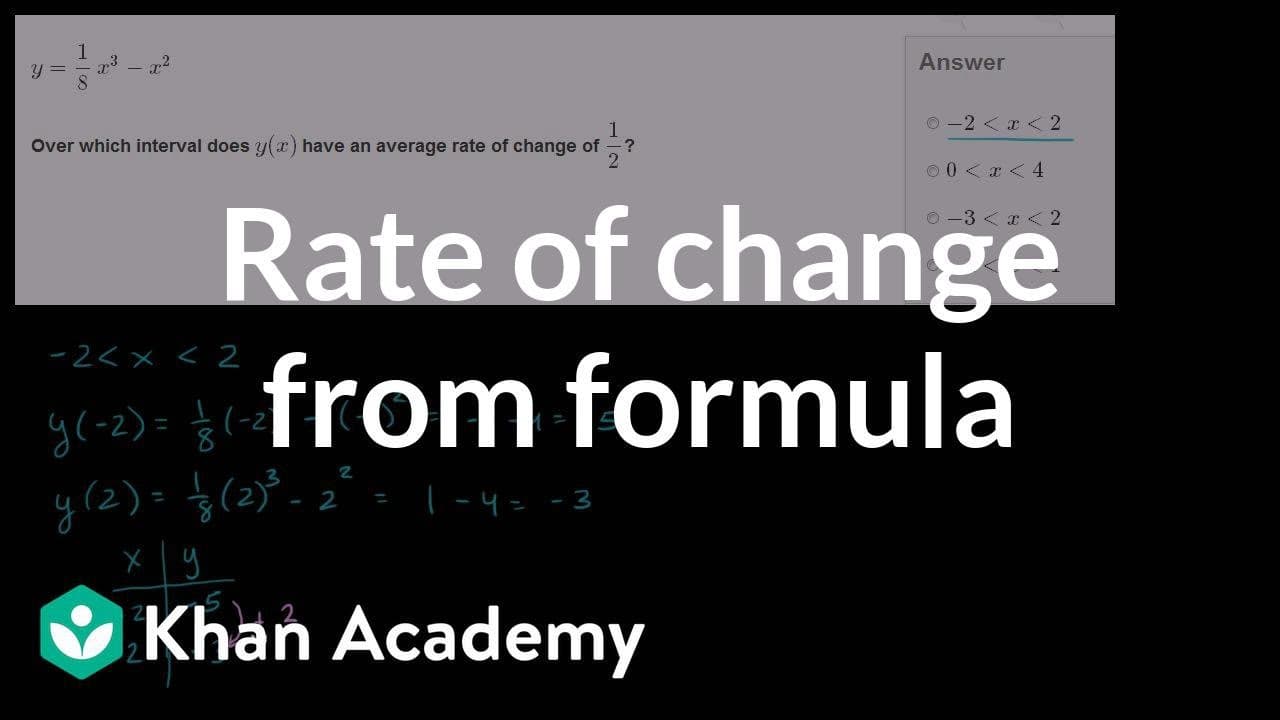
y equals 1/8 x to the third minus x squared. Over which interval does y of x have an average rate of change of 1/2? So let's go interval by interval and calculate the average rate of change. So first let's think about this interval right over here. x is between negative 2 and 2. So negative 2 is less than x, which is less than 2. So let's just thin... Read More
Key Insights
- 💱 The average rate of change of a function is determined by evaluating the function at different points and calculating the change in y divided by the change in x.
- 💱 The average rate of change can be positive, negative, or zero, depending on how the y-values change with respect to the x-values.
- 💱 A positive average rate of change indicates that as x increases, the corresponding y-values also increase.
- 💱 A negative average rate of change means that as x increases, the corresponding y-values decrease.
- ☠️ The average rate of change can be used to analyze the overall trend of a function over a given interval.
- 💱 To find the interval where the average rate of change is a specific value, evaluate the function at different points and compare the changes in y and x.
- ☠️ The average rate of change can be different for different intervals, even within the same function.
Install to Summarize YouTube Videos and Get Transcripts
Explore YouTube Video Summarizer or Get YouTube Transcript Extractor
Questions & Answers
Q: What is the average rate of change over the interval x = -2 to x = 2?
The average rate of change is (y(2) - y(-2))/(2 - (-2)) = (-3 - (-5))/4 = 1/2.
Q: Why is the average rate of change in the second interval not 1/2?
The average rate of change over the interval x = 0 to x = 4 is (y(4) - y(0))/(4 - 0) = (-8 - 0)/4 = -2. Therefore, the average rate of change is -2, not 1/2.
Q: How can the average rate of change be calculated using different points on the graph?
To find the average rate of change, evaluate the function at two points and divide the change in y-values by the change in x-values.
Q: What is the difference between the average rate of change and the instantaneous rate of change?
The average rate of change is calculated over a given interval, while the instantaneous rate of change refers to the rate of change at a specific point. It is obtained by finding the derivative of the function.
Summary & Key Takeaways
-
The function is y = 1/8x^3 - x^2, and the task is to find the interval where the average rate of change of y with respect to x is equal to 1/2.
-
By evaluating the function at x = -2 and x = 2, we find that y(-2) = -5 and y(2) = -3.
-
The average rate of change over the interval x = -2 to x = 2 is calculated as (2 - (-5))/(2 - (-2)) = 7/4, which is not equal to 1/2.
-
Evaluating the function at x = 0 and x = 4 gives y(0) = 0 and y(4) = -8, resulting in an average rate of change of -8/4 = -2 over the interval x = 0 to x = 4.
Read in Other Languages (beta)
Share This Summary 📚
Summarize YouTube Videos and Get Video Transcripts with 1-Click
Try YouTube Summary with ChatGPT & Claude or YouTube Transcript Generator
Explore More Summaries from Khan Academy 📚



Summarize YouTube Videos and Get Video Transcripts with 1-Click
Try YouTube Summary with ChatGPT & Claude or YouTube Transcript Generator