Law of cosines for star distance | Trig identities and examples | Trigonometry | Khan Academy
TL;DR
Artemis uses the Law of Cosines to calculate the distance between two stars in Orion's belt, which is approximately 184 light years.
Transcript
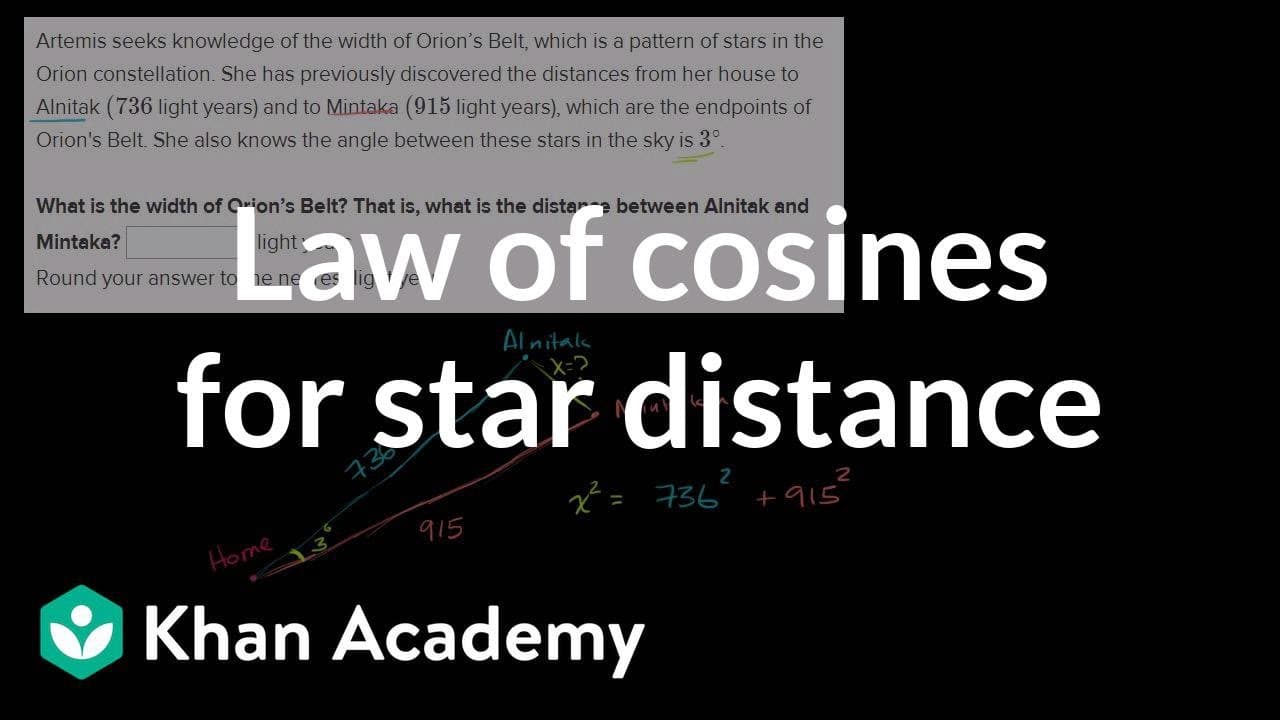
Voiceover:Artemis seeks knowledge of the width of Orion's belt, which is a pattern of stars in the Orion constellation. She has previously discovered the distances from her house to Alnitak, 736 lights years, and to Mintaka, 915 light years, which are the endpoints of Orion's belt. She knows the angle between these stars in the sky is three degrees... Read More
Key Insights
- 🤩 Artemis seeks to calculate the width of Orion's belt, which is the distance between the stars Alnitak and Mintaka.
- 🙂 She knows the distance from her house to Alnitak is 736 light years, and the distance to Mintaka is 915 light years.
- 🙂 By utilizing the Law of Cosines and the given angle of three degrees, Artemis determines that the width of Orion's belt is approximately 184 light years.
- 🔺 The Law of Cosines is a useful tool in astronomy and trigonometry for determining distances and angles in non-right triangles.
- 🔺 Calculations in astronomy often require knowledge of distances, angles, and mathematical formulas.
- 🫵 Artemis encourages viewers to try the calculation themselves before proceeding with the explanation.
Install to Summarize YouTube Videos and Get Transcripts
Explore YouTube Video Summarizer or Get YouTube Transcript Extractor
Questions & Answers
Q: How does Artemis determine the distances from her house to Alnitak and Mintaka?
Artemis knows the distances because they were provided in the content. She knows that Alnitak is 736 light years away from her house, and Mintaka is 915 light years away.
Q: What does the angle between the stars have to do with calculating the width of Orion's belt?
The angle helps in utilizing the Law of Cosines. By knowing the angle and the lengths of the other two sides (distances to Alnitak and Mintaka), Artemis can find the length of the side opposite the angle, which is the width of Orion's belt.
Q: How does the Law of Cosines work in this scenario?
The Law of Cosines states that the square of one side of a triangle is equal to the sum of the squares of the other two sides, minus two times the product of the lengths of those two sides, multiplied by the cosine of the angle between them. This equation is used to find the length of the side opposite the given angle.
Q: What is the final calculated width of Orion's belt?
The calculated width of Orion's belt is approximately 184 light years, as determined by Artemis using the Law of Cosines.
Summary & Key Takeaways
-
Artemis wants to find the width of Orion's belt, which is the distance between two stars in the constellation.
-
She knows the distances from her house to the stars Alnitak and Mintaka, as well as the angle between the stars.
-
By using the Law of Cosines, Artemis calculates that the width of Orion's belt is approximately 184 light years.
Read in Other Languages (beta)
Share This Summary 📚
Summarize YouTube Videos and Get Video Transcripts with 1-Click
Try YouTube Summary with ChatGPT & Claude or YouTube Transcript Generator
Explore More Summaries from Khan Academy 📚



Summarize YouTube Videos and Get Video Transcripts with 1-Click
Try YouTube Summary with ChatGPT & Claude or YouTube Transcript Generator