Products
Features
YouTube Video Summarizer
Summarize YouTube videos
Web & PDF Highlighter
Highlight web pages & PDFs
Chat with PDF
Ask any PDF questions with AI
Ask AI Clone
Chat with your highlights & memories
Audio Transcriber
Transcribe audio files to text
Glasp Reader
Read and highlight articles
Kindle Highlight Export
Export your Kindle highlights
Idea Hatch
Hatch ideas from your highlights
Integrations
Obsidian Plugin
Notion Integration
Pocket Integration
Instapaper Integration
Medium Integration
Readwise Integration
Snipd Integration
Hypothesis Integration
Apps & Extensions
Chrome Extension
Safari Extension
Edge Add-ons
Firefox Add-ons
iOS App
Android App
Discover
Discover
Ideas
Discover new ideas and insights
Articles
Curated articles and insights
Books
Book recommendations by great minds
Posts
Essays and notes from readers
Quotes
Inspiring quotes collection
Videos
Curated videos and summaries
Explore Glasp
Glasp Newsletter
Weekly insights and updates
Glasp Talk
Interview series with great minds
Glasp Blog
Latest news and articles
Glasp Use Cases
Learn how others use Glasp
Build & Support
Glasp API
Access Glasp's API for developers
MCP Connector
Connect Glasp to Claude & ChatGPT
Community
Glasp Reddit Community
Students
Student discount and benefits
FAQs
Frequently Asked Questions
AboutPricing
DashboardLog inSign up

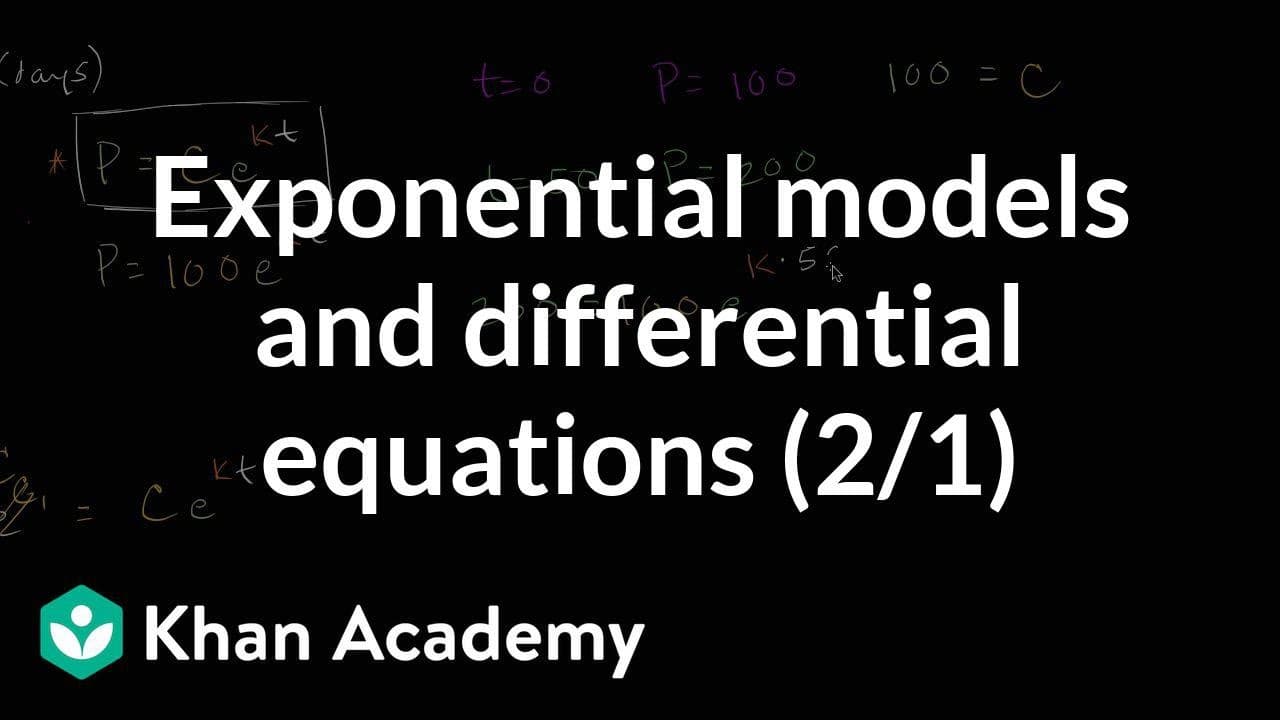
Particular solution given initial conditions for population | Khan Academy
September 24, 2014
by
Khan Academy
YouTube video player
Particular solution given initial conditions for population | Khan Academy

TL;DR

An explanation on how to model population growth using exponential functions, with an example using concrete numbers.

Transcript

  • [Voiceover] In the last video, we established that if we say the rate of change of a population with respect to time is going to be proportional to the population, we were able to solve that differential equation, find a general solution, which involves an exponential. That the population is going to be equal to some constant times e to some othe... Read More

Key Insights

  • ☠️ Modeling population growth using exponential functions relies on the assumption of proportionality between the rate of change and population size.
  • 👻 By providing initial conditions, the constants in the exponential function can be determined, allowing for the creation of a particular solution.
  • 🤢 The constant "C" represents the initial population, while the constant "k" is determined through the use of logarithmic functions.
  • ⌛ The particular solution obtained represents the growth or decline of the population over time.

Install to Summarize YouTube Videos and Get Transcripts

Explore YouTube Video Summarizer or Get YouTube Transcript Extractor

Questions & Answers

Q: How can population growth be modeled using exponential functions?

Population growth can be modeled using exponential functions by assuming that the rate of change of the population is proportional to the population itself. Using initial conditions, the constants in the exponential function can be determined to create a particular solution.

Q: What does the constant "C" represent in the exponential function?

The constant "C" represents the initial population at time equals zero. It is the value that the population starts with before any growth or decay occurs.

Q: How are the constants "C" and "k" determined in the modeling process?

The constant "C" is determined by using the initial condition where time equals zero and the population is known. Solving for "C" involves substituting the values into the exponential function equation. The constant "k" is solved by using a second set of initial conditions and using logarithmic functions to isolate it.

Q: Can population growth be accurately modeled using exponential functions?

Yes, population growth can be accurately modeled using exponential functions if the rate of change of the population is proportional to the population itself. However, it is important to note that real-life populations may involve more complex factors and the model may need to be adjusted accordingly.

Summary & Key Takeaways

  • The previous video established that the rate of change of a population with respect to time is proportional to the population, leading to the use of exponential functions.

  • Applying this concept, the video demonstrates how to model population growth using concrete numbers.

  • By providing initial conditions and using the exponential function formula, the constants can be solved to create a particular solution that represents population growth.


Read in Other Languages (beta)

English

Share This Summary 📚

Summarize YouTube Videos and Get Video Transcripts with 1-Click

Download browser extensions on:

Try YouTube Summary with ChatGPT & Claude or YouTube Transcript Generator

Explore More Summaries from Khan Academy 📚

Bitcoin - Cryptographic hash function thumbnail
Bitcoin - Cryptographic hash function
Khan Academy
Magnitude of vector sums | Vectors | Precalculus | Khan Academy thumbnail
Magnitude of vector sums | Vectors | Precalculus | Khan Academy
Khan Academy
Cosmic background radiation 2 | Scale of the universe | Cosmology & Astronomy | Khan Academy thumbnail
Cosmic background radiation 2 | Scale of the universe | Cosmology & Astronomy | Khan Academy
Khan Academy
Addition elimination method 1 | Systems of equations | 8th grade | Khan Academy thumbnail
Addition elimination method 1 | Systems of equations | 8th grade | Khan Academy
Khan Academy
Selective incorporation | Civil liberties and civil rights | US government and civics | Khan Academy thumbnail
Selective incorporation | Civil liberties and civil rights | US government and civics | Khan Academy
Khan Academy
Worked example: recognizing function from Taylor series | Series | AP Calculus BC | Khan Academy thumbnail
Worked example: recognizing function from Taylor series | Series | AP Calculus BC | Khan Academy
Khan Academy

Summarize YouTube Videos and Get Video Transcripts with 1-Click

Download browser extensions on:

Try YouTube Summary with ChatGPT & Claude or YouTube Transcript Generator

Apps & Extensions

  • Chrome Extension
  • Safari Extension
  • Edge Add-ons
  • Firefox Add-ons
  • iOS App
  • Android App

Key Features

  • YouTube Video Summarizer
  • Web & PDF Summarizer
  • Web & PDF Highlighter
  • Chat with PDF
  • Ask AI Clone
  • Audio Transcriber
  • Glasp Reader
  • Kindle Highlight Export
  • Idea Hatch

Integrations

  • Obsidian Plugin
  • Notion Integration
  • Pocket Integration
  • Instapaper Integration
  • Medium Integration
  • Readwise Integration
  • Snipd Integration
  • Hypothesis Integration

More Features

  • APIs
  • MCP Connector
  • Blog & Post
  • Embed Links
  • Image Highlight
  • Personality Test
  • Quote Shots

Company

  • About us
  • Blog
  • Community
  • FAQs
  • Job Board
  • Newsletter
  • Pricing
Terms

•

Privacy

•

Guidelines

© 2026 Glasp Inc. All rights reserved.