Worked example: Calculating partial pressures | AP Chemistry | Khan Academy
TL;DR
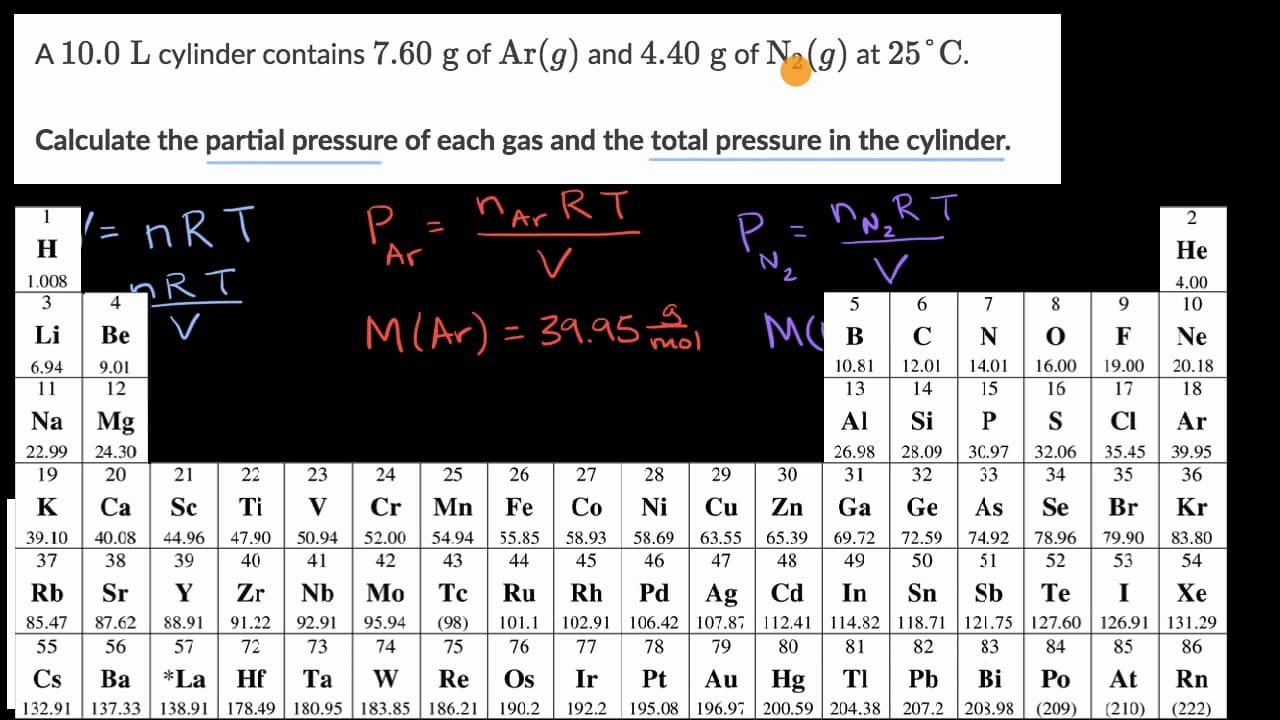
Calculate the partial pressure of argon and molecular nitrogen, as well as the total pressure in a 10-liter gas cylinder containing 7.60 grams of argon and 4.40 grams of molecular nitrogen at 25 degrees Celsius.
Transcript
- [Instructor] We're told that a 10-liter cylinder contains 7.60 grams of argon, in gas form, and 4.40 grams of molecular nitrogen, once again in gas form, at 25 degrees Celsius. Calculate the partial pressure of each gas and the total pressure in the cylinder. All right, so pause this video, and see if you can work through this on your own before ... Read More
Key Insights
- 🫢 The ideal gas law is used to calculate the partial pressure and total pressure in a gas cylinder.
- 💆 The molar mass of argon is 39.95 grams per mole, and the molar mass of molecular nitrogen is 28.02 grams per mole.
- 🫢 The partial pressure of a gas is determined by the number of moles of the gas, multiplied by the ideal gas constant and temperature, divided by the volume.
- 🫢 The total pressure in the gas cylinder is the sum of the partial pressures of each gas.
Install to Summarize YouTube Videos and Get Transcripts
Explore YouTube Video Summarizer or Get YouTube Transcript Extractor
Questions & Answers
Q: What is the ideal gas law used for in this context?
The ideal gas law is used to calculate the partial pressure and total pressure in the gas cylinder, given the volume, temperature, and number of moles of each gas.
Q: How do you calculate the partial pressure of argon and molecular nitrogen?
The partial pressure of each gas is determined by multiplying the number of moles of the gas by the ideal gas constant and temperature, divided by the volume.
Q: How do you convert the temperature from degrees Celsius to Kelvin?
To convert degrees Celsius to Kelvin, you add 273 to the temperature in degrees Celsius.
Q: What is the total pressure in the gas cylinder?
The total pressure in the gas cylinder is the sum of the partial pressure of argon and the partial pressure of molecular nitrogen.
Summary & Key Takeaways
-
The ideal gas law is applicable to calculate the partial pressure and total pressure in a gas cylinder.
-
The partial pressure of argon is determined by multiplying the number of moles of argon by the ideal gas constant and temperature, divided by the volume.
-
The partial pressure of molecular nitrogen is found by multiplying the number of moles of nitrogen by the ideal gas constant and temperature, divided by the volume.
Read in Other Languages (beta)
Share This Summary 📚
Summarize YouTube Videos and Get Video Transcripts with 1-Click
Try YouTube Summary with ChatGPT & Claude or YouTube Transcript Generator
Explore More Summaries from Khan Academy 📚



Summarize YouTube Videos and Get Video Transcripts with 1-Click
Try YouTube Summary with ChatGPT & Claude or YouTube Transcript Generator