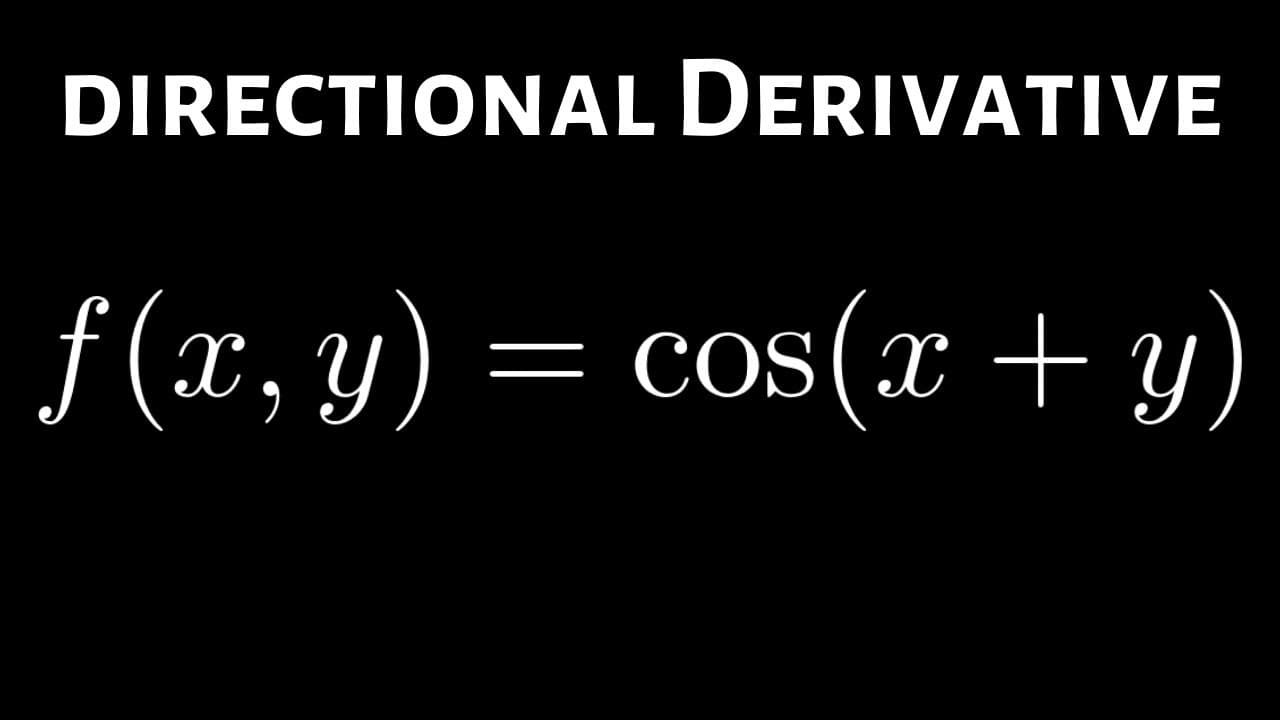
How to Find the Directional Derivative of f(x, y) = cos(x + y) using the Gradient Vector
TL;DR
The video explains how to calculate the directional derivative of a function at a given point in the direction of a vector.
Transcript
in this video we're going to find the directional derivative of this function at this point in the direction of this vector so before we go through the problem let me refresh your memory on the formula we're going to use so the directional derivative of a function which we'll call f of XY in the direction of a unit vector U is given by the gradient... Read More
Key Insights
- 🇦🇪 The formula for the directional derivative involves the gradient vector of the function and the unit vector in the given direction.
- 😥 Calculating the unit vector requires subtracting the initial and terminal points of the given vector and normalizing it by dividing by its magnitude.
- 🫡 The gradient vector is found by taking the partial derivatives of the function with respect to each variable and plugging in the given point.
- 💱 A directional derivative of 0 indicates no change in the function in the direction of the vector.
- ❓ It is important to simplify calculations and consider possible outcomes before proceeding with complex steps.
- 🫥 Understanding the concept of unit vectors and dot products is essential in calculating directional derivatives.
- 🈸 The directional derivative formula can be used for various applications in vector calculus.
Install to Summarize YouTube Videos and Get Transcripts
Explore YouTube Video Summarizer or Get YouTube Transcript Extractor
Questions & Answers
Q: What is the formula for calculating the directional derivative of a function?
The formula is the dot product of the gradient vector of the function and the unit vector in the given direction.
Q: How do you calculate the unit vector in a given direction?
Subtract the initial and terminal points of the given vector and then normalize it by dividing by its magnitude.
Q: How do you find the gradient vector of a function?
Take the partial derivatives of the function with respect to each variable and plug in the given point to get the components of the gradient vector.
Q: What does a directional derivative of 0 indicate?
A directional derivative of 0 means that there is no change in the function in the direction of the given vector.
Summary & Key Takeaways
-
The formula for the directional derivative of a function is the dot product of the gradient vector of the function and the unit vector in the given direction.
-
To calculate the unit vector, subtract the initial and terminal points of the given vector and then normalize it by dividing by its magnitude.
-
The gradient vector is found by taking the partial derivatives of the function with respect to each variable and plugging in the given point.
-
In the provided example, the resulting directional derivative is 0, indicating no change in the function in the direction of the vector.
Read in Other Languages (beta)
Share This Summary 📚
Summarize YouTube Videos and Get Video Transcripts with 1-Click
Try YouTube Summary with ChatGPT & Claude or YouTube Transcript Generator
Explore More Summaries from The Math Sorcerer 📚

Summarize YouTube Videos and Get Video Transcripts with 1-Click
Try YouTube Summary with ChatGPT & Claude or YouTube Transcript Generator