Mean value theorem | Existence theorems | AP Calculus AB | Khan Academy
TL;DR
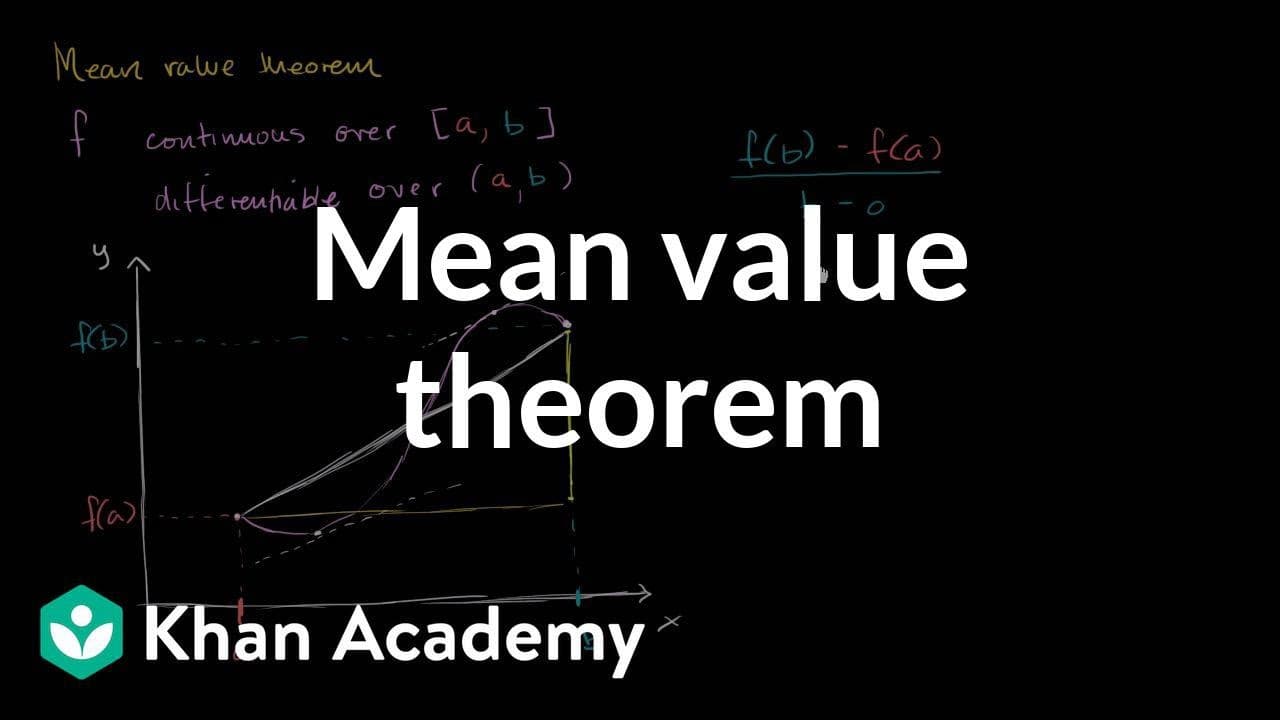
The Mean Value Theorem states that for a continuous and differentiable function over a closed interval, there exists a point within the interval where the average rate of change is equal to the instantaneous rate of change.
Transcript
Let's see if we can give ourselves an intuitive understanding of the mean value theorem. And as we'll see, once you parse some of the mathematical lingo and notation, it's actually a quite intuitive theorem. And so let's just think about some function, f. So let's say I have some function f. And we know a few things about this function. We know tha... Read More
Key Insights
- ❓ The Mean Value Theorem applies to functions that are both continuous and differentiable within specific intervals.
- 🫥 Visually, the theorem indicates that there is a point within the interval where the tangent line has the same slope as the secant line.
- ☠️ Mathematically, the theorem is expressed as the equality of the average rate of change and the instantaneous rate of change at some point within the interval.
- ☠️ The Mean Value Theorem provides a useful tool for understanding the relationship between average and instantaneous rates of change.
- 🛟 Real-life examples can help illustrate the application and significance of the Mean Value Theorem.
- ❓ The theorem is intuitive once the mathematical language and notation are understood.
- 🥹 The conditions of continuity and differentiability are crucial for the Mean Value Theorem to hold true.
Install to Summarize YouTube Videos and Get Transcripts
Explore YouTube Video Summarizer or Get YouTube Transcript Extractor
Questions & Answers
Q: What are the conditions for the Mean Value Theorem to apply to a function?
The function must be continuous over a closed interval and differentiable over the open interval within that closed interval. This means that there can be no gaps or jumps in the function, and the derivative must be defined within the open interval.
Q: What does the slope of the secant line represent in the Mean Value Theorem?
The slope of the secant line represents the average rate of change of the function over the interval. It is calculated as the change in y divided by the change in x between two points on the function.
Q: What does the slope of the tangent line represent in the Mean Value Theorem?
The slope of the tangent line represents the instantaneous rate of change of the function at a specific point. It is the derivative of the function at that point, which represents how the function is changing at that instant.
Q: What does the Mean Value Theorem tell us about the relationship between the slope of the secant line and the slope of the tangent line?
The Mean Value Theorem states that at some point within the open interval, the instantaneous rate of change (slope of the tangent line) will be equal to the average rate of change (slope of the secant line). In other words, there exists a point where the function is changing at the same rate as its average rate of change over the interval.
Summary & Key Takeaways
-
The Mean Value Theorem applies to a function that is continuous over a closed interval and differentiable over the open interval within that closed interval.
-
Visually, the theorem states that there is a point within the interval where the slope of the tangent line is equal to the slope of the secant line.
-
Mathematically, the theorem can be expressed as the average rate of change (slope of the secant line) being equal to the instantaneous rate of change (slope of the tangent line) at some point in the interval.
Read in Other Languages (beta)
Share This Summary 📚
Summarize YouTube Videos and Get Video Transcripts with 1-Click
Try YouTube Summary with ChatGPT & Claude or YouTube Transcript Generator
Explore More Summaries from Khan Academy 📚



Summarize YouTube Videos and Get Video Transcripts with 1-Click
Try YouTube Summary with ChatGPT & Claude or YouTube Transcript Generator