Type 1 Problem 2 - Finite State Machine - Automata Theory
TL;DR
This video explains how to design a finite state machine that accepts strings in which the number of 'a's and 'b's is divisible by three.
Transcript
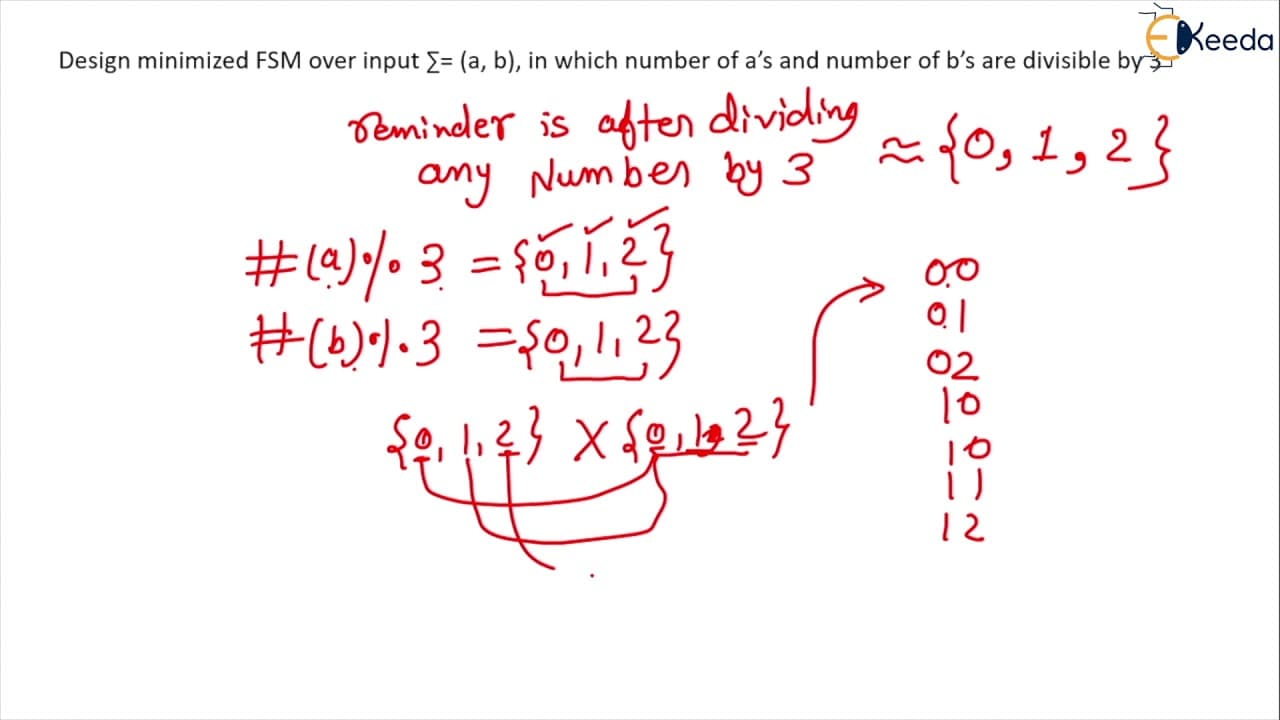
hello student in this video we see the type 1 problem problem is design minimized finite state machine over the input input set a and b in which the number of s and the number of b's are difficult by three means the input set is the string of input a and b and every string in which the number of a means the count of a is divisible by 3 and the coun... Read More
Key Insights
- 🎰 The design of a finite state machine depends on the divisibility requirement of input strings.
- 🗂️ The remainder generated when dividing a number by three helps determine the transitions between states.
- 🔄 The machine can accept the empty string and strings with counts of 'a's and 'b's divisible by three.
- 🎰 The minimum string accepted by the machine is the empty string, 'λ'.
Install to Summarize YouTube Videos and Get Transcripts
Explore YouTube Video Summarizer or Get YouTube Transcript Extractor
Questions & Answers
Q: What is the condition for a string to be accepted by the finite state machine?
The string must have a count of 'a's and 'b's that are divisible by three. This means both counts should have remainders of zero when divided by three.
Q: How is the finite state machine constructed?
The machine has nine states, represented as q0 to q8. Each state corresponds to a combination of remainders when dividing the counts of 'a's and 'b's by three.
Q: What are the transitions for the input 'a'?
The transitions depend on the current state and the count of 'a's and 'b's. The transitions are determined by finding the state with the corresponding remainder for the 'a' count.
Q: What are the transitions for the input 'b'?
Similar to the 'a' transitions, the transitions for 'b' depend on the current state and the count of 'a's and 'b's. The state with the corresponding remainder for the 'b' count is selected.
Q: Can the finite state machine accept the empty string?
Yes, the machine accepts the empty string, represented as 'λ'. When both the count of 'a's and 'b's are zero, the string is divisible by three and is accepted by the machine.
Q: Is the initial state also a final state?
Yes, the initial state, q0, is also a final state. This is because the machine accepts the empty string, and the initial state is reached when processing the empty string.
Q: What is the minimum string that is accepted by the finite state machine?
The minimum string that is accepted is one in which both the count of 'a's and 'b's is zero. This is represented as the empty string, 'λ'.
Q: Can the machine accept strings with counts of 'a's and 'b's not divisible by three?
No, if either the count of 'a's or 'b's is not divisible by three, the string will not be accepted by the finite state machine.
Summary & Key Takeaways
-
The problem is to design a finite state machine that accepts strings with a count of 'a's and 'b's divisible by three.
-
The logic behind designing the machine is based on the remainder generated when dividing a number by three.
-
The machine has nine states, and the transitions are determined by the remainder of the counts of 'a's and 'b's divided by three.
-
The machine accepts the empty string and the minimum string of 'a's and 'b's when both counts are zero.
Read in Other Languages (beta)
Share This Summary 📚
Summarize YouTube Videos and Get Video Transcripts with 1-Click
Try YouTube Summary with ChatGPT & Claude or YouTube Transcript Generator
Explore More Summaries from Ekeeda 📚

Summarize YouTube Videos and Get Video Transcripts with 1-Click
Try YouTube Summary with ChatGPT & Claude or YouTube Transcript Generator