Diffraction Numerical Problems 9
TL;DR
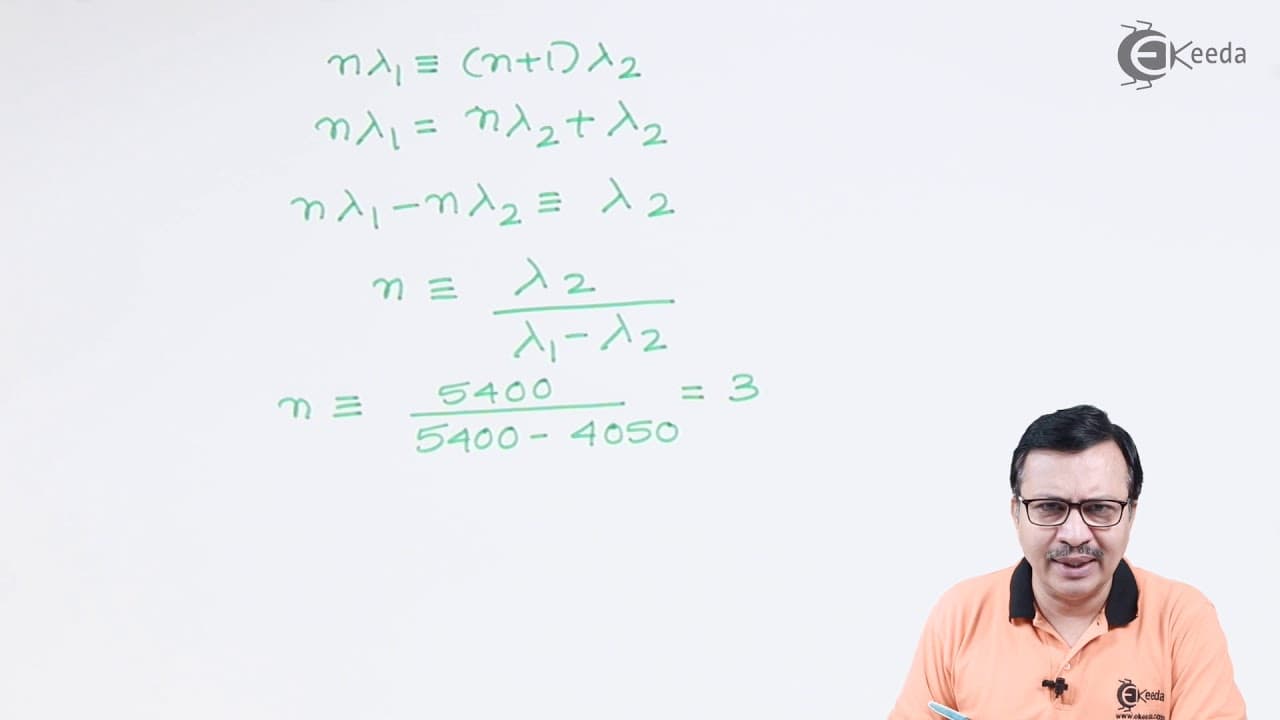
A numerical problem is solved to determine the order of diffraction and the number of lines per centimeter on a diffraction grating.
Transcript
click the Bell icon to get latest videos from equator hello friends so now we have a problem a numerical problem wherein we are going to find out the order in which the diffraction is going to take place not only that but from this information we are also into find out the greeting element and mind you we are being provided with two different wavel... Read More
Key Insights
- 🫥 The problem involves finding the order of diffraction and number of lines per centimeter on a diffraction grating.
- 🫥 The grating equations are used to establish the relationship between the order, wavelength, and number of lines per centimeter.
- ❓ The wavelengths provided are 5400 angstroms and 4050 angstroms.
- 🫱 By equating the right-hand sides of the grating equations, the order of diffraction is calculated using the given wavelengths.
Install to Summarize YouTube Videos and Get Transcripts
Explore YouTube Video Summarizer or Get YouTube Transcript Extractor
Questions & Answers
Q: What is the purpose of this numerical problem?
The purpose of this numerical problem is to find the order of diffraction and the number of lines per centimeter on a diffraction grating.
Q: How are the equations for the grating used to solve the problem?
The grating equations, involving the grating constant, wavelength, and diffraction angle, are used to determine the relationship between the order, wavelength, and number of lines per centimeter.
Q: Why is lambda 2 chosen to be less than lambda 1?
Lambda 2 is chosen to be less than lambda 1 to ensure that the next higher order is considered for the second wavelength, as lambda 2 is associated with n+1.
Q: What is the final result for the order of diffraction and number of lines per centimeter?
The order of diffraction is calculated to be three, and the total number of lines per centimeter on the diffraction grating is determined to be 3086.
Summary & Key Takeaways
-
The problem involves finding the order of diffraction and the corresponding wavelength using a diffraction grating.
-
The grating equation and two different wavelengths are provided to solve the problem.
-
The order of diffraction is calculated to be three, and the total number of lines per centimeter on the grating is determined to be 3086.
Read in Other Languages (beta)
Share This Summary 📚
Summarize YouTube Videos and Get Video Transcripts with 1-Click
Try YouTube Summary with ChatGPT & Claude or YouTube Transcript Generator
Explore More Summaries from Ekeeda 📚






Summarize YouTube Videos and Get Video Transcripts with 1-Click
Try YouTube Summary with ChatGPT & Claude or YouTube Transcript Generator