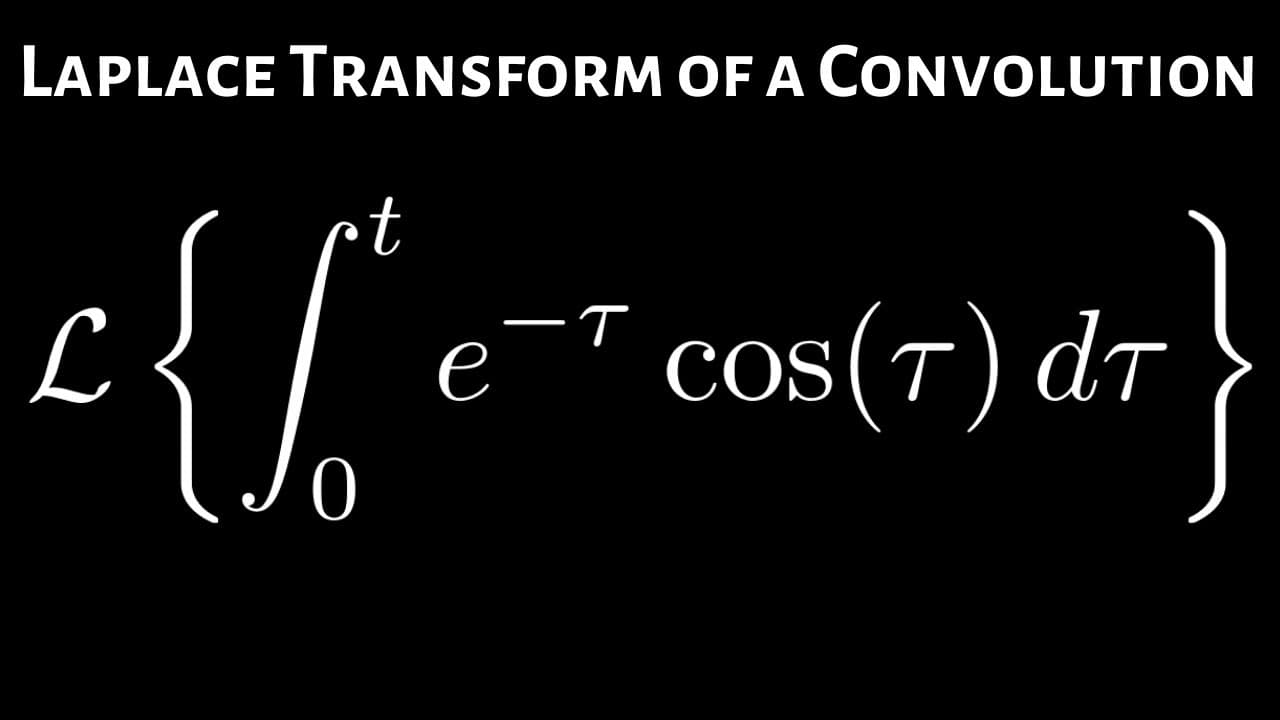
Laplace Transform the Definite Integral of e^(-T)cos(T) using the Convolution Theorem
TL;DR
This video explains how to find the Laplace transform of a definite integral using the convolution theorem.
Transcript
in this problem we have to find the laplace transform of this definite integral so the trick to do this is to recognize that this is the convolution of two functions recall that the convolution of f with g is defined to be the definite integral from zero to t of f of tau times g of t minus tau d tau so the first step in this problem is to identify ... Read More
Key Insights
- ❓ The Laplace transform of a definite integral can be found by recognizing it as the convolution of two functions.
- 🟰 The convolution theorem states that the Laplace transform of the convolution is equal to the product of the Laplace transforms of the individual functions.
- 👻 The first translation theorem allows for simplification of the Laplace transform by replacing the exponential term with a shift.
- 👻 Commutativity of convolution allows for flexibility in choosing the order of the functions in the convolution.
- 💨 Finding the Laplace transform using convolution is often faster and more efficient than directly solving the integral.
- ❓ The Laplace transform of e^(-t)cos(t) is s/(s^2+1).
- ❓ The Laplace transform of 1 is 1/s.
Install to Summarize YouTube Videos and Get Transcripts
Explore YouTube Video Summarizer or Get YouTube Transcript Extractor
Questions & Answers
Q: What is the trick to finding the Laplace transform of a definite integral?
The trick is to recognize that the integral represents the convolution of two functions, which allows us to apply the convolution theorem.
Q: Can the order of f and g be switched in the convolution theorem?
Yes, the convolution theorem states that the convolution is commutative, so the order of f and g can be easily switched.
Q: How do we determine the functions f and g in the convolution?
By examining the integral, we can set f(t) and g(t) accordingly. In this case, f(t) is e^(-t)cos(t) and g(t) is 1.
Q: What is the first translation theorem used in finding the Laplace transform?
The first translation theorem allows us to drop the exponential function in the Laplace transform and replace it with a shift. We then take s to s-a, where a is the coefficient of the exponential term.
Summary & Key Takeaways
-
The problem involves finding the Laplace transform of a definite integral, which can be solved using the convolution of two functions.
-
The first step is to identify the integral with two functions, f and g, and then apply the convolution theorem.
-
By setting f(t) to e^(-t)cos(t) and g(t) to 1, the Laplace transform of the integral can be found using the first translation theorem.
Read in Other Languages (beta)
Share This Summary 📚
Summarize YouTube Videos and Get Video Transcripts with 1-Click
Try YouTube Summary with ChatGPT & Claude or YouTube Transcript Generator
Explore More Summaries from The Math Sorcerer 📚


Summarize YouTube Videos and Get Video Transcripts with 1-Click
Try YouTube Summary with ChatGPT & Claude or YouTube Transcript Generator