Stanford Seminar - Multi-Sensory Neural Objects: Modeling, Inference, and Applications in Robotics
TL;DR
This analysis focuses on the development and application of multi-sensory neural object representations, addressing challenges in object-centric modeling and inference for robotics.
Transcript
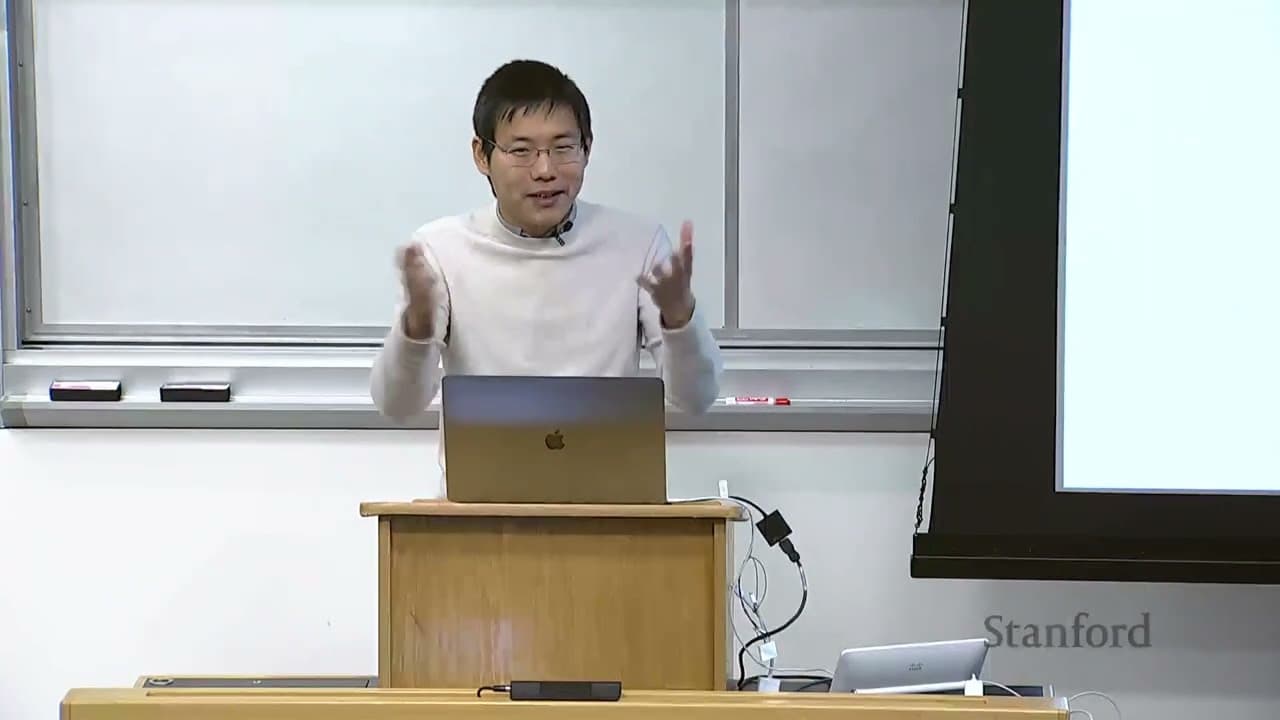
thanks for the introduction Mark and nice to be here um so I'm chatting I I started actually at Stanford assistant professor computer science at Stanford I started 2020 um you know so technically it's not that new but because most of the time you know we had pandemic and we had a beauty renovation so it has to be remote so I do feel pretty new uh i... Read More
Key Insights
- 👂 Multi-sensory neural objects enable accurate modeling and representation of object appearance, sound, and touch, enhancing robotic perception and interaction capabilities.
- 🙂 Object-centric neural scattering functions capture the interaction of light with objects, enabling relighting and appearance synthesis from different viewpoints.
- 👻 Virtualized datasets of objects with neural representations allow for standardized benchmarking and enhance training and evaluation in robotics tasks.
- ⛑️ Inference methods, such as Eisens, can leverage motion and appearance cues to achieve unsupervised and category-agnostic object segmentation and 3D-aware object representations.
Install to Summarize YouTube Videos and Get Transcripts
Explore YouTube Video Summarizer or Get YouTube Transcript Extractor
Questions & Answers
Q: What are multi-sensory neural objects, and why are they important in robotics?
Multi-sensory neural objects refer to representations that capture the appearance, sound, and tactile properties of objects using neural networks. These representations are crucial in robotics as they enable tasks such as manipulation, recognition, and perception, mimicking how humans interact with objects.
Q: How do neural scattering functions capture the appearance of objects?
Neural scattering functions model how light interacts with objects, allowing the representation of object appearance based on factors such as geometry, reflectance, and lighting conditions. By conditioning the function on lighting directions and viewing angles, it captures the intrinsic properties of objects, enabling the synthesis of objects from different viewpoints and lighting conditions.
Q: How do object-centric neural representations differ from other approaches?
Object-centric neural representations focus on capturing the intrinsic properties of objects, such as geometry, materials, and reflectance, without encoding the lighting conditions or scene descriptions. This approach is more suitable for robotics, as it allows for more accurate object modeling and relighting, which are essential in manipulation and navigation tasks.
Q: What challenges arise when creating virtualized object datasets?
Virtualizing real objects to create datasets faces challenges such as capturing both visual and physical properties, ensuring diversity in object textures and shapes, and addressing real-world conditions such as lighting variations and occlusions. The speaker's work aims to address these challenges by developing methods to derive virtualized object representations from real observations.
Summary & Key Takeaways
-
The speaker discusses their work on multi-sensory neural objects, which involve modeling object appearance, sound, and touch using neural networks.
-
The speaker highlights the importance of accurately representing objects in robotics, as it enables tasks such as manipulation and recognition.
-
They introduce the concept of object-centric neural scattering functions, which capture the interaction of light and objects, as well as object-centric tactile simulations and sound simulations.
Read in Other Languages (beta)
Share This Summary 📚
Summarize YouTube Videos and Get Video Transcripts with 1-Click
Try YouTube Summary with ChatGPT & Claude or YouTube Transcript Generator
Explore More Summaries from Stanford Online 📚
Summarize YouTube Videos and Get Video Transcripts with 1-Click
Try YouTube Summary with ChatGPT & Claude or YouTube Transcript Generator