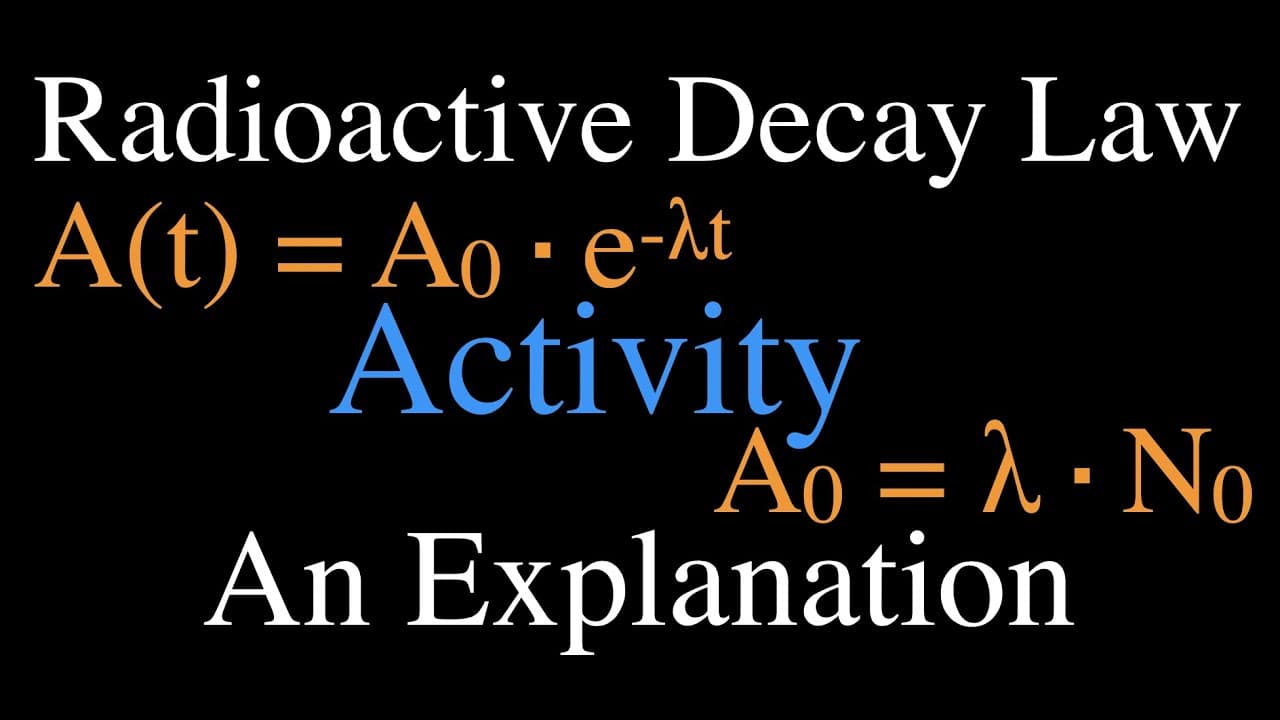
Radioactivity (8 of 16) Decay Activity, An Explanation
TL;DR
This video provides an introduction to activity as it relates to radioactive decay, explaining the concept, units, equations, and graphing methods used to calculate activity and determine half-life.
Transcript
hopefully in today's video we are going to be going over activity and that would be activity as it relates to radioactive decay well what is activity as it relates to radioactive decay well it is simply the rate of decay of a radioactive sample expressed in the number of decays of that radioactive sample per unit of time that unit of time being the... Read More
Key Insights
- 😑 Activity is a measure of the rate of decay for a radioactive sample, expressed as the number of decays per second.
- 💆 The activity is determined by both the mass of the radioactive substance and the half-life.
- ⌛ Three equations can be used to calculate activity: the definition of activity, the decay constant equation, and the activity at different times equation.
Install to Summarize YouTube Videos and Get Transcripts
Explore YouTube Video Summarizer or Get YouTube Transcript Extractor
Questions & Answers
Q: What is activity in relation to radioactive decay?
Activity is the rate of decay for a radioactive sample, measured as the number of decays per second.
Q: How does activity depend on the mass of the substance?
Activity and mass are directly proportional. More mass leads to more nuclei and, therefore, a higher activity.
Q: How does activity depend on the half-life?
Activity and half-life are inversely proportional. A longer half-life means less frequent decays, resulting in lower activity.
Q: What equations can be used to calculate activity?
There are three equations: the definition of activity (activity = number of decays per second), the decay constant equation (activity = decay constant × number of nuclei), and the activity at different times equation (activity2 = activity1 × e^(- λt)).
Q: How can graphing activity over time determine the half-life?
By graphing the activity measurements over time, a curve emerges. The half-life can be estimated as the time at which the activity is half of its original value.
Summary & Key Takeaways
-
Activity is the rate of decay of a radioactive sample, expressed as the number of decays per second.
-
The activity depends on the mass of the radioactive substance and the half-life. More mass leads to higher activity, while a longer half-life results in lower activity.
-
Three equations can be used to calculate activity: the definition of activity, the decay constant equation, and the activity at different times equation.
-
Graphing the activity over time can yield the half-life of a sample.
Read in Other Languages (beta)
Share This Summary 📚
Summarize YouTube Videos and Get Video Transcripts with 1-Click
Try YouTube Summary with ChatGPT & Claude or YouTube Transcript Generator
Explore More Summaries from Step by Step Science 📚

Summarize YouTube Videos and Get Video Transcripts with 1-Click
Try YouTube Summary with ChatGPT & Claude or YouTube Transcript Generator