Data Processing For Question & Answering Systems: BERT vs. RoBERTa
TL;DR
This video discusses the differences in data processing for question and answering systems using Bert and Roberta models.
Transcript
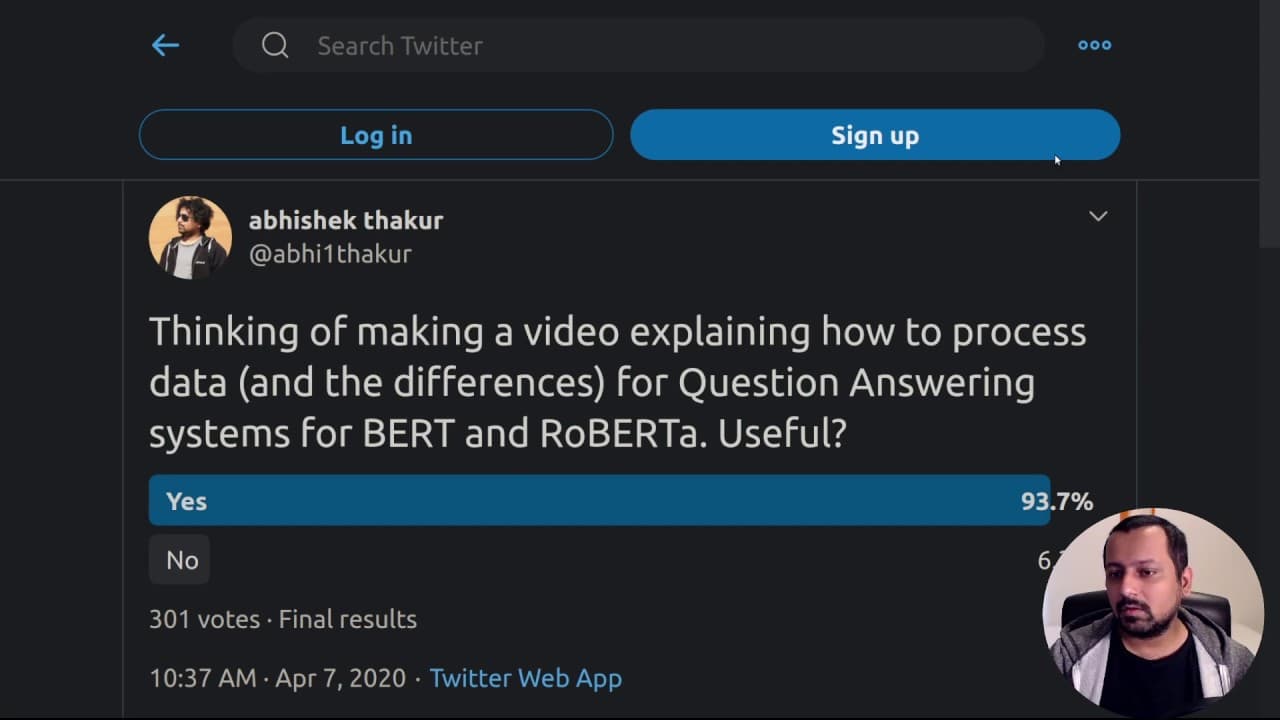
hello everyone and welcome to my new video a few days ago I made a video about Bert and how it can be used for not question answering but similar to that and after that I made a tweet thinking of making a video explaining how to process data and the differences for a question and answering system for Bert and Roberta so yeah it seems a lot of peopl... Read More
Key Insights
- 🥳 Both Bert and Roberta have distinct tokenization methods, with special tokens used for identifying the beginning and end of sentence and question parts.
- 🍵 Document strides are used to handle context texts that exceed 512 tokens in length.
- ❤️🩹 The start and end indices of the answer in the context are crucial for training the models.
Install to Summarize YouTube Videos and Get Transcripts
Explore YouTube Video Summarizer or Get YouTube Transcript Extractor
Questions & Answers
Q: What is the difference between Bert and Roberta in terms of data processing?
The main difference lies in the special tokens used for tokenization. Bert uses CLS and SCP tokens, while Roberta uses slashes (/). Additionally, Roberta does not automatically add special tokens during tokenization, unlike Bert.
Q: How does the data processing pipeline for question and answering systems work?
The pipeline involves tokenizing the question and context, identifying the start and end indices of the answer in the context, padding the tokens if necessary, and training the model using cross-entropy loss with the start and end indices as targets.
Q: How is the data handled when the context exceeds 512 tokens in length?
Document strides are used to select smaller sections of the context, allowing for processing within the token limit. The start and end indices are adjusted accordingly for the selected section.
Q: Why is character-level processing important in data processing for question and answering systems?
Character-level processing ensures that the start and end indices accurately capture the answer, even if it starts or ends within a word. Processing on a word level may cause incorrect or missed matches.
Summary & Key Takeaways
-
The video explores the data structure for question and answering systems, which consists of a question and a context text. The goal is to find the answer to the question within the context.
-
Both Bert and Roberta process data differently due to their underlying tokenization methods. Special tokens like CLS and SCP are used in Bert, while Roberta uses slashes (/).
-
Context can be larger than 512 tokens, so document strides are used to select smaller sections.
-
The video explains how to tokenize the data, design the data processing pipeline, and train the models using start and end indices as targets.
Read in Other Languages (beta)
Share This Summary 📚
Summarize YouTube Videos and Get Video Transcripts with 1-Click
Try YouTube Summary with ChatGPT & Claude or YouTube Transcript Generator
Explore More Summaries from Abhishek Thakur 📚
Summarize YouTube Videos and Get Video Transcripts with 1-Click
Try YouTube Summary with ChatGPT & Claude or YouTube Transcript Generator