Magnetism (12 of 13) The Lorentz Force, Charged Particles in Magnetic Fields
TL;DR
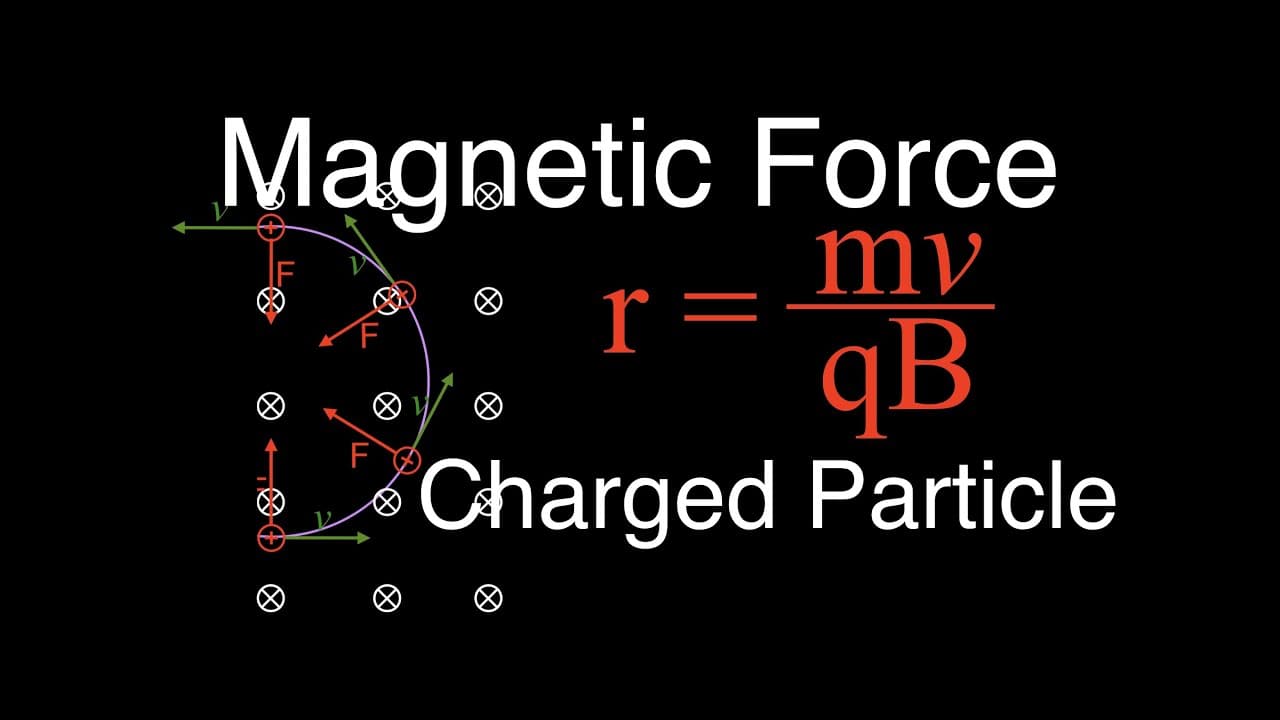
This video explains how a charged particle experiences a magnetic force and moves in a curved path in a magnetic field.
Transcript
okay today once again we're going to be talking about the force on a charged particle when it is moving through a magnetic field now you might say this is part two because I'm going to kind of go a little further here with part two then we did in part one we're just talking about the direction of force and this is what we're gonna be talking about ... Read More
Key Insights
- 🫱 The direction of the force on a charged particle in a magnetic field can be determined using the right-hand rule.
- 🏑 The radius of the path followed by a charged particle in a magnetic field is determined by its velocity, mass, charge, and the strength of the magnetic field.
- ✋ A higher velocity or mass results in a larger radius, while a higher charge or stronger magnetic field results in a smaller radius.
- 🧑🏭 The equation for calculating the radius in terms of these factors is derived from Newton's second law.
Install to Summarize YouTube Videos and Get Transcripts
Explore YouTube Video Summarizer or Get YouTube Transcript Extractor
Questions & Answers
Q: How does the direction of the force on a charged particle in a magnetic field determine its path?
The direction of the force is determined by the right-hand rule, where the thumb represents the direction of motion, fingers represent the direction of the magnetic field, and the palm represents the direction of the force.
Q: What factors affect the radius of the curved path followed by a charged particle in a magnetic field?
The radius is directly proportional to the velocity and mass of the particle, and inversely proportional to the charge and strength of the magnetic field.
Q: How does the charge of a particle affect the radius of its path in a magnetic field?
A higher charge on the particle will result in a smaller radius for its curved path in a magnetic field.
Q: Can the radius of the path change if the charge of the particle is negative instead of positive?
The radius of the path will remain the same, but the direction of the path will be opposite if the charge is negative.
Summary & Key Takeaways
-
The video explains the direction of the force on a charged particle when it enters a magnetic field.
-
As the charged particle moves through the magnetic field, it experiences a force that causes it to follow a curved path.
-
The radius of the curved path is determined by factors such as the velocity, mass, charge, and strength of the magnetic field.
Read in Other Languages (beta)
Share This Summary 📚
Summarize YouTube Videos and Get Video Transcripts with 1-Click
Try YouTube Summary with ChatGPT & Claude or YouTube Transcript Generator
Explore More Summaries from Step by Step Science 📚



Summarize YouTube Videos and Get Video Transcripts with 1-Click
Try YouTube Summary with ChatGPT & Claude or YouTube Transcript Generator