First order homogeneous equations 2 | First order differential equations | Khan Academy
TL;DR
This video explains how to solve a first order homogeneous differential equation step by step.
Transcript
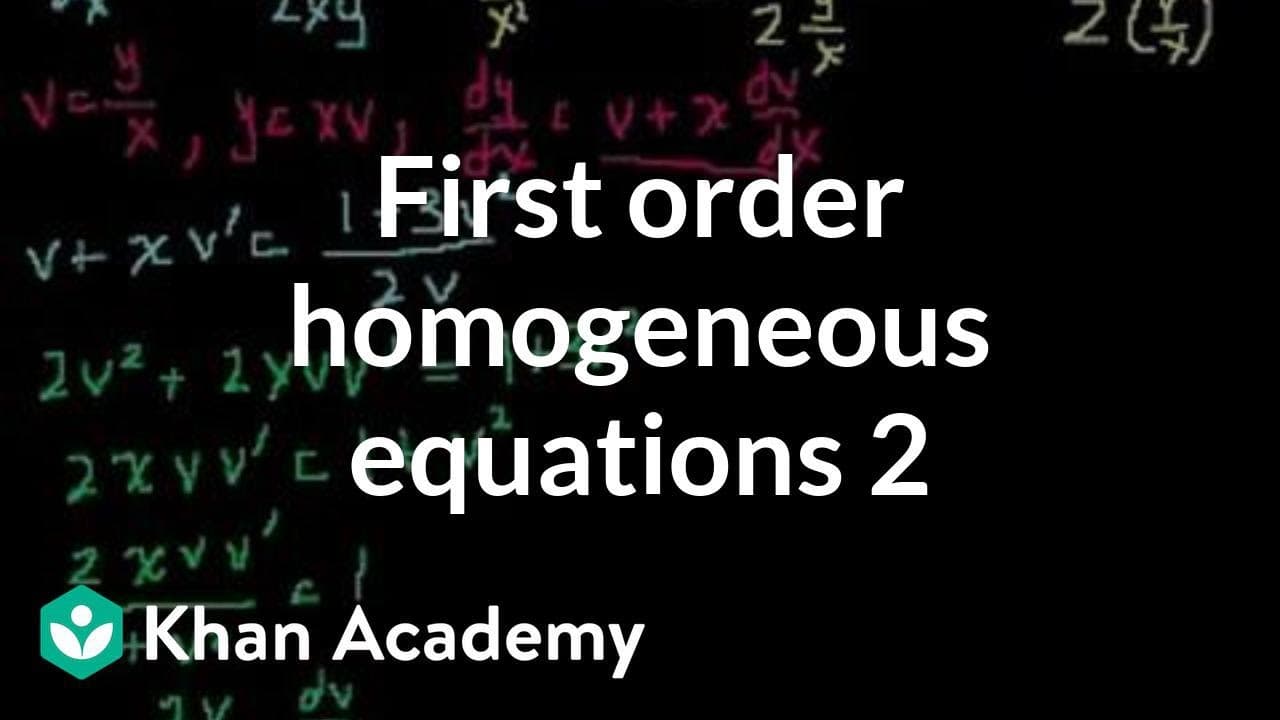
Let's do one more homogeneous differential equation, or first order homogeneous differential equation, to differentiate it from the homogeneous linear differential equations we'll do later. But anyway, the problem we have here. It's the derivative of y with respect to x is equal to-- that x looks like a y-- is equal to x squared plus 3y squared. I'... Read More
Key Insights
- ➗ Homogeneous differential equations can be identified by rewriting them as functions of y divided by x.
- ❣️ The substitution v = y/x simplifies the equation and makes it separable.
- 🧑💻 The integral of (1 + v^2) is the natural log of (1 + v^2).
Install to Summarize YouTube Videos and Get Transcripts
Explore YouTube Video Summarizer or Get YouTube Transcript Extractor
Questions & Answers
Q: What is a homogeneous differential equation?
A homogeneous differential equation is one that can be written as a function of y divided by x, where y and x are variables. In other words, all terms in the equation have the same degree of x and y.
Q: How is the substitution v = y/x helpful in solving the equation?
The substitution v = y/x allows us to simplify the equation and make it separable. It transforms the equation into a new form that is easier to integrate and find the solution.
Q: How is the antiderivative of (1 + v^2) found?
The antiderivative of (1 + v^2) is the natural log of (1 + v^2). This can be derived using the reverse chain rule, where the expression and its derivative are known.
Q: How is the solution to the differential equation finally obtained?
By simplifying the equation obtained after integration, x^2 + y^2 - cx^3 = 0, we have the implicit solution to the original homogeneous first order differential equation.
Summary & Key Takeaways
-
The video demonstrates how to identify and solve a homogeneous first order differential equation.
-
The equation in question is the derivative of y with respect to x equal to (x^2 + 3y^2)/(2xy).
-
The video shows how to transform the equation into a function of y divided by x and then make the substitution v = y/x.
-
By simplifying and integrating both sides, the solution to the homogeneous first order differential equation is derived as x^2 + y^2 - cx^3 = 0.
Read in Other Languages (beta)
Share This Summary 📚
Summarize YouTube Videos and Get Video Transcripts with 1-Click
Try YouTube Summary with ChatGPT & Claude or YouTube Transcript Generator
Explore More Summaries from Khan Academy 📚



Summarize YouTube Videos and Get Video Transcripts with 1-Click
Try YouTube Summary with ChatGPT & Claude or YouTube Transcript Generator