FCFS Disk Scheduling - Memory Management - Operating System
TL;DR
This video explains the concept of disk scheduling and focuses on the First Come First Serve (FCFS) algorithm, highlighting its limitations.
Transcript
click the bell icon to get latest videos from akira hello friends today we are going to discuss what is this scheduling what are the parameters that need to be conferred while disk idling and algorithm implementing the scheduling known as FCFS as we know that is the major components of an operating system is a hardware concern and an operating syst... Read More
Key Insights
- 💨 Efficient hardware control in operating systems requires faster access time and larger disk bandwidth.
- ⌛ Disk scheduling involves considering seek time, rotation latency, and transferred bandwidth.
- 🤕 The FCFS algorithm in disk scheduling schedules requests in the order they arrive, resulting in high total head movements.
- ❓ Other algorithms, such as SSTF or SCAN, are preferred over FCFS for better performance.
- 👌 System calls are made to the operating system to handle I/O requests to and from the disk.
- 🪜 Pending requests are either allocated or added to a queue in multi-programming systems.
- 🥺 FCFS algorithm can lead to wild swings and inefficient disk access in certain scenarios.
Install to Summarize YouTube Videos and Get Transcripts
Explore YouTube Video Summarizer or Get YouTube Transcript Extractor
Questions & Answers
Q: What are the three components to consider in disk scheduling?
The three components to consider are seek time, rotation latency, and transferred bandwidth. Seek time is the time it takes for the disk's head to move to the desired sector. Rotation latency refers to the time it takes for the disk to rotate, allowing the head to move. Transferred bandwidth is the ratio of actual bandwidth to the total time for the requests.
Q: How does the operating system handle I/O requests to and from the disk?
Whenever an I/O request is made, the system makes a system call to the operating system. The operating system receives information about the input/output operation, disk address of the transfer, memory address of the transfer, and the number of sectors to be transferred. It then allocates the request if the disk and controllers are available or adds it to a queue of pending requests.
Q: What is the FCFS disk scheduling algorithm?
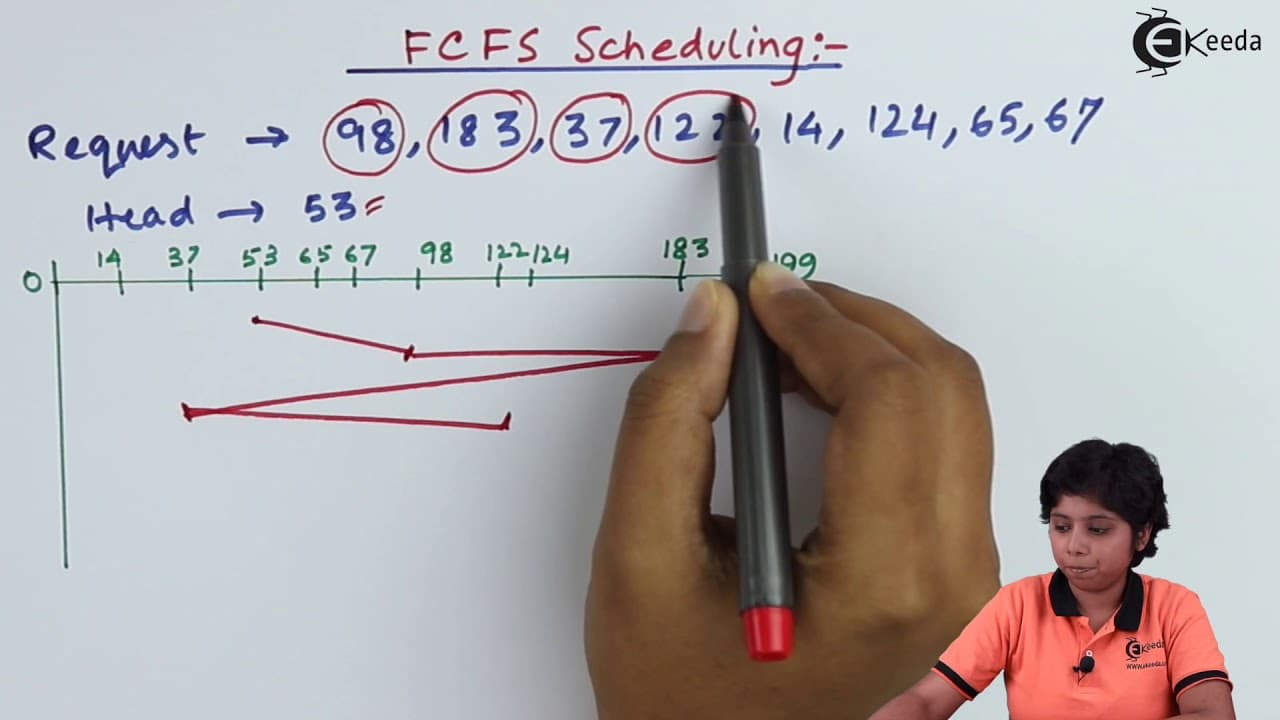
The FCFS algorithm, or First Come First Serve, schedules pending requests in the order they arrive. When a request is serviced, the head moves to the next sector in the queue. However, this algorithm can result in high total head movement, as demonstrated in the video.
Q: Why is the FCFS algorithm not commonly implemented in disk scheduling?
The FCFS algorithm is not commonly implemented in disk scheduling due to its problem of high total head movements. As shown in the video, the FCFS algorithm can result in wild swings and inefficient disk access. Other algorithms, like Shortest Seek Time First (SSTF) or SCAN, are preferred for better performance.
Summary & Key Takeaways
-
The video discusses the importance of efficient hardware control in operating systems and the need for faster access time and larger disk bandwidth.
-
It explains the three components to consider in disk scheduling: seek time, rotation latency, and transferred bandwidth.
-
The video demonstrates the implementation of the FCFS algorithm in disk scheduling and highlights its problem of high total head movement.
Read in Other Languages (beta)
Share This Summary 📚
Summarize YouTube Videos and Get Video Transcripts with 1-Click
Try YouTube Summary with ChatGPT & Claude or YouTube Transcript Generator
Explore More Summaries from Ekeeda 📚






Summarize YouTube Videos and Get Video Transcripts with 1-Click
Try YouTube Summary with ChatGPT & Claude or YouTube Transcript Generator