Resonance
TL;DR
Resonance allows molecules like benzene and carbonate ion to exist in a stable intermediate state between different bonding structures.
Transcript
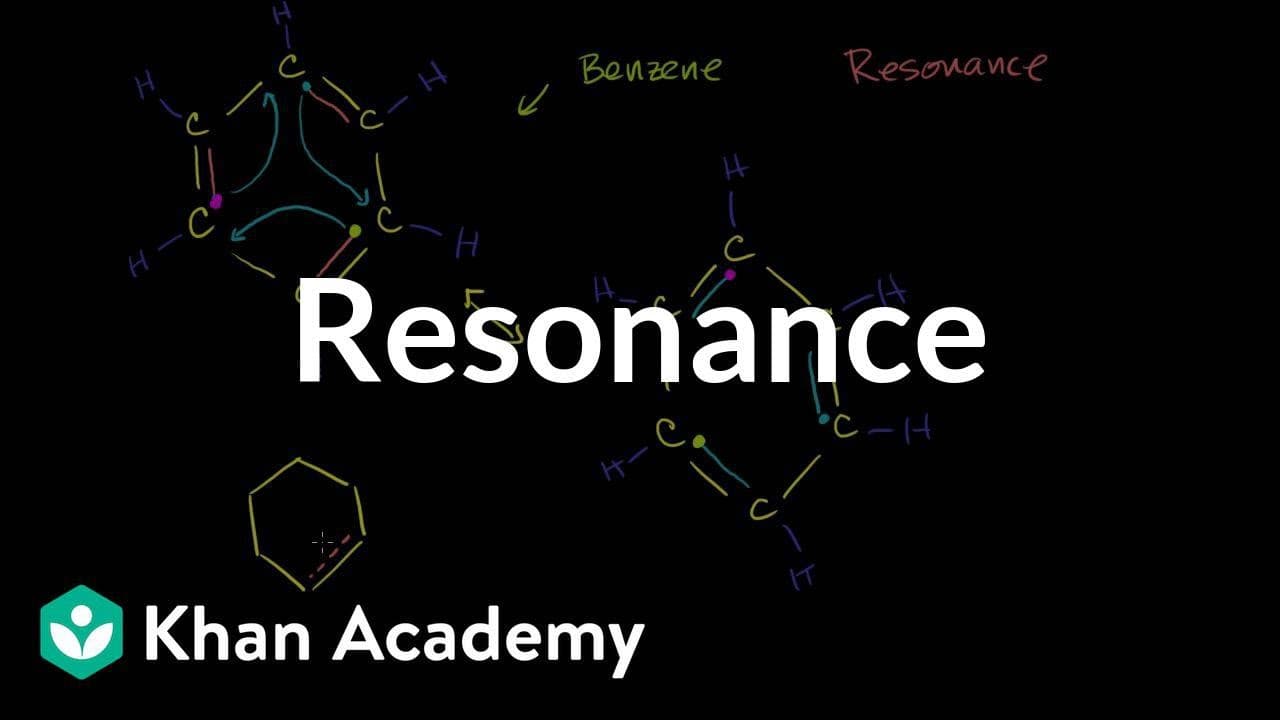
I'm going to draw a molecule of benzene. And then we're going to think about if anything interesting might happen with that molecule. So let me draw it. So we have 6 carbons in a ring. 1, 2, 3, 4, 5 and 6 carbons in a ring. What's interesting about benzene, why it's different than cyclohexane, is that it has these 3 double bonds in the ring. So let... Read More
Key Insights
- 😋 Benzene has a unique structure with three double bonds in a ring of six carbon atoms, making it different from other cyclic hydrocarbons like cyclohexane.
- 😋 Resonance in benzene occurs when electrons continuously shift between different positions around the ring, resulting in an intermediate structure that is more stable than any individual contributing structure.
- 😌 The true structure of benzene lies in an intermediate state with each carbon having a half double bond with its neighboring carbons, allowing for electron delocalization.
- 😑 Resonance is not limited to benzene and can occur in other organic molecules, such as the carbonate ion, where electrons shift between different oxygen atoms.
- 💐 Resonance increases stability by spreading out electron density, lowering the energy state, and reducing reactivity.
- ❓ Experimental evidence supports the concept of resonance, even though it cannot be directly observed.
Install to Summarize YouTube Videos and Get Transcripts
Explore YouTube Video Summarizer or Get YouTube Transcript Extractor
Questions & Answers
Q: Why is benzene different from other cyclic hydrocarbons?
Benzene has three double bonds within its ring structure, whereas other cyclic hydrocarbons lack these double bonds. This difference in bonding makes benzene more stable and gives it unique properties.
Q: What is resonance in benzene?
Resonance in benzene refers to the continuous shifting of electrons within the double bonds around the ring. This results in an intermediate structure that is more stable than the individual contributing structures, with the electrons delocalized over the entire molecule.
Q: How does resonance affect the structure of benzene?
Resonance allows benzene to exist in a state where it is neither in one of the contributing structures nor in a hybrid. The true structure of benzene is an intermediate between the two structures, with each carbon having a half double bond to its neighboring carbons.
Q: Does resonance only occur in benzene?
No, resonance is not specific to benzene. Many organic molecules exhibit resonance, with the electrons delocalized and spread out over different atoms. The carbonate ion is another example that shows resonance behavior.
Q: What is the significance of resonance in carbonate ion?
Resonance in the carbonate ion allows the electrons to continuously shift between the three oxygen atoms. This makes the ion more stable than any individual resonance structure, with a true structure that is an intermediate between the contributing forms.
Q: How does resonance affect the stability of molecules?
Resonance increases the stability of molecules by spreading out the electron density and lowering the overall energy, making it more difficult to disrupt or break the bonds. The delocalization of electrons contributes to the molecule's overall stability.
Q: Can resonance be observed experimentally?
Resonance cannot be directly observed experimentally since it represents an intermediate state between different bonding structures. However, resonance is supported by experimental evidence, such as the characteristic properties and reactivity patterns observed in molecules with resonance.
Q: Why does resonance make molecules more stable?
Resonance increases stability by distributing the electron density more evenly throughout the molecule. This stabilization is due to the lowering of energy resulting from electron delocalization, preventing the accumulation of high-energy regions and reducing the overall reactivity of the molecule.
Summary & Key Takeaways
-
Benzene is a molecule with a ring of six carbon atoms, each bonded to one or two other carbons and hydrogen atoms. It has three double bonds within the ring, making it different from other cyclic hydrocarbons.
-
Resonance in benzene occurs when the electrons in the double bonds continuously shift between different positions around the ring, resulting in an intermediate structure that is more stable than the individual contributing structures.
-
The carbonate ion, consisting of a carbon atom double bonded to one oxygen and singly bonded to two other oxygens, also exhibits resonance. The electrons in the double bond and lone pairs continuously shift between the three oxygen atoms.
-
The true structure of benzene and carbonate ion lies somewhere in between the different resonance structures, with the electrons delocalized and spread out over the entire molecule.
Read in Other Languages (beta)
Share This Summary 📚
Summarize YouTube Videos and Get Video Transcripts with 1-Click
Try YouTube Summary with ChatGPT & Claude or YouTube Transcript Generator
Explore More Summaries from Khan Academy 📚



Summarize YouTube Videos and Get Video Transcripts with 1-Click
Try YouTube Summary with ChatGPT & Claude or YouTube Transcript Generator