What Are the Roles of Endoplasmic Reticulum and Golgi Apparatus in Protein Synthesis?
TL;DR
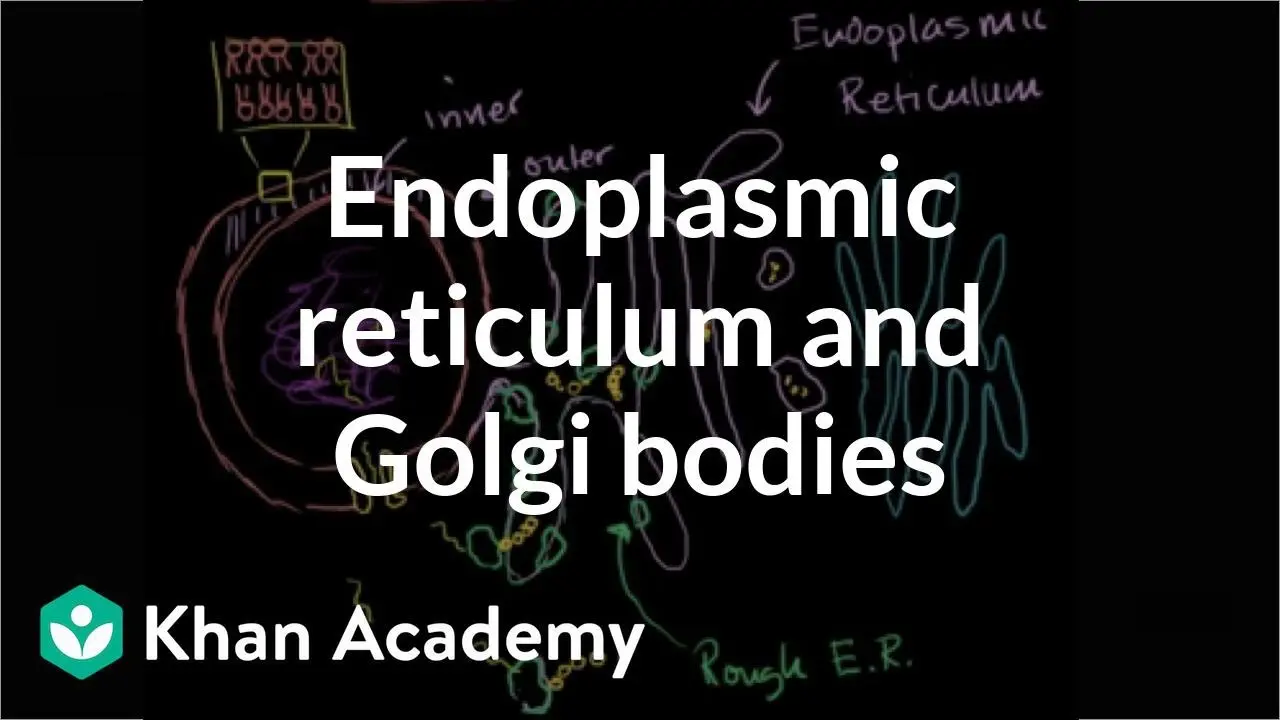
The endoplasmic reticulum (ER) and Golgi apparatus are vital for protein synthesis. The rough ER synthesizes proteins using ribosomes, while the smooth ER helps package them into vesicles. These vesicles then transport proteins to the Golgi apparatus for further processing and preparation for export or integration into the cell membrane.
Transcript
We've already talked about the process from going from DNA to messenger RNA. And we call that process transcription. And this occurs in the nucleus. And then that messenger RNA makes its way outside of the nucleus, and it attaches to a ribosome. And then it is translated into a protein. And so you could say that this part right over here, this is b... Read More
Key Insights
- 🧬 Transcription is the process of converting DNA into mRNA in the nucleus.
- 👻 Nuclear pores allow mRNA to exit the nucleus and reach ribosomes outside.
- ❓ The rough endoplasmic reticulum facilitates the translation of mRNA into proteins.
- 🆘 The smooth endoplasmic reticulum and Golgi apparatus help in packaging and maturation of proteins.
Install to Summarize YouTube Videos and Get Transcripts
Explore YouTube Video Summarizer or Get YouTube Transcript Extractor
Questions & Answers
Q: How does mRNA make its way out of the nucleus?
mRNA exits the nucleus through nuclear pores, which are protein tunnels through the double bilipid membrane of the nucleus.
Q: What is the role of the rough endoplasmic reticulum?
The rough ER, with attached ribosomes, facilitates the translation of mRNA into proteins inside the ER lumen.
Q: What happens to proteins inside the endoplasmic reticulum?
Proteins synthesized inside the ER can be transported through the ER membrane via vesicles and undergo maturation in the Golgi apparatus.
Q: How are proteins transported outside the cell?
Fully-manufactured proteins are transported from the Golgi apparatus to the cell membrane for export or embedding into the cellular membrane.
Summary & Key Takeaways
-
Transcription is the process of converting DNA into messenger RNA (mRNA) in the nucleus. mRNA then attaches to a ribosome for translation into proteins.
-
Nuclear pores in the double bilipid membrane of the nucleus allow mRNA to exit the nucleus and reach ribosomes.
-
The endoplasmic reticulum (ER) plays a crucial role in protein synthesis. The rough ER with attached ribosomes helps synthesize proteins, while the smooth ER aids in packaging them.
Read in Other Languages (beta)
Share This Summary 📚
Summarize YouTube Videos and Get Video Transcripts with 1-Click
Try YouTube Summary with ChatGPT & Claude or YouTube Transcript Generator
Explore More Summaries from Khan Academy 📚



Summarize YouTube Videos and Get Video Transcripts with 1-Click
Try YouTube Summary with ChatGPT & Claude or YouTube Transcript Generator