Application Topological Sorting
TL;DR
This content discusses the applications and concept of topological sorting in directed acyclic graphs (DAGs) and how it can be used for scheduling jobs and tasks.
Transcript
now let us discuss what are the applications of graph we discussed different implementation methods of graph that that is breadth first search then depth the first research and many more technique that we discussed as before in this slide now it is a time when we have to discuss what is the application of a graph in which area we can actually imple... Read More
Key Insights
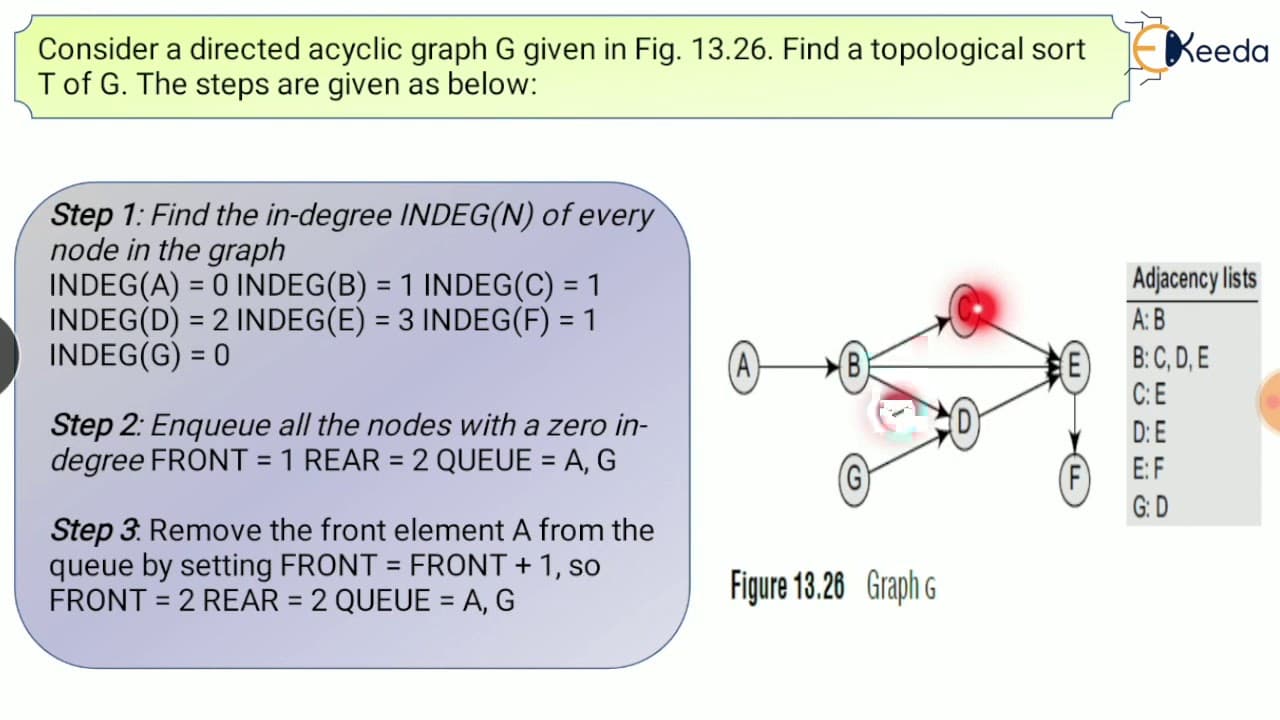
- ⚾ Topological sorting is a technique used to linearly order the nodes in a directed acyclic graph (DAG) based on their dependencies.
- 🤕 This technique is applicable only to DAGs, which do not contain any cycles.
- ❓ In topological sorting, the in-degree of each node is calculated to understand the dependencies between nodes.
- ❓ Nodes with in-degree 0 are enqueued and processed first.
- ❓ The process involves repeatedly removing nodes with in-degree 0 from the queue and updating the in-degree of their neighboring nodes.
- 🈸 Topological sorting is commonly used in scheduling applications for organizing jobs or tasks.
- 🪈 It helps ensure that tasks are executed in the correct order without violating any dependencies.
Install to Summarize YouTube Videos and Get Transcripts
Explore YouTube Video Summarizer or Get YouTube Transcript Extractor
Questions & Answers
Q: What is topological sorting and in which types of graphs is it applicable?
Topological sorting is a technique used to linearly order the nodes in a directed acyclic graph (DAG). It is applicable only to DAGs, which are graphs without any cycles.
Q: What is the significance of calculating the in-degree of each node in topological sorting?
Calculating the in-degree of each node helps determine the dependencies between nodes. In topological sorting, nodes with in-degree 0 are enqueued and processed first, ensuring that they come before any nodes to which they have outbound edges.
Q: What are the applications of topological sorting?
Topological sorting is commonly used in scheduling applications, such as organizing tasks or jobs. It helps determine the order in which tasks can be executed without violating any dependencies.
Q: What are the steps involved in performing topological sorting?
The steps in topological sorting include calculating the in-degree of each node, enqueuing nodes with in-degree 0, repeatedly removing nodes from the queue and updating the in-degree of their neighbors until all nodes have been processed.
Summary & Key Takeaways
-
Topological sorting is a technique used to linearly order the nodes in a directed acyclic graph (DAG) based on their dependencies.
-
It is only applicable to graphs without cycles and is commonly used in scheduling applications for organizing jobs or tasks.
-
The process involves calculating the in-degree of each node, enqueueing nodes with in-degree 0, and repeatedly removing nodes with in-degree 0 and updating the in-degree of their neighbors.
Read in Other Languages (beta)
Share This Summary 📚
Summarize YouTube Videos and Get Video Transcripts with 1-Click
Try YouTube Summary with ChatGPT & Claude or YouTube Transcript Generator
Explore More Summaries from Ekeeda 📚






Summarize YouTube Videos and Get Video Transcripts with 1-Click
Try YouTube Summary with ChatGPT & Claude or YouTube Transcript Generator