Language and religion of the former Yugoslavia | The 20th century | World history | Khan Academy
TL;DR
This video explains the linguistic, religious, and historical factors that contributed to the breakup of Yugoslavia.
Transcript
Understanding the ethnic and religious commonalities and differences in the state or the region that used to be Yugoslavia can be quite confusing. What I want to do in this video is try to give a primer on it. It's really key to understanding some of the triggers of World War I. And to, obviously, understand the breakup of Yugoslavia which was quit... Read More
Key Insights
- 🍉 The term "Yugoslavia" refers to the southern Slavic states, and its linguistic connection is through the Serbo-Croatian language.
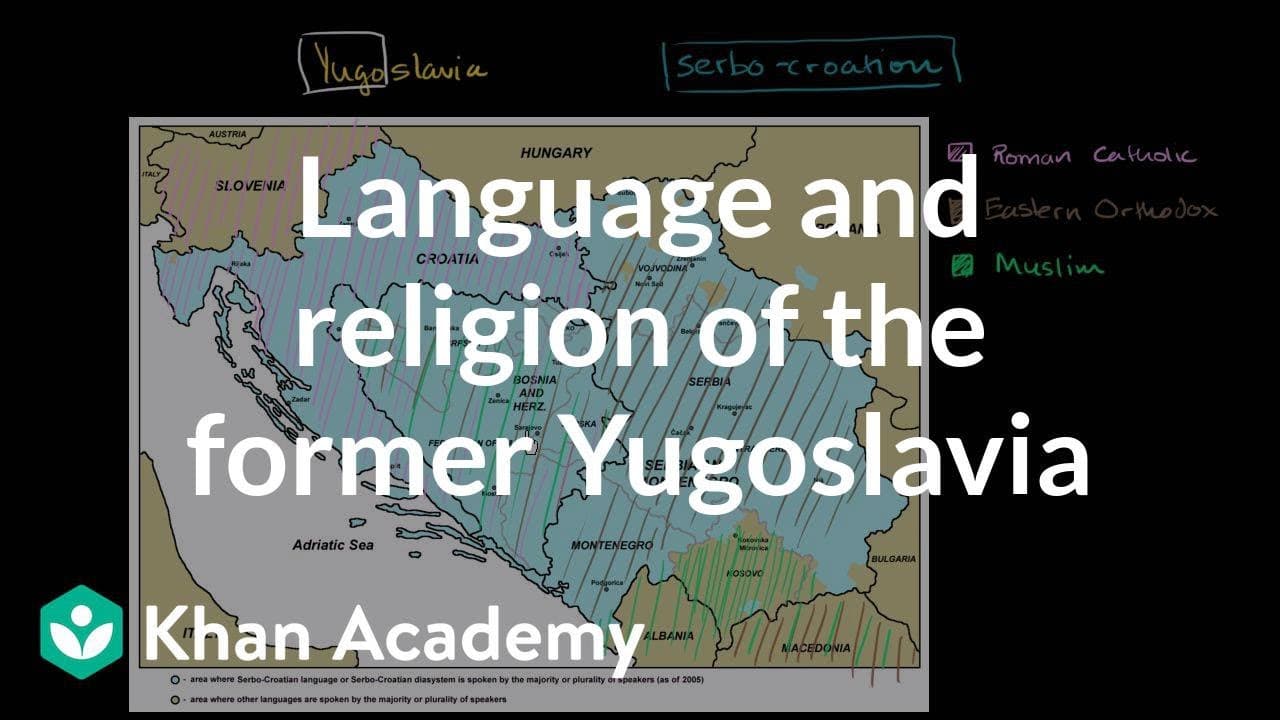
- 💄 The religious makeup of the region is diverse, with Roman Catholic, Eastern Orthodox, and Muslim populations.
- 🇧🇦 Bosnia and Herzegovina has a complex composition, with Bosniaks (Bosnian Muslims), Bosnian Croats (Roman Catholic), and Bosnian Serbs (Eastern Orthodox) forming significant ethnic and religious groups.
- 🥺 The linguistic and ethnic ties in the region were challenged by religious differences, leading to divisions and conflicts.
- 🖐️ The decline of the Ottoman Empire and World War I played a role in the formation of Yugoslavia as a unified state.
- 🇪🇺 Despite being a socialist state during the Cold War, Yugoslavia had a distant relationship with the Soviet Union.
Install to Summarize YouTube Videos and Get Transcripts
Explore YouTube Video Summarizer or Get YouTube Transcript Extractor
Questions & Answers
Q: What does the term "Yugoslavia" mean?
"Yugoslavia" refers to the southern Slavic states, indicating the linguistic and cultural connection among these regions.
Q: What is the dominant Slavic language in the former Yugoslavia?
Serbo-Croatian is the dominant Slavic language in the region, with dialects that can be categorized as one language despite different regional names.
Q: How did religion contribute to the divisions in Yugoslavia?
The control of various empires, such as the Austro-Hungarian Empire (Roman Catholic) and the Ottoman Empire (Muslim), resulted in a mix of religions that often became tied to people's ethnicities.
Q: How is Bosnia and Herzegovina religiously divided?
Bosnia and Herzegovina has a mixed religious makeup, with Islam as the dominant religion, significant fractions of Eastern Orthodox Serbs, and a considerable Roman Catholic population.
Summary & Key Takeaways
-
The word "Yugoslavia" refers to the southern Slavic states, and it is important to understand its origins to comprehend the triggers of World War I and the breakup of Yugoslavia in the late '80s and early '90s.
-
The dominant Slavic language in the region is Serbo-Croatian, which is spoken in modern-day Croatia, Bosnia and Herzegovina, Serbia, and Montenegro.
-
The region is divided by religion and history, with a mix of Roman Catholic, Eastern Orthodox, and Muslim populations.
Read in Other Languages (beta)
Share This Summary 📚
Summarize YouTube Videos and Get Video Transcripts with 1-Click
Try YouTube Summary with ChatGPT & Claude or YouTube Transcript Generator
Explore More Summaries from Khan Academy 📚



Summarize YouTube Videos and Get Video Transcripts with 1-Click
Try YouTube Summary with ChatGPT & Claude or YouTube Transcript Generator