Recoverability - Transaction Management - Database Management System
TL;DR
This video discusses recoverability and cascade-less schedules in transactions, emphasizing the importance of preserving atomicity and durability to avoid data inconsistencies.
Transcript
click the bell icon to get latest videos from akira how the friends today will know about what is recoverability and the situation where we can produce and recover this radio and also we will talk about a cascade les schedules suppose that if two or more transactions are involved in a schedule and in such situation that the atomicity property must ... Read More
Key Insights
- 🛟 Recoverability ensures that transactions can be restored to a consistent state from an inconsistent state, preserving atomicity.
- 🫠 To produce recoverable schedules, certain conditions need to be met, such as the order of transactions and their read and write operations.
- 🥺 Cascade rollbacks can lead to data inconsistencies and increased computational overhead, making cascade-less schedules preferable.
- 🫠 Cascade-less schedules prioritize commits on write operations before the read operations of subsequent transactions to avoid cascading rollbacks.
- 📅 Recoverable schedules are not always cascade-less, but cascade-less schedules are always recoverable.
- ❓ Maintaining atomicity and durability is crucial to prevent data inconsistencies and ensure the successful execution of transactions.
- 🪈 The commitment order and the order of read and write operations within transactions play a significant role in determining recoverability and cascade-less schedules.
Install to Summarize YouTube Videos and Get Transcripts
Explore YouTube Video Summarizer or Get YouTube Transcript Extractor
Questions & Answers
Q: What is recoverability in transactions?
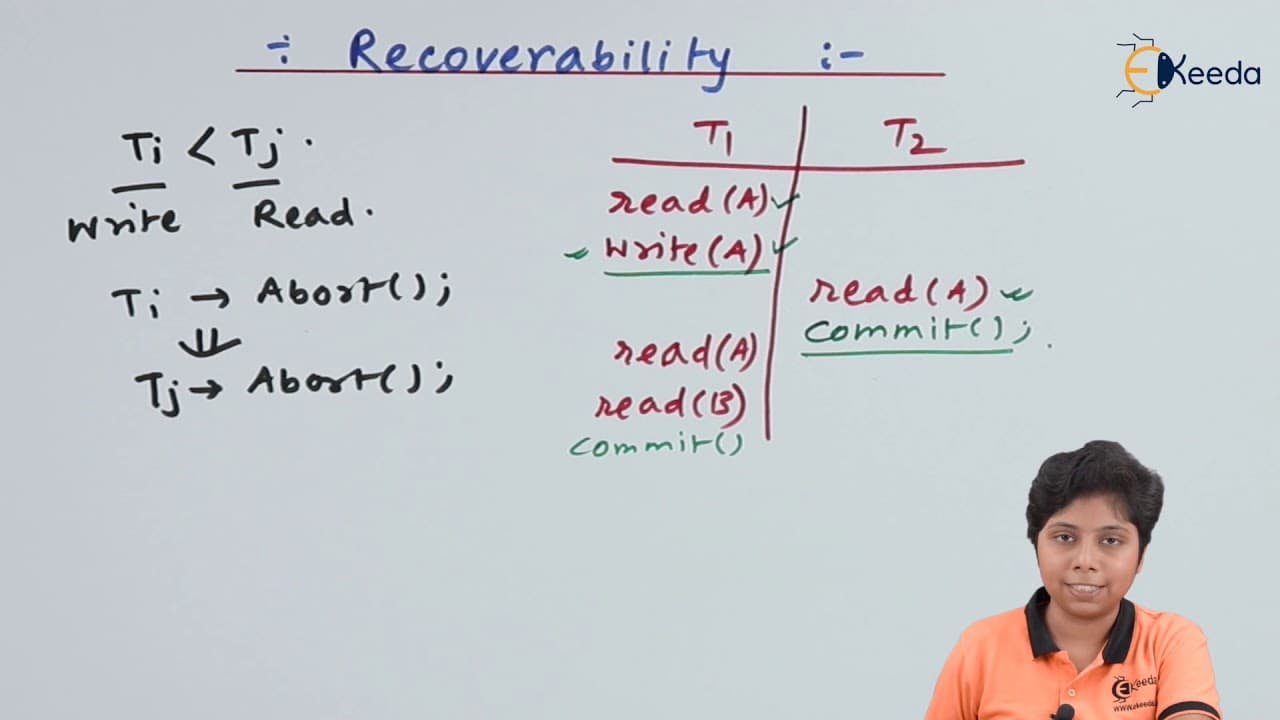
Recoverability refers to the ability to recover a transaction from an inconsistent state to a previous consistent state. It ensures that if Transaction I (TI) precedes Transaction J (TJ) and TI's write is read by TJ, both TI and TJ need to abort if TI encounters any problems.
Q: How can recoverable schedules be produced?
To create recoverable schedules, TI must precede TG, and TI's write must be followed by TJ's read on the same data item. If the commits on TG appear after TJ's read, a recoverable schedule can be achieved.
Q: What is a cascade rollback?
A cascade rollback occurs when a failing transaction causes multiple transactions that have read or written its values to also be rolled back. This can result in data inconsistencies and performance issues.
Q: How are cascade-less schedules defined?
Cascade-less schedules ensure that if TI precedes TJ and TI has a write, TJ's read must occur after TI's commit. This prevents cascading rollbacks and guarantees consistency in data operations.
Summary & Key Takeaways
-
The video explains the concept of recoverability, where transactions are recovered from an inconsistent state to a previous consistent state.
-
It introduces the idea of cascade-less schedules, which maintain atomicity by ensuring that transactions are not affected by the failure of preceding transactions.
-
An example is provided to illustrate the potential issues that can arise with non-recoverable schedules and cascading rollbacks.
Read in Other Languages (beta)
Share This Summary 📚
Summarize YouTube Videos and Get Video Transcripts with 1-Click
Try YouTube Summary with ChatGPT & Claude or YouTube Transcript Generator
Explore More Summaries from Ekeeda 📚




Summarize YouTube Videos and Get Video Transcripts with 1-Click
Try YouTube Summary with ChatGPT & Claude or YouTube Transcript Generator