Breaking down vectors into components | Vectors | Precalculus | Khan Academy
TL;DR
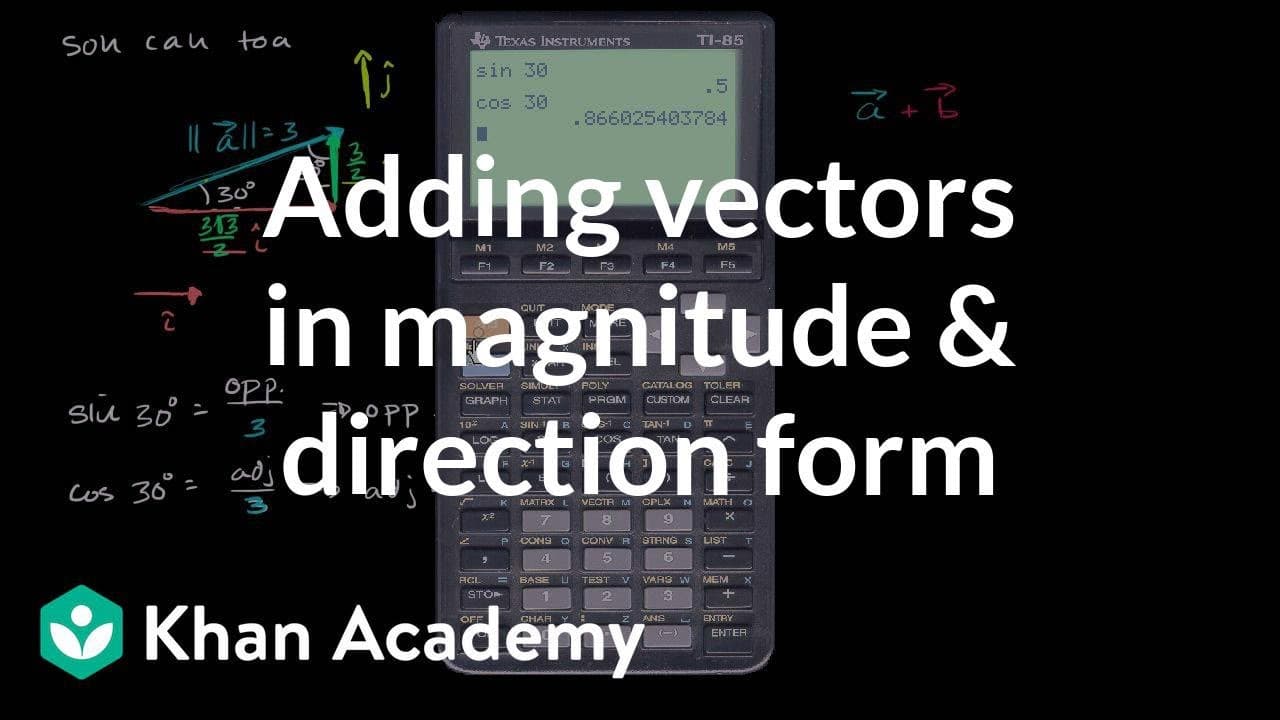
This video explains how to decompose vectors into their horizontal and vertical components, and then calculates the magnitude and direction of the sum of two vectors.
Transcript
Voiceover:We have two vectors here. Vector A, it has a magnitude of three so the length of this blue arrow is three. Its direction, it forms a 33 degree angle with the positive, I guess you could say the positive x axis. I haven't drawn that here and vector B has a magnitude of two, the length of this arrow is two and it forms a 135 degree angle wi... Read More
Key Insights
- 🚥 Vectors can be decomposed into their horizontal and vertical components using unit vectors.
- 🆘 Trigonometry and 30-60-90 triangles help determine the magnitudes of the vector components.
- 🚥 Adding the horizontal and vertical components of two vectors gives the horizontal and vertical components of their sum.
Install to Summarize YouTube Videos and Get Transcripts
Explore YouTube Video Summarizer or Get YouTube Transcript Extractor
Questions & Answers
Q: How do you decompose a vector into its horizontal and vertical components?
To decompose a vector, you can use unit vectors in the horizontal (I) and vertical (J) directions. Multiply the magnitude of the vector by the cosine of the angle formed with the x-axis to find the horizontal component, and multiply it by the sine of the angle to find the vertical component.
Q: What is the significance of the 30-60-90 triangle in vector decomposition?
The 30-60-90 triangle helps determine the magnitudes of the horizontal and vertical components. The shorter side is half the length of the hypotenuse, and the longer side is the shorter side multiplied by the square root of three.
Q: Can you use trigonometric functions to find the lengths of the vector components?
Yes, using the sine and cosine functions, you can calculate the lengths of the components. For example, to find the vertical component, multiply the hypotenuse by the sine of the angle. Similarly, multiply the hypotenuse by the cosine of the angle to find the horizontal component.
Q: How do you calculate the sum of two vectors?
To find the sum of two vectors, add their corresponding horizontal components and their corresponding vertical components. This will give you the horizontal and vertical components of the sum vector.
Summary & Key Takeaways
-
The video introduces two vectors, A and B, with different magnitudes and angles relative to the positive x-axis.
-
The presenter explains how to decompose each vector into its horizontal and vertical components using unit vectors.
-
The video demonstrates how to calculate the magnitudes of the components using trigonometry and 30-60-90 triangles.
-
Finally, the presenter shows how to add the horizontal and vertical components of vectors A and B to find the magnitude and direction of the sum vector, A + B.
Read in Other Languages (beta)
Share This Summary 📚
Summarize YouTube Videos and Get Video Transcripts with 1-Click
Try YouTube Summary with ChatGPT & Claude or YouTube Transcript Generator
Explore More Summaries from Khan Academy 📚



Summarize YouTube Videos and Get Video Transcripts with 1-Click
Try YouTube Summary with ChatGPT & Claude or YouTube Transcript Generator