Vi and Sal talk about the mysteries of Benford's law | Logarithms | Algebra II | Khan Academy
TL;DR
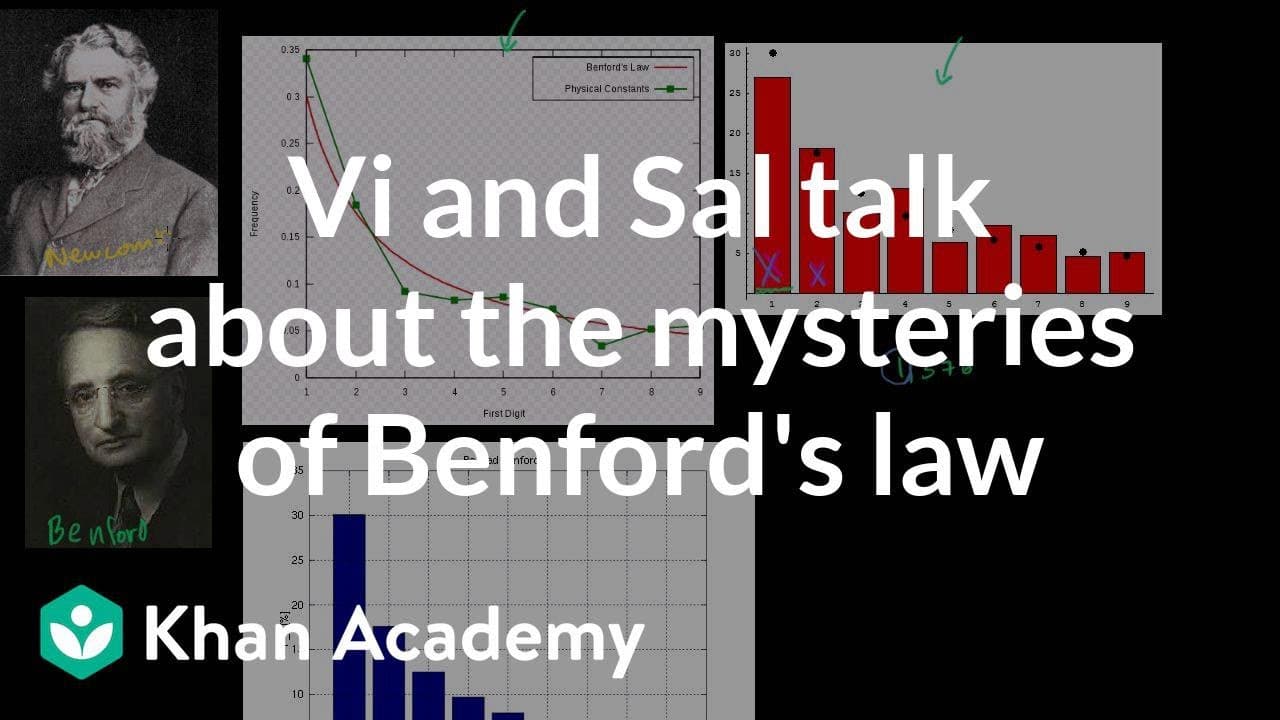
Benford's Law is a phenomenon where the first digit of numbers in the real world, such as populations and financial data, follows a non-random pattern.
Transcript
SAL KHAN: I am very excited to have Vi Hart visiting the office over here. And we were just having a very mathematical conversation earlier today. And she mentioned something that is fascinating. VI HART: Yeah, I was just telling Sal about a cool thing called Benford's Law. SAL KHAN: Benford's Law. And what is Benford's law? VI HART: It's this weir... Read More
Key Insights
- 🌍 Benford's Law describes a non-random pattern in the first digit distribution of numbers in the real world.
- ❓ It is observed in populations of countries, financial data, and physical constants.
- ✊ Mathematical constructs like powers of numbers also exhibit Benford's Law.
- ❓ The digit 1 occurs more frequently than the digits 8 or 9.
- 🌂 Benford's Law is not an exact law but is a close approximation.
- ❓ The reason behind Benford's Law is not fully understood but may be attributed to exponential growth or decay in various phenomena.
- ❓ Researchers are still exploring alternative explanations for this phenomenon.
Install to Summarize YouTube Videos and Get Transcripts
Explore YouTube Video Summarizer or Get YouTube Transcript Extractor
Questions & Answers
Q: What is Benford's Law?
Benford's Law describes a phenomenon where the first digit of numbers in the real world follows a specific distribution pattern, where the digit 1 occurs more frequently than the other digits.
Q: Do other types of data follow Benford's Law?
Yes, Benford's Law is observed in various types of data, including financial data, populations of countries, and even physical constants. The pattern holds even for mathematical constructs like powers of numbers.
Q: Is Benford's Law exact or approximate?
Benford's Law is not an exact law, but it is a highly accurate approximation. While there may be some deviations, especially with small sample sizes or specific number sets, the overall pattern holds true.
Q: Why does Benford's Law occur?
The exact reason for Benford's Law is not fully understood, but there are some intuitive explanations. One explanation is that many real-world phenomena follow exponential growth or decay, leading to a higher occurrence of numbers starting with the digit 1.
Summary & Key Takeaways
-
Benford's Law is a pattern observed in the first digits of numbers in the real world, such as populations of countries or financial data.
-
The distribution of first digits is not random, with the digit 1 occurring more frequently than digits 8 or 9.
-
The same pattern is observed in physical constants and even mathematical constructs like powers of numbers.
Read in Other Languages (beta)
Share This Summary 📚
Summarize YouTube Videos and Get Video Transcripts with 1-Click
Try YouTube Summary with ChatGPT & Claude or YouTube Transcript Generator
Explore More Summaries from Khan Academy 📚



Summarize YouTube Videos and Get Video Transcripts with 1-Click
Try YouTube Summary with ChatGPT & Claude or YouTube Transcript Generator