How Do We See the Smallest Things in the Universe?
TL;DR
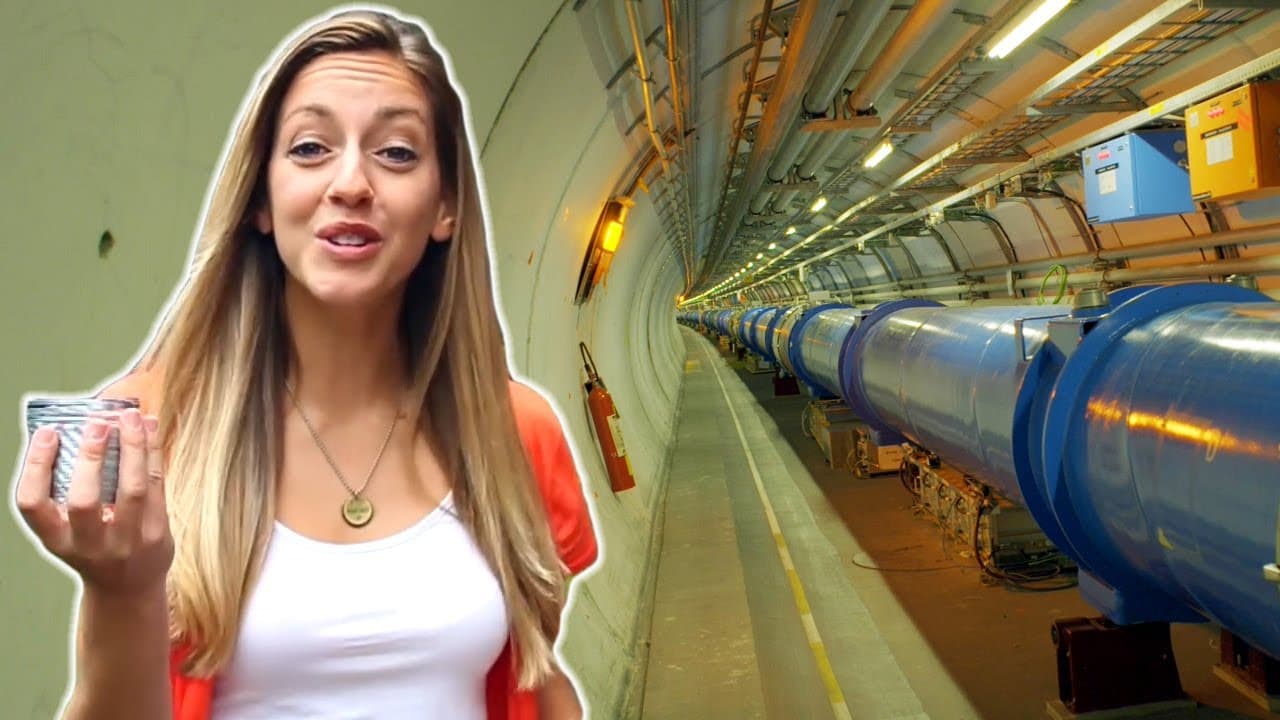
We can see the smallest things in the universe using electron microscopy and particle colliders. Electron microscopes allow imaging down to half a nanometer, while particle colliders like the Large Hadron Collider enable the exploration of subatomic particles. Theoretical physics suggests that particles could be one-dimensional strings, measuring around the Planck length, which is the smallest measurable distance in the universe.
Transcript
Have you ever looked through a microscope? It's a very different world from ours. But this is what makes up our world. Those are cells in your lungs. Well, that makes you wonder what makes of this world? What would it look like if you zoomed in even farther to the individual molecules that make up these cells? We didn't know until 2009, when a sing... Read More
Key Insights
- 👻 Microscopy allows us to explore the world at different scales, from cells to molecules and atomic particles.
- 🛩️ Visible light has limitations in resolving extremely small structures, leading to the development of electron microscopy.
- 👶 Particle colliders have been instrumental in discovering new particles and understanding the fundamental building blocks of matter.
- 🛩️ Theoretical physics proposes the existence of one-dimensional strings as the smallest components of particles.
- 🛩️ The Planck length represents the smallest measurable length in the universe and is a fundamental scale for understanding quantum phenomena.
- ❓ Current measurements suggest that quarks, electrons, and neutrinos are elementary particles with no discernible structure.
- 😒 The use of advanced technology, such as the Large Hadron Collider, enables scientists to investigate smaller scales and push the boundaries of our understanding.
Install to Summarize YouTube Videos and Get Transcripts
Explore YouTube Video Summarizer or Get YouTube Transcript Extractor
Questions & Answers
Q: How do electron microscopes differ from traditional microscopes?
Electron microscopes use electrons instead of light waves to image objects at a smaller scale. This allows us to see structures such as molecules or atomic bonds that are not visible with visible light.
Q: How do particle colliders help us understand smaller scales?
Particle colliders smash particles together at high speeds, causing them to break apart. By analyzing the resulting fragments, scientists can gain insights into the fundamental building blocks of matter and explore theories such as the existence of quarks.
Q: Are there limits to how small we can measure in terms of particle sizes?
According to current measurements, particles such as quarks, electrons, and neutrinos are considered to be the smallest possible units. However, the concept of strings in string theory proposes that particles are one-dimensional loops, allowing for a solution to problems of infinite forces as particles are approached.
Q: What is the Planck length and why is it significant?
The Planck length is the theoretical shortest measurable length in the universe. It is approximately 10 to the power of minus 35 meters, making it 100 quintillion times smaller than a proton. It represents the fundamental scale at which space and time can be meaningfully defined.
Summary & Key Takeaways
-
Microscopy allows us to observe cells, molecules, and even the atomic structure of particles, but there are limitations to what we can see with visible light.
-
Electron microscopy, using electrons instead of light waves, enables us to image smaller scales.
-
Particle colliders, such as the Large Hadron Collider, allow scientists to explore even smaller scales by smashing particles together at high speeds.
-
Theoretical physics proposes that particles are made up of one-dimensional strings at the smallest scale, known as the Planck length.
Read in Other Languages (beta)
Share This Summary 📚
Summarize YouTube Videos and Get Video Transcripts with 1-Click
Try YouTube Summary with ChatGPT & Claude or YouTube Transcript Generator
Explore More Summaries from Physics Girl 📚
Summarize YouTube Videos and Get Video Transcripts with 1-Click
Try YouTube Summary with ChatGPT & Claude or YouTube Transcript Generator