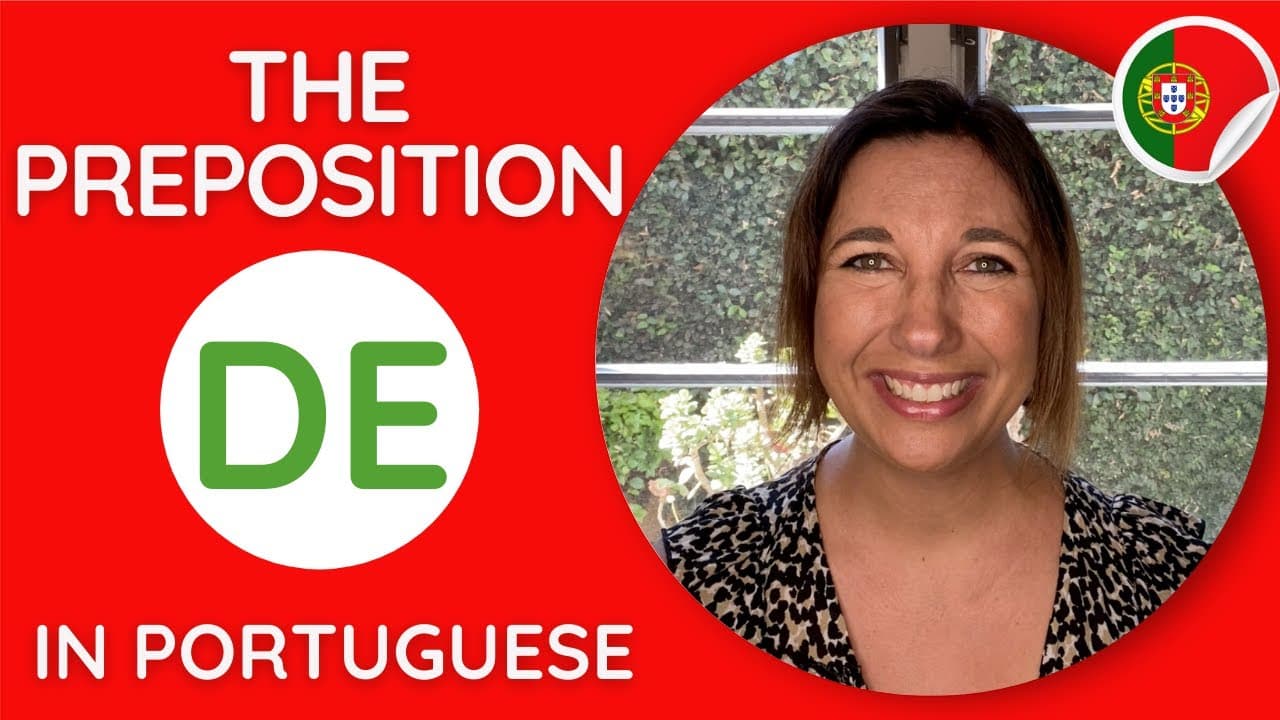
The Preposition "de" and its Uses in European Portuguese.
TL;DR
Learn the uses of 'de' in European Portuguese with examples.
Transcript
today i decided to talk about one of the most challenging things to learn in portuguese from my experience most students struggle with the use of prepositions and its contractions in this episode i will walk you through the preposition du and its main uses i will give you useful tips on how to succeed in using this important word if you enjoy my co... Read More
Key Insights
- The preposition 'de' can mean 'of,' 'from,' 'about,' and 'by,' depending on the context, making it challenging to learn.
- In Portuguese, 'de' contracts with definite and indefinite articles, which is common in European Portuguese oral conversations.
- 'De' is used to indicate origin or movement, as in 'from Portugal' or 'from Lisbon to Porto.'
- When referring to time, 'de' is used to express parts of the day, like 'in the morning' or 'at night.'
- 'De' also expresses ownership, similar to the English possessive apostrophe, as in 'João's book.'
- In terms of describing types or materials, 'de' is used in phrases like 'sunglasses' or 'driver's license.'
- The preposition 'de' can mean 'about' when discussing subjects, with verbs like 'gostar' (to like) or 'precisar' (to need).
- The video offers practical examples and tips for mastering the use of 'de' in European Portuguese.
Install to Summarize YouTube Videos and Get Transcripts
Explore YouTube Video Summarizer or Get YouTube Transcript Extractor
Questions & Answers
Q: What are the main meanings of the preposition 'de' in Portuguese?
'De' can mean 'of,' 'from,' 'about,' and 'by,' depending on the context. It is versatile and used in various situations, such as indicating origin, describing types or materials, and expressing ownership. Understanding its context is crucial for proper usage.
Q: How does 'de' contract with articles in Portuguese?
'De' contracts with definite articles to form 'do,' 'da,' 'dos,' and 'das,' and with indefinite articles to form 'dum' and 'duma.' These contractions are more common in spoken European Portuguese, while the separate form 'de' is often used in writing.
Q: How is 'de' used to express time in Portuguese?
'De' is used to express parts of the day, such as 'in the morning' or 'at night.' It helps indicate specific times, like 'I wake up early in the morning' or 'The meeting starts at three in the afternoon.' Understanding these expressions is essential for discussing time.
Q: In what context is 'de' used to indicate ownership?
In Portuguese, 'de' indicates ownership similarly to the English possessive apostrophe. For example, 'João's book is blue' translates to 'O livro de João é azul,' literally 'the book of João.' This structure highlights how 'de' conveys possession in the language.
Q: How does 'de' describe types or materials in Portuguese?
'De' is used to describe types or materials, such as in 'óculos de sol' (sunglasses) or 'carta de condução' (driver's license). These expressions show how 'de' specifies the type or material of an object, a common usage in everyday Portuguese.
Q: What are some common verbs used with 'de' in Portuguese?
Common verbs that pair with 'de' include 'gostar' (to like), 'precisar' (to need), and 'ter' (to have to). These verbs often require 'de' to connect them to their objects or complements, making it important to learn these combinations for fluency.
Q: How does the video help learners understand 'de' better?
The video provides practical examples and explanations of 'de's various uses, helping learners grasp its meanings and contexts. It addresses common challenges and offers tips for mastering 'de,' encouraging viewers to practice and engage with additional resources.
Q: What additional resources does the video creator offer?
The creator offers a Patreon page with exclusive content, a Facebook page for creative posts, and a website for more information. These resources provide learners with further opportunities to engage with the language and improve their understanding of Portuguese.
Summary & Key Takeaways
-
The video explains the various uses of the preposition 'de' in European Portuguese, highlighting its meanings and contexts. It provides examples to help learners use 'de' correctly and discusses its contractions with articles.
-
The content emphasizes the importance of understanding 'de' for expressing movement, origin, time, ownership, and description. It also covers how 'de' is used in common phrases and with certain verbs.
-
For learners struggling with Portuguese prepositions, the video offers valuable insights and tips. It encourages viewers to explore related content and engage with the creator's community for further learning.
Read in Other Languages (beta)
Share This Summary 📚
Summarize YouTube Videos and Get Video Transcripts with 1-Click
Try YouTube Summary with ChatGPT & Claude or YouTube Transcript Generator
Explore More Summaries from Learn European Portuguese Online 📚




Summarize YouTube Videos and Get Video Transcripts with 1-Click
Try YouTube Summary with ChatGPT & Claude or YouTube Transcript Generator