Physics, Kinematics, Free Fall (2 of 12) Solving for Final Velocity, No.1
TL;DR
This video explains how to calculate the final velocity of an object in freefall using kinematic equations.
Transcript
okay in today's video I'm going to go over a problem involving one-dimensional kinematics for freefall and in this video we're going to calculate the final velocity of the object at the bottom of its fall so to speak okay and this is the problem that we're going to use we have Sally is standing at the edge of a cliff that overlooks Lake she picks u... Read More
Key Insights
- 🍂 Freefall kinematics involves calculating the final velocity of a falling object using kinematic equations.
- 🦻 Drawing a diagram and keeping track of the negative direction can aid in problem visualization.
- 🧘 The five variables in kinematic equations are initial velocity, final velocity, change in position, acceleration, and time.
- 👻 Selecting the appropriate equation with known variables allows for the calculation of the unknown variable.
- 💦 The initial velocity is typically zero when objects are dropped in freefall.
Install to Summarize YouTube Videos and Get Transcripts
Explore YouTube Video Summarizer or Get YouTube Transcript Extractor
Questions & Answers
Q: What is the problem discussed in the video?
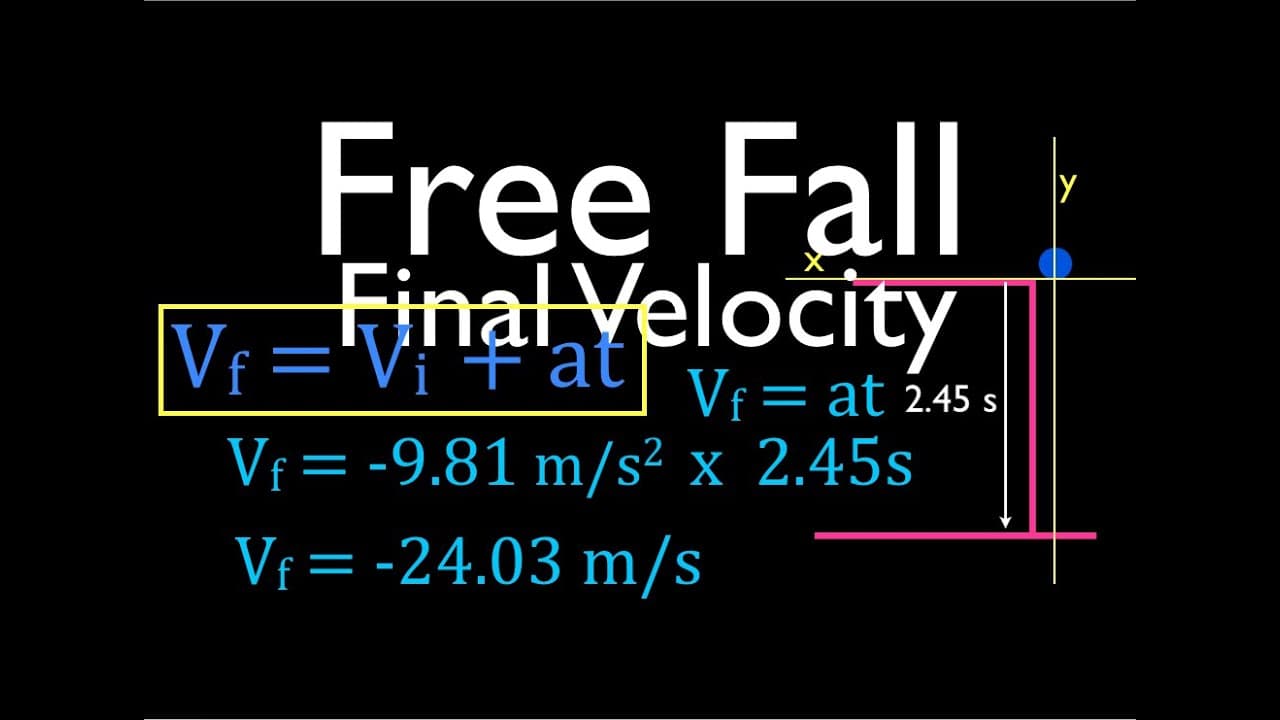
The problem involves calculating the final velocity of a rock dropped by Sally from a cliff into a lake.
Q: How is the problem set up using a diagram?
The video suggests drawing a simple diagram with Sally standing on the cliff, the rock falling through a distance, and an XY coordinate system. It helps visualize the problem and keep track of the negative direction.
Q: Which variables are known and unknown in the problem?
The known variables are the time taken for the rock to reach the water (2.45 seconds), initial velocity (0 m/s), and acceleration due to gravity (-9.81 m/s^2). The unknown variable is the final velocity.
Q: How is the final velocity calculated?
The video explains the selection of the appropriate kinematic equation and simplifies it based on the initial velocity being zero. The final velocity is then calculated as -24.03 m/s.
Summary & Key Takeaways
-
This video discusses a problem involving freefall kinematics and the calculation of the final velocity of a falling object.
-
The problem involves Sally dropping a rock from a cliff into a lake and determining the final velocity of the rock before it hits the water.
-
The video covers the steps to solve the problem, including drawing a diagram, identifying known and unknown variables, and selecting the appropriate kinematic equation.
Read in Other Languages (beta)
Share This Summary 📚
Summarize YouTube Videos and Get Video Transcripts with 1-Click
Try YouTube Summary with ChatGPT & Claude or YouTube Transcript Generator
Explore More Summaries from Step by Step Science 📚

Summarize YouTube Videos and Get Video Transcripts with 1-Click
Try YouTube Summary with ChatGPT & Claude or YouTube Transcript Generator