Natural Language Inference | Stanford CS224U Natural Language Understanding | Spring 2021
TL;DR
Introduction to NLI, its formulation, and its relevance in common sense reasoning and language understanding.
Transcript
welcome everyone this is the first screencast in our series on natural language inference or nli this is one of my favorite problems what i'd like to do is give you a sense for how the task is formulated and then situate the task within the broader landscape of ideas for nlu as usual we have a bunch of materials that would allow you to get hands-on... Read More
Key Insights
- 🏷️ NLI involves assigning labels to pairs of premise and hypothesis sentences.
- 🤪 Common sense reasoning plays an important role in NLI, going beyond strict logic.
- 🏆 NLI can be applied to various tasks by framing them as entailment tests.
- ⚾ The landscape of NLI models has evolved from logic-based systems to deep learning architectures.
- ❓ Deep learning models for NLI have surpassed traditional approaches in effectiveness.
- 🛟 NLI serves as a fundamental task for language understanding and can provide useful generic modules across applications.
- ❓ NLI requires considering linguistic and semantic complexity, such as negations and quantifiers.
Install to Summarize YouTube Videos and Get Transcripts
Explore YouTube Video Summarizer or Get YouTube Transcript Extractor
Questions & Answers
Q: What is the task of natural language inference (NLI)?
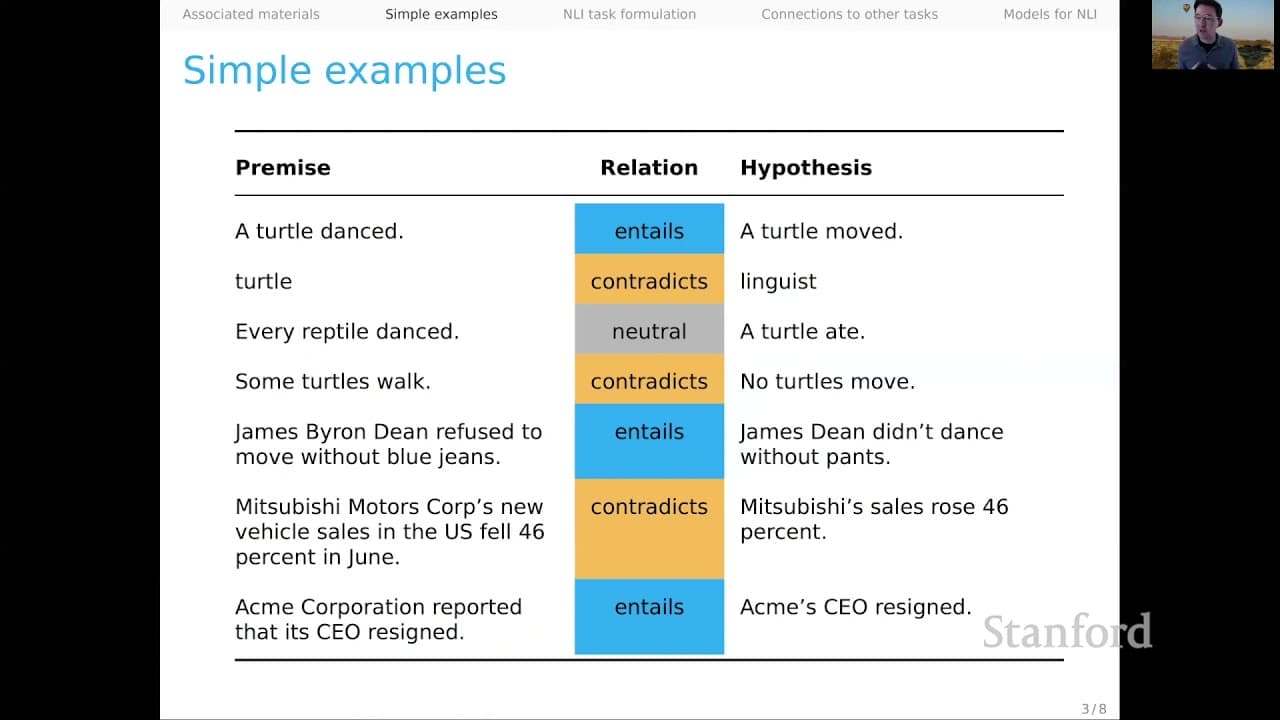
NLI is a classification task that involves assigning labels (entails, contradicts, neutral) to pairs of premise and hypothesis sentences based on their relationship.
Q: How does NLI differ from strict logical reasoning?
NLI is not purely based on strict logic but incorporates common sense reasoning, allowing for inferences that may not be logically necessary but are likely based on real-world knowledge and understanding.
Q: How can NLI be applied to other tasks?
NLI can be formulated as other tasks such as paraphrase, summarization, information retrieval, and question answering by framing them as entailment tests between different text pairs.
Q: How has the landscape of NLI models evolved over time?
NLI models have transitioned from logic-based systems to natural logic approaches, semantic graphs, and finally deep learning architectures, which have proven to be more effective due to modeling innovations and large benchmark datasets.
Summary & Key Takeaways
-
NLI is a classification task where a premise sentence and a hypothesis sentence are given, and the task is to assign one of three labels: entails, contradicts, or neutral.
-
NLI involves common sense reasoning rather than strict logical reasoning and focuses on local inference steps rather than long deductive chains.
-
NLI can be formulated as various tasks, including paraphrase, summarization, information retrieval, and question answering.
Read in Other Languages (beta)
Share This Summary 📚
Summarize YouTube Videos and Get Video Transcripts with 1-Click
Try YouTube Summary with ChatGPT & Claude or YouTube Transcript Generator
Explore More Summaries from Stanford Online 📚


Summarize YouTube Videos and Get Video Transcripts with 1-Click
Try YouTube Summary with ChatGPT & Claude or YouTube Transcript Generator