Energy, Work & Power (8 of 31) Work, An Explanation
TL;DR
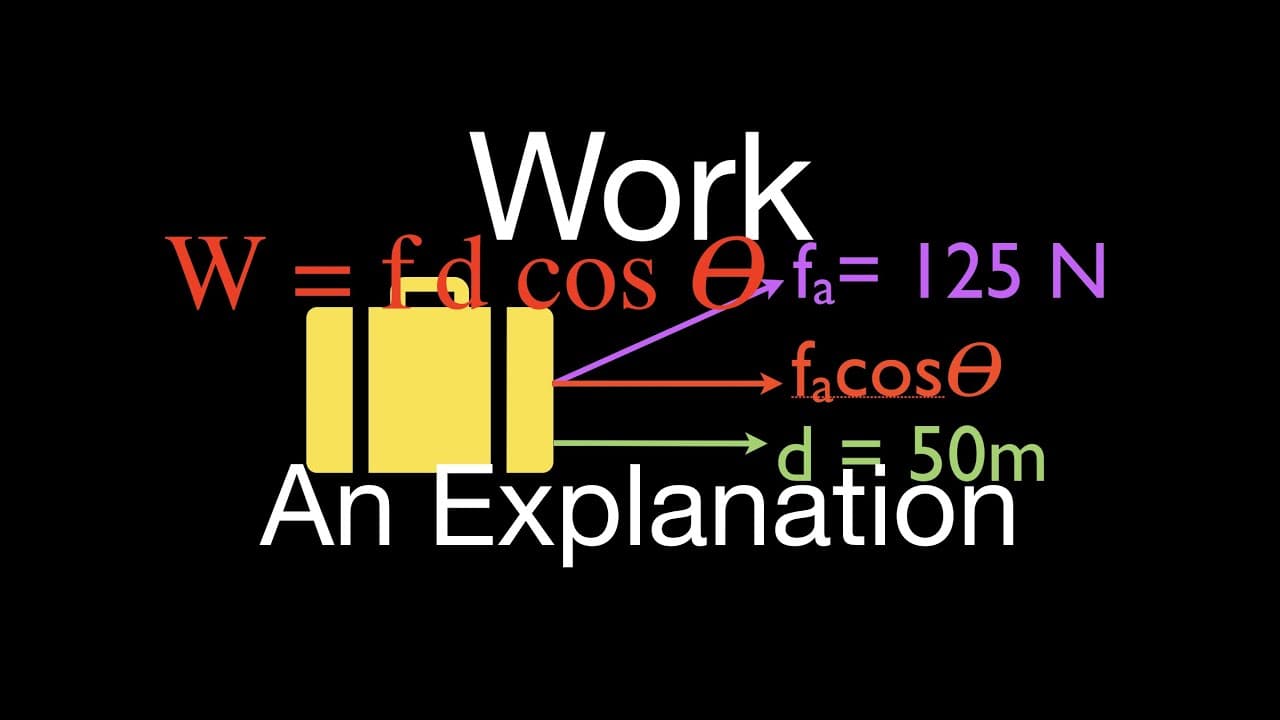
Work in physics is a scalar quantity defined by its magnitude and is the product of the magnitude of displacement and the component of force parallel to the displacement.
Transcript
okay in today's video 10 maybe 12 minutes or less I'm to go going to go over almost everything you need to know about work one thing you definitely need to know about work is that work is a scalar quantity it is defined only by its magnitude it is not a vector quantity which would be defined by its magnitude and a direction work is a scalar quantit... Read More
Key Insights
- 💦 Work is a scalar quantity defined by its magnitude.
- 💦 The force and the object upon which the force is applied need to be specified to calculate work.
- 💦 Work is calculated using the equation FDcos(θ), where FD represents the product of displacement magnitude and the component of force parallel to the displacement.
- 🔺 The angle between the force and displacement vectors determines the component of force parallel to the displacement.
- 💦 Pushing or pulling an object without any movement does not result in work being done.
- 💦 The force of gravity does not do work on an object moving in a circular path around another object.
Install to Summarize YouTube Videos and Get Transcripts
Explore YouTube Video Summarizer or Get YouTube Transcript Extractor
Questions & Answers
Q: What defines work in physics?
In physics, work is defined as a scalar quantity that is determined by its magnitude. It is not a vector quantity like force or displacement.
Q: How is work calculated?
Work is calculated using the equation FDcos(θ), where FD represents the product of the magnitude of displacement and the component of force parallel to the displacement. θ represents the angle between the force and displacement vectors.
Q: Is work dependent on the direction of the force?
No, work is only dependent on the magnitude of the force and the magnitude of the displacement, regardless of their direction. The angle between the force and displacement vectors is what determines the component of force parallel to the displacement.
Q: Can work be done if an object does not move?
No, work can only be done if there is a force applied over a distance. If an object does not move, no work is being done, even if a force is being applied.
Summary & Key Takeaways
-
Work is a scalar quantity defined by its magnitude and is not a vector quantity.
-
To calculate work, the force and the object upon which the force is applied need to be specified.
-
Work is calculated using the equation FDcos(θ), where FD is the product of the magnitude of displacement and the component of force parallel to the displacement, and θ is the angle between the force and displacement vectors.
Read in Other Languages (beta)
Share This Summary 📚
Summarize YouTube Videos and Get Video Transcripts with 1-Click
Try YouTube Summary with ChatGPT & Claude or YouTube Transcript Generator
Explore More Summaries from Step by Step Science 📚
Summarize YouTube Videos and Get Video Transcripts with 1-Click
Try YouTube Summary with ChatGPT & Claude or YouTube Transcript Generator