Balancing of V Engines - Balancing in Dynamics of Machinery - Dynamics of Machinery
TL;DR
This video discusses the balancing of V engines, which involve two connecting rods running on a common shaft and cylinders grouped at certain angles for compactness and reduced weight.
Transcript
hello everyone in this video we'll discuss about balancing of v engines so we engines are the type of engine where two connecting rods they run a common shaft or we can also say that in this the cylinders are grouped together at certain angle in such a way that they share a common shaft sorry a common crank and the common angles at which these cyli... Read More
Key Insights
- 🥰 V engines have compact dimensions and reduced weight due to the grouping of cylinders and sharing of a common shaft.
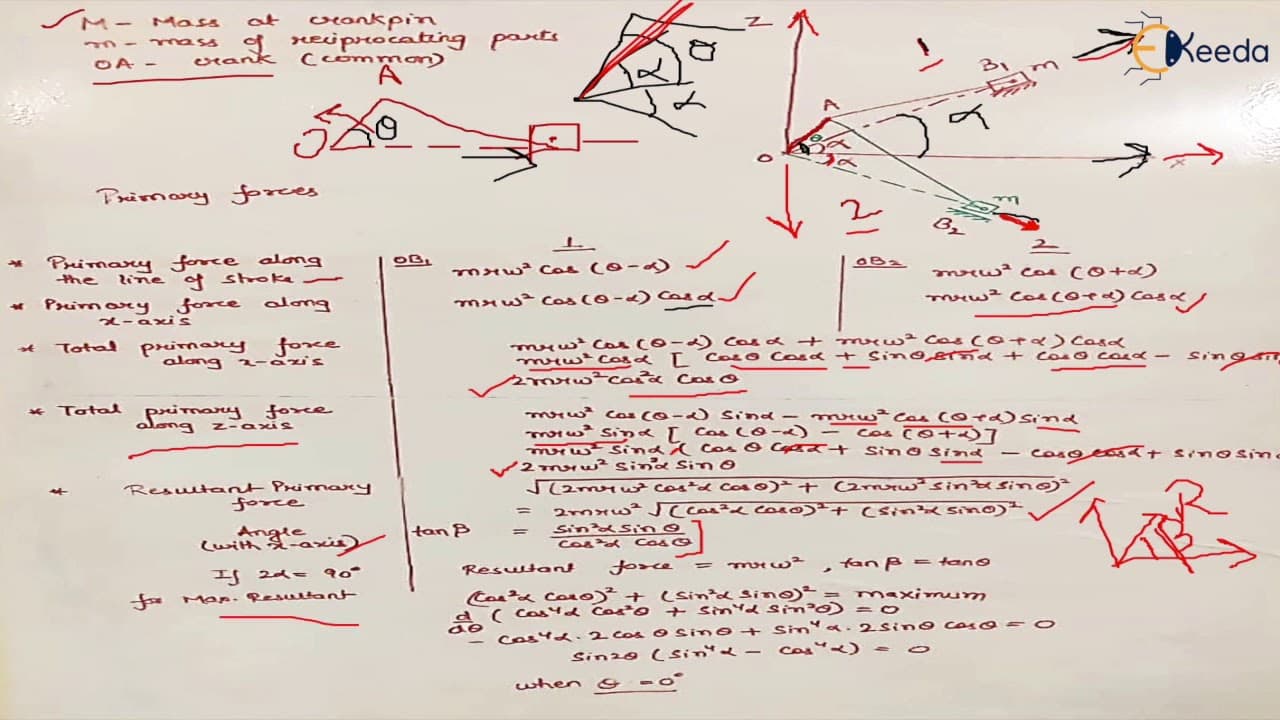
- ☺️ Primary unbalanced forces are calculated along the x-axis and z-axis using equations involving cos and sine functions.
- 🥰 The secondary unbalanced forces in V engines are determined through similar calculations as the primary forces.
- 🔺 The resultant force and angle of the secondary forces can be found using trigonometric equations.
Install to Summarize YouTube Videos and Get Transcripts
Explore YouTube Video Summarizer or Get YouTube Transcript Extractor
Questions & Answers
Q: How are V engines different from inline engines?
V engines have cylinders grouped at certain angles, reducing dimensions and weight by sharing a common shaft, while inline engines have cylinders placed in a straight line.
Q: What are the primary unbalanced forces in V engines?
The primary forces are caused by reciprocating parts and can be calculated using equations like mr omega square cos theta.
Q: How are the primary forces distributed along the x-axis and z-axis?
The primary force along the x-axis is m r omega square cos theta minus alpha cos alpha, while the primary force along the z-axis is m r omega square sine square alpha sine theta.
Q: How can the maximum condition for the resultant force be obtained?
To find the maximum condition, the variable factors are differentiated and equated to zero. The resultant force is maximum when theta equals zero.
Summary & Key Takeaways
-
V engines have cylinders grouped at certain angles to reduce dimensions and weight, with two connecting rods running on a common shaft.
-
The video analyzes the primary and secondary unbalanced forces in V engines due to reciprocating parts.
-
The primary force along the line of stroke and the secondary force along the x and z-axis are calculated for both connecting rods.
Read in Other Languages (beta)
Share This Summary 📚
Summarize YouTube Videos and Get Video Transcripts with 1-Click
Try YouTube Summary with ChatGPT & Claude or YouTube Transcript Generator
Explore More Summaries from Ekeeda 📚





Summarize YouTube Videos and Get Video Transcripts with 1-Click
Try YouTube Summary with ChatGPT & Claude or YouTube Transcript Generator