Coding Challenge 95: Approximating the Value of Pi
TL;DR
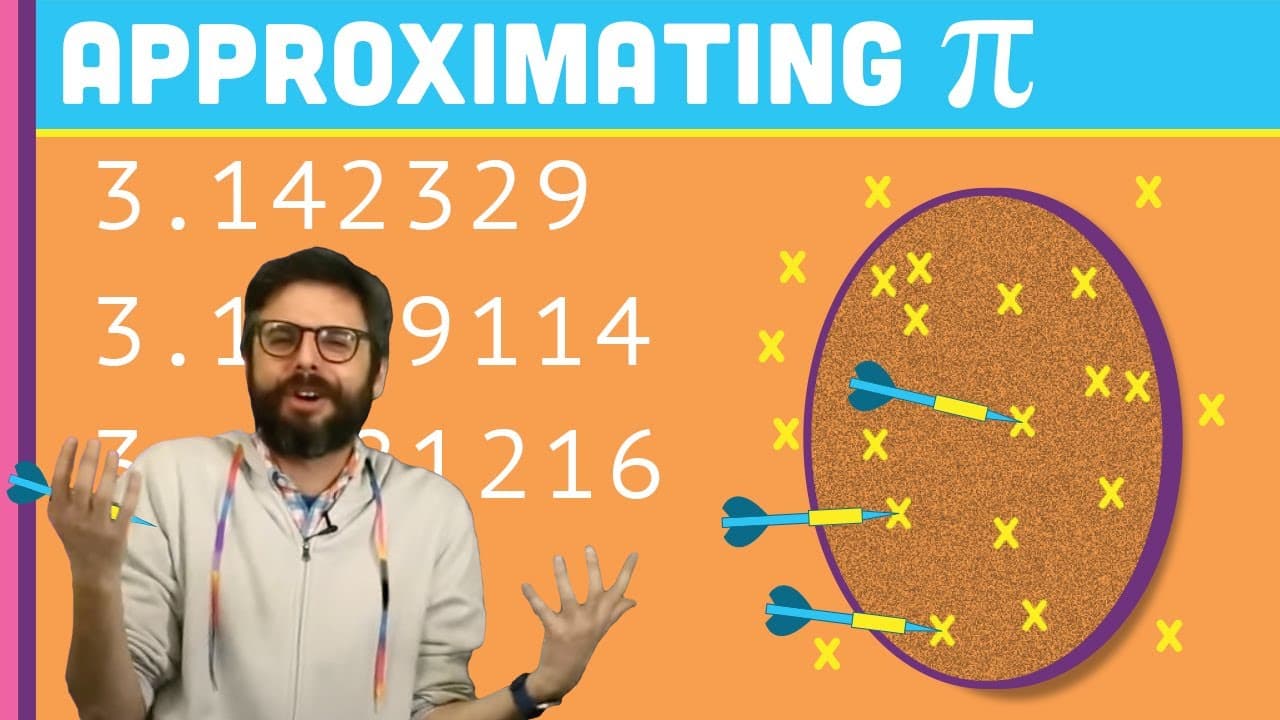
This video explores a method for approximating the value of pi using a random particle simulation within a circle and square.
Transcript
[TRAIN WHISTLE] [BELL RINGS] Hello. Happy Pi Day. I admit this is take number two. I messed up the first time. I'm going to do a coding challenge, where I am going to approximate the value of pi. Now what's running here right now is the actual number pi. I mean someone should fact check that this is correct. You can go compare it to PiDay.org/milli... Read More
Key Insights
- 🤨 The circumference and area formulas of a circle can be used to approximate the value of pi.
- 🍾 The ratio of the area of a circle to the area of a square can be used as an approximation for pi.
- 🍾 Random particle simulations can be used to estimate this ratio and obtain a closer approximation of pi.
- ✋ Higher precision data types, such as double, can improve the accuracy of the approximation.
- 🤨 Increasing the number of particles in the simulation can lead to better approximations of pi.
- 🤨 Visualizing the difference between the approximation and the actual value of pi can help understand the accuracy of the simulation.
- ❓ The simulation can be further enhanced by highlighting the correct and incorrect digits of the approximation.
Install to Summarize YouTube Videos and Get Transcripts
Explore YouTube Video Summarizer or Get YouTube Transcript Extractor
Questions & Answers
Q: How does the simulation use random particles to approximate pi?
The simulation throws random particles on a square bounding box around a circle. The ratio of particles in the circle to particles in the square can be used as an approximation for pi.
Q: What is the significance of using the area of a circle and a square in the approximation?
The ratio of the area of the circle to the area of the square gives a relationship that can be used to approximate pi without directly calculating its value.
Q: What data type is used for storing the approximation of pi in the simulation?
The presenter initially uses integers for counting the number of particles in the circle and square, but later switches to the double data type for greater precision.
Q: How is the quality of the approximation improved in the simulation?
By increasing the number of particles thrown in the simulation, the approximation of pi gets closer to its actual value.
Summary & Key Takeaways
-
The video introduces the concept of using a circle's circumference and area to approximate the value of pi.
-
The presenter explains the relationship between the area of a circle and the area of a square, and how this can be used in a simulation using random particles.
-
The video demonstrates the coding implementation of the simulation and discusses the limitations and potential improvements.
Read in Other Languages (beta)
Share This Summary 📚
Summarize YouTube Videos and Get Video Transcripts with 1-Click
Try YouTube Summary with ChatGPT & Claude or YouTube Transcript Generator
Explore More Summaries from The Coding Train 📚




Summarize YouTube Videos and Get Video Transcripts with 1-Click
Try YouTube Summary with ChatGPT & Claude or YouTube Transcript Generator