2015 AP Chemistry free response 2f
TL;DR
Ethanol dissolves in water due to hydrogen bonding, while ethene does not due to its nonpolar nature.
Transcript
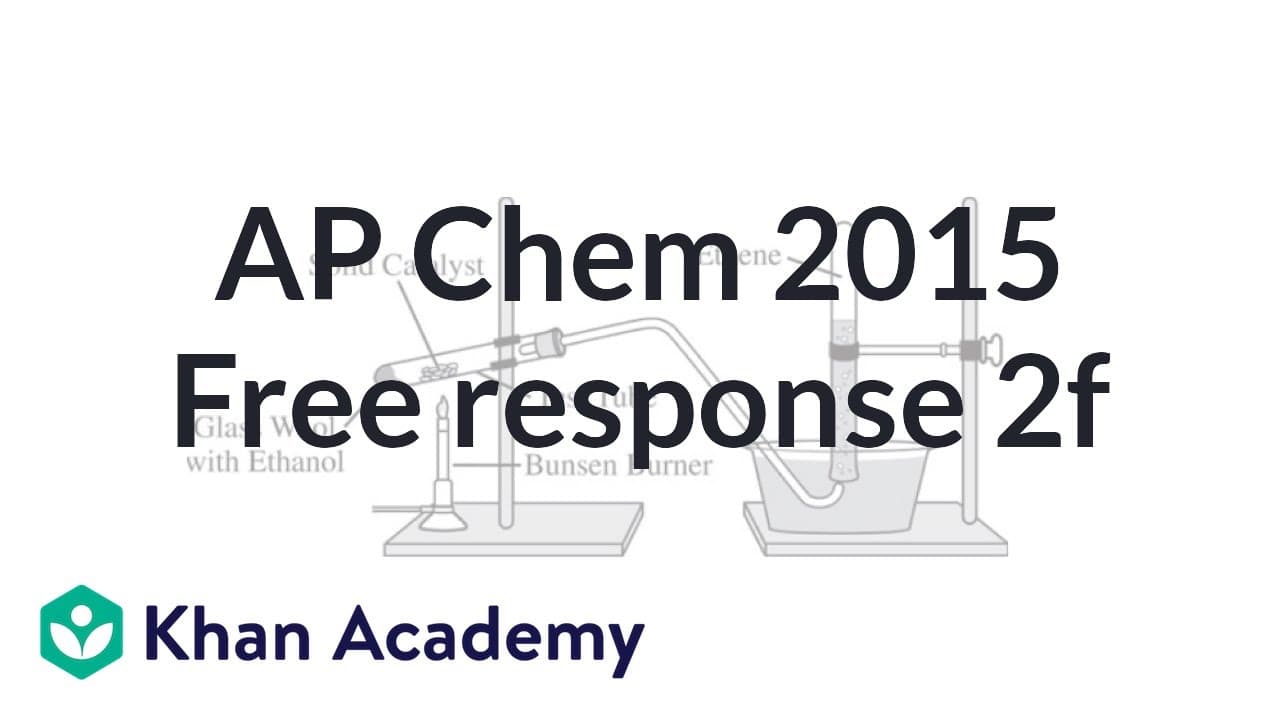
- [Voiceover] During the dehydration experiment, ethene gas and unreacted ethanol passed through the tube into the water. The ethene was quantitatively collected as a gas, but the unreacted ethanol was not. Explain this observation in terms of the intermolecular forces between water and each of the two gases. And just to be clear, what they're talk... Read More
Key Insights
- 💦 Ethanol, being a polar molecule, can dissolve in water due to hydrogen bonding.
- 💦 The polarity of molecules determines their solubility in water.
- 🖤 Ethene, being nonpolar, lacks the ability to form hydrogen bonds with water molecules, resulting in poor solubility.
- 💦 The asymmetrical distribution of partial charges in ethanol enables it to interact more strongly with water compared to ethene.
- 🐻❄️ Water, as a polar solvent, can dissolve polar substances better than nonpolar substances.
- 💦 The ability of ethanol to dissolve in water is due to the presence of partially positive and partially negative charges in its molecular structure.
- 🖤 Ethene's lack of polarity limits its interactions with water to induced dipole interactions.
Install to Summarize YouTube Videos and Get Transcripts
Explore YouTube Video Summarizer or Get YouTube Transcript Extractor
Questions & Answers
Q: Why does ethanol dissolve in water better than ethene?
Ethanol is a polar molecule, allowing it to form hydrogen bonds with water molecules. This increases its solubility in water. On the other hand, ethene is nonpolar, lacking the ability to form hydrogen bonds, leading to poor solubility in water.
Q: What are the intermolecular forces between ethanol and water?
Ethanol and water can form hydrogen bonds. The oxygen atom in ethanol is partially negative, while the hydrogen atoms are partially positive, allowing for the formation of hydrogen bonds with water molecules.
Q: How do intermolecular forces explain the dissolution of ethanol in water?
The hydrogen bonds between ethanol and water molecules contribute to their attraction and enable ethanol to dissolve in water. The polar nature of ethanol and water molecules facilitates the formation of these hydrogen bonds.
Q: Why does ethene not dissolve in water?
Ethene is a nonpolar molecule and does not possess a permanent dipole. As a result, it can only exhibit induced dipole interactions with the polar water molecules. These interactions are not as strong, leading to poor solubility and causing ethene to bubble through water.
Summary & Key Takeaways
-
Ethanol and ethene are gases that can be produced through a dehydration experiment.
-
Ethanol is a polar molecule and can dissolve in water due to hydrogen bonding.
-
Ethene is nonpolar and does not dissolve in water, instead, it bubbles through.
Read in Other Languages (beta)
Share This Summary 📚
Summarize YouTube Videos and Get Video Transcripts with 1-Click
Try YouTube Summary with ChatGPT & Claude or YouTube Transcript Generator
Explore More Summaries from Khan Academy 📚



Summarize YouTube Videos and Get Video Transcripts with 1-Click
Try YouTube Summary with ChatGPT & Claude or YouTube Transcript Generator