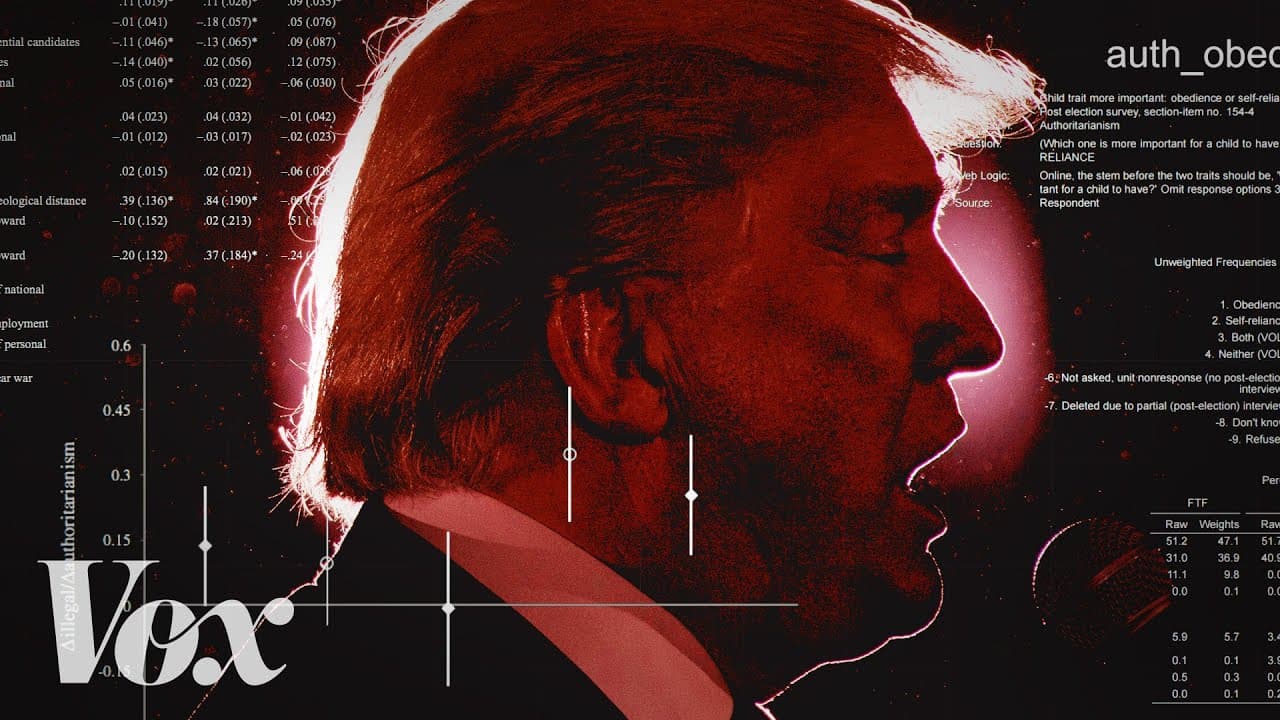
Authoritarianism: The political science that explains Trump
TL;DR
Trump's rise linked to authoritarianism in U.S. politics.
Transcript
“He’s a war hero because he was captured. I like people who weren’t captured ok? I hate to tell you.” The 2016 Republican presidential nominee disregards the norms of adult behavior. He disregards the norms of American democracy as we know it. “It should be heartbreaking to every American that we have a frontrunner who suggests there will be a reli... Read More
Key Insights
- Donald Trump's rhetoric and behavior deviate from traditional political norms, appealing to those with authoritarian tendencies.
- Authoritarianism is characterized by a preference for order, authority, and a distrust of outsiders and social change.
- The Republican Party has increasingly attracted authoritarian voters by aligning with traditional values and opposing major social changes.
- Political scientists use parenting preference questions to identify authoritarian tendencies, revealing a strong correlation with Trump support.
- Authoritarian voters prioritize force over diplomacy and are willing to sacrifice civil liberties for perceived safety.
- The rise of authoritarianism within the Republican Party suggests a long-term shift beyond Trump's candidacy.
- Authoritarianism is not inherently partisan but has increasingly aligned with Republican positions on issues like terrorism and immigration.
- Trump's success is not a fluke; it reflects a broader demand for strongman leadership among a significant voter base.
Install to Summarize YouTube Videos and Get Transcripts
Explore YouTube Video Summarizer or Get YouTube Transcript Extractor
Questions & Answers
Q: What is the significance of authoritarianism in Trump's rise?
Authoritarianism plays a crucial role in Trump's rise as it aligns with his strongman leadership style, appealing to voters who prioritize order and authority. These voters have increasingly found a home in the Republican Party, which has embraced traditional values and opposed social changes, making Trump a natural fit for their preferences.
Q: How do political scientists measure authoritarian tendencies?
Political scientists measure authoritarian tendencies using questions about parenting preferences. These questions, focusing on values like independence versus respect for elders, serve as proxies for assessing individuals' preference for order and authority. The responses have shown a strong correlation with support for Trump, particularly among white voters.
Q: Why have authoritarian voters gravitated towards the Republican Party?
Authoritarian voters have gravitated towards the Republican Party due to its alignment with traditional values and opposition to social changes like racial integration and same-sex marriage. The party's stance on foreign threats and terrorism also resonates with authoritarian preferences, further solidifying their support within the GOP.
Q: What are some characteristics of authoritarian voters?
Authoritarian voters prioritize order and authority, often supporting strongman leaders who promise forceful solutions to perceived threats. They are more likely to support the use of force over diplomacy and are willing to sacrifice civil liberties for security. These voters also tend to distrust outsiders and resist social changes.
Q: How does Trump's rhetoric appeal to authoritarian voters?
Trump's rhetoric appeals to authoritarian voters by emphasizing strength, order, and a willingness to take decisive, often punitive, actions against perceived threats. His statements on issues like immigration and terrorism resonate with their fears and preferences for a strongman leader, making him an attractive candidate for this voter base.
Q: What does the rise of authoritarianism mean for American politics?
The rise of authoritarianism signifies a shift in American politics towards candidates who emphasize strongman leadership and order. This trend suggests that Trump's success is not an anomaly but part of a broader demand for such leadership, potentially leading to the emergence of more candidates with similar appeals in the future.
Q: How do authoritarian voters differ from traditional Republican voters?
Authoritarian voters differ from traditional Republican voters in their priorities, often favoring forceful government actions and security over small government and fiscal conservatism. They are less interested in shrinking entitlements like Social Security and Medicaid, focusing instead on issues related to order, authority, and perceived threats.
Q: What future implications does this trend have for the Republican Party?
The trend of increasing authoritarianism within the Republican Party suggests a potential shift in its platform and candidate selection, as it caters to this growing voter base. This could lead to more candidates like Trump, who emphasize strongman leadership, and a continued focus on issues that resonate with authoritarian preferences.
Summary & Key Takeaways
-
Donald Trump's unconventional political approach has resonated with voters who exhibit authoritarian tendencies, characterized by a preference for order and authority. These voters have increasingly aligned with the Republican Party, which has embraced traditional values and opposed social changes, driving Trump's rise in American politics.
-
Political scientists have identified a strong correlation between authoritarian tendencies and support for Trump, using parenting preference questions as a predictive tool. Authoritarian voters prioritize force over diplomacy and are willing to sacrifice civil liberties for security, diverging from traditional Republican priorities.
-
The shift towards authoritarianism within the Republican Party indicates a larger trend in American politics, suggesting that Trump's success is part of a broader demand for strongman leadership. This trend may lead to the emergence of more candidates like Trump in the future.
Read in Other Languages (beta)
Share This Summary 📚
Summarize YouTube Videos and Get Video Transcripts with 1-Click
Try YouTube Summary with ChatGPT & Claude or YouTube Transcript Generator
Explore More Summaries from Vox 📚



Summarize YouTube Videos and Get Video Transcripts with 1-Click
Try YouTube Summary with ChatGPT & Claude or YouTube Transcript Generator