CNG Merit and Demerits Suitability as Fuel - Engine Testing and Performance Engine - Internal
TL;DR
CNG is a gaseous fuel used as an alternative to petroleum. It has advantages like lower maintenance costs and increased safety but contributes to climate change due to methane leakage.
Transcript
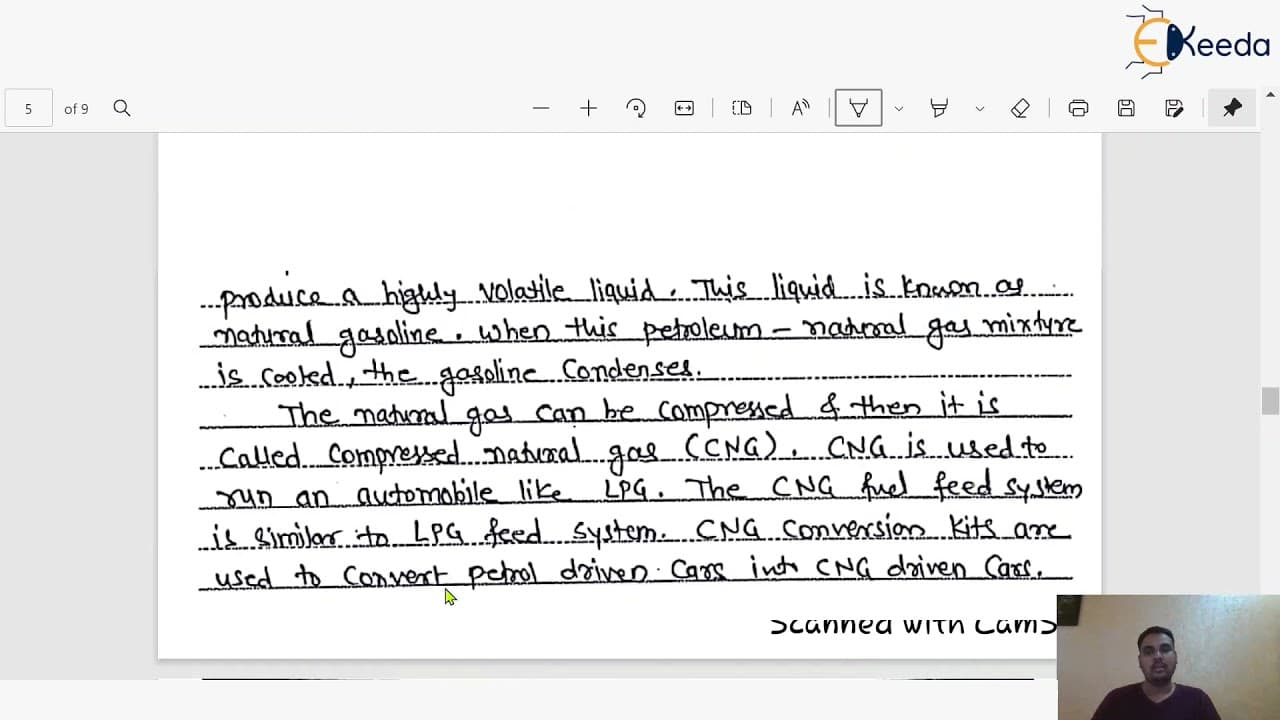
dear friends now in this video we are going to discuss cng merit and demerit suitability as well the use of cng as an alternative field the petroleum and natural gas are obtained by process of drilling winds petroleum products are composed of hydrocarbons it contains some amount of water sulfur and impurities petroleum when mixed with natural gas p... Read More
Key Insights
- 🫢 CNG is produced by compressing a mixture of petroleum and natural gas, making it a gaseous fuel alternative to petrol.
- 🌸 The advantages of using CNG include lower maintenance costs, sealed fuel systems preventing losses, increased lubricating oil life, easy mixing in air, and enhanced safety.
- 👾 However, CNG requires more space for fuel storage compared to petrol-powered vehicles and contributes to climate change through methane leakage.
- 🏙️ In India, CNG usage is widespread, particularly in metro cities, due to its environmental benefits.
- 🪡 The leakage of unburned methane from CNG is a significant contributor to climate change, emphasizing the need for improved containment measures.
- 🧡 CNG is considered a safer option compared to petrol due to its high auto-ignition temperature and narrow range of flammability.
- 👳 CNG's cleaner combustion process results in less pollution, making it an attractive alternative fuel for urban areas.
Install to Summarize YouTube Videos and Get Transcripts
Explore YouTube Video Summarizer or Get YouTube Transcript Extractor
Questions & Answers
Q: What is CNG and how is it produced?
CNG is a compressed natural gas, produced by mixing petroleum with natural gas and then compressing it. This process creates a gaseous fuel suitable for running automobiles.
Q: What are the advantages of using CNG as a fuel?
CNG-powered vehicles have lower maintenance costs, thanks to the cleaner combustion process. Additionally, the fuel systems are sealed, preventing spills or evaporation, and CNG is less likely to ignite on hot surfaces, making it safer than petrol-powered vehicles.
Q: Are there any environmental concerns with CNG?
Yes, CNG contributes to climate change through the leakage of unburned methane, a potent greenhouse gas. This leakage occurs from the production and transportation of natural gas, highlighting the need for proper containment and mitigation measures.
Q: How popular is CNG usage in India?
CNG-operated vehicles are popular in most metro cities in India. The government has promoted the use of CNG as a cleaner alternative fuel, leading to significant adoption in public transportation and private vehicles.
Summary & Key Takeaways
-
Petroleum and natural gas are obtained through drilling, and when mixed, produce a highly volatile liquid called natural gasoline. When this mixture is compressed, it becomes CNG, which is used as fuel for automobiles.
-
The advantages of CNG include lower maintenance costs, sealed fuel systems preventing losses, increased life of lubricating oils, easy and even mixing in air, and greater safety compared to petrol-powered vehicles.
-
However, CNG has disadvantages such as requiring more space for fuel storage than petrol-powered vehicles and contributing to climate change through leakage of unburned methane, a potent greenhouse gas.
Read in Other Languages (beta)
Share This Summary 📚
Summarize YouTube Videos and Get Video Transcripts with 1-Click
Try YouTube Summary with ChatGPT & Claude or YouTube Transcript Generator
Explore More Summaries from Ekeeda 📚






Summarize YouTube Videos and Get Video Transcripts with 1-Click
Try YouTube Summary with ChatGPT & Claude or YouTube Transcript Generator