What Are the Types of Architectures in Embedded Systems?
TL;DR
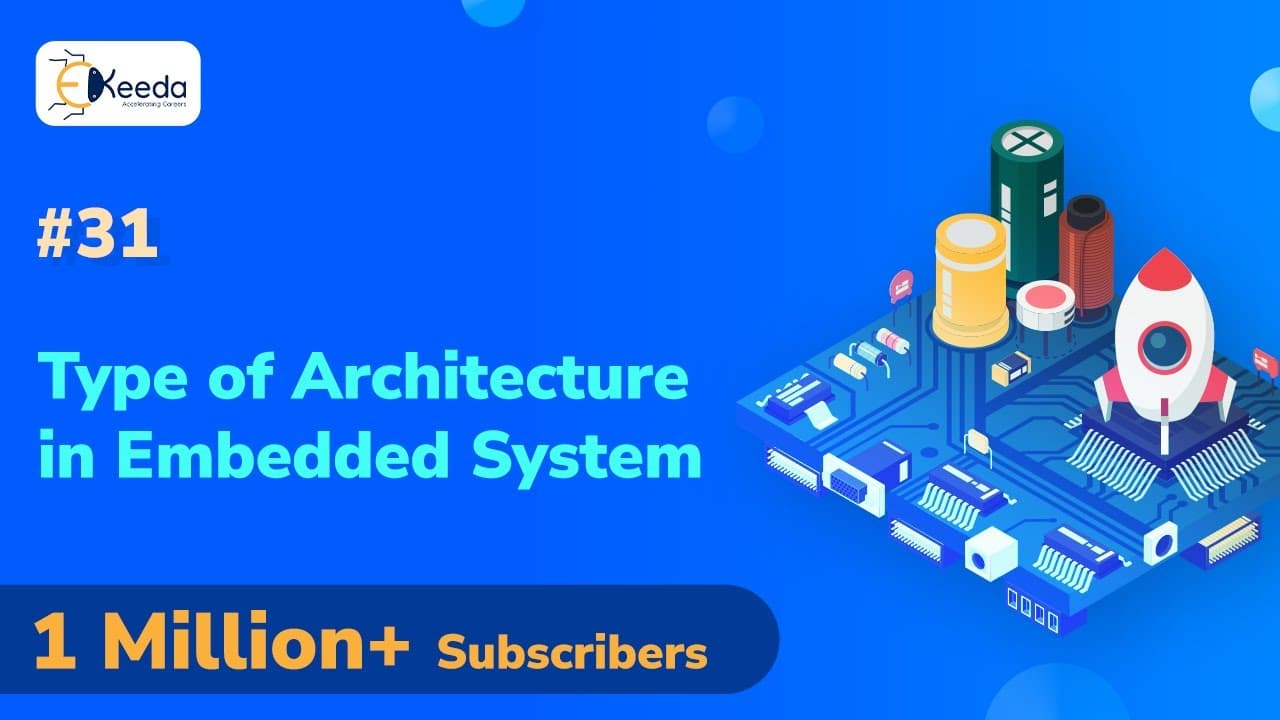
Embedded systems commonly use four architectures: von Neumann, Harvard, CISC, and RISC. Von Neumann integrates instructions and data in a single memory, leading to potential bottlenecks, while Harvard separates them, enabling faster processing. CISC features a complex instruction set with many commands, whereas RISC simplifies instructions for quicker execution.
Transcript
hello friends in this video we are going to study about the types of architectures in the embedded systems there are various types of architecture supported in embedded system like one newman and harvard architecture syst architecture and risk architecture so we will study about these types of architecture what is the configuration of the embedded ... Read More
Key Insights
- 🈸 Embedded systems consist of hardware (processor, memory, peripherals) and software (operating system, applications).
- 😒 The von Neumann architecture uses a single memory for software and data, while the Harvard architecture has separate memories for each.
- 😫 CISC architecture has complex instructions and a large instruction set, while RISC architecture has simpler instructions and a reduced instruction set.
- 👻 Von Neumann architecture can create a bottleneck in data and instruction execution, while Harvard architecture allows for faster processing.
- 💨 Harvard architecture provides greater performance and faster execution due to separate memories, while von Neumann architecture is simpler in design.
- ❓ CISC architecture emphasizes hardware implementation, while RISC architecture relies more on software.
- 👻 CISC architecture allows for more addressing modes, while RISC architecture has fewer.
- 🏍️ Von Neumann architecture requires separate clock cycles for instruction and data fetching, while Harvard architecture can fetch both in a single clock cycle.
- ❓ Harvard architecture supports pipelining, while von Neumann architecture does not.
Install to Summarize YouTube Videos and Get Transcripts
Explore YouTube Video Summarizer or Get YouTube Transcript Extractor
Questions & Answers
Q: What is an embedded system and what are its main components?
An embedded system is a computer hardware with embedded software. Its main components include a processor, memory, bus interface, peripheral devices, input/output ports, and controllers.
Q: What is the difference between von Neumann and Harvard architectures?
In the von Neumann architecture, software and data share the same memory, while the Harvard architecture has separate memories for software (instructions) and data.
Q: What is the difference between CISC and RISC architectures?
CISC stands for complex instruction set computer, which has a large number of complex instructions. RISC stands for reduced instruction set computer, which has a smaller set of simpler instructions.
Q: What are the advantages of the Harvard architecture over the von Neumann architecture?
The Harvard architecture provides greater data memory bandwidth, faster processing speed, and allows for simultaneous instruction execution and data operations.
Summary & Key Takeaways
-
An embedded system consists of hardware and software components, including a processor, memory, bus interface, peripheral devices, input/output ports, and controllers.
-
The von Neumann architecture uses a single memory for both software (instructions) and data, while the Harvard architecture has separate memories for instructions and data.
-
The CISC architecture has a complex instruction set with a large number of instructions, while the RISC architecture has a reduced instruction set with simpler instructions.
-
Each architecture has its own advantages and disadvantages in terms of speed, performance, instruction set size, instruction execution, and hardware vs software emphasis.
Read in Other Languages (beta)
Share This Summary 📚
Summarize YouTube Videos and Get Video Transcripts with 1-Click
Try YouTube Summary with ChatGPT & Claude or YouTube Transcript Generator
Explore More Summaries from Ekeeda 📚
Summarize YouTube Videos and Get Video Transcripts with 1-Click
Try YouTube Summary with ChatGPT & Claude or YouTube Transcript Generator