Hedge fund strategies: Long short 2 | Finance & Capital Markets | Khan Academy
TL;DR
Long-short hedge funds minimize market risk by taking long positions in companies expected to do well and short positions in those expected to perform poorly.
Transcript
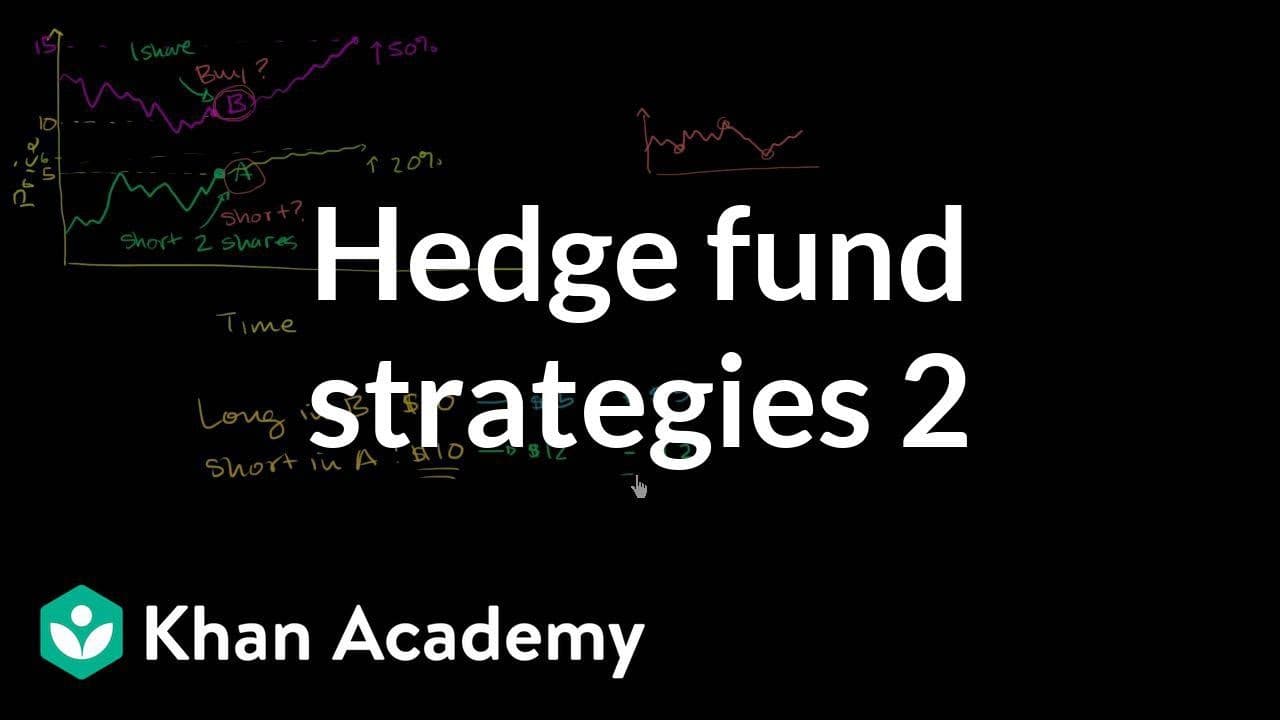
In my attempt to have a portfolio whose performance should depend only on my ability to identify good companies, and to identify bad companies, and not be held sway by whatever the market might do, I have bought a share of company B, thinking that it's a pretty good company and will do better than expected. And I have shorted two shares of company ... Read More
Key Insights
- 🦔 Long-short hedge funds aim to minimize market risk by focusing on relative performance of individual companies rather than the overall market.
- ❓ Profits are derived from the ability to identify companies that will outperform or underperform their peers.
- 👻 The strategy allows investors to potentially make gains even in a down market if they accurately predict poor performance of certain companies.
- 🦔 Long-short hedge funds are less dependent on the investor's ability to predict market direction and more reliant on their ability to analyze individual companies.
- 💁 This investment strategy is a form of portfolio diversification that can reduce exposure to overall market volatility.
- 🧘 Long positions in companies expected to perform well provide potential upside, while short positions in underperforming companies offer protection in case of market downturns.
- 👨🔬 Long-short hedge funds require thorough research and analysis to identify successful investment opportunities.
Install to Summarize YouTube Videos and Get Transcripts
Explore YouTube Video Summarizer or Get YouTube Transcript Extractor
Questions & Answers
Q: How does a long-short hedge fund strategy work?
A long-short hedge fund strategy involves taking long positions in companies expected to perform well and short positions in those expected to perform poorly. This minimizes market risk as profits are derived from the relative performance of individual companies rather than the overall market.
Q: What happens to the investment if the stock market moves up?
If the stock market moves up and company B performs better than company A, the investor makes profits on the long position in company B but incurs losses on the short position in company A. The net result is a profit due to the outperformance of company B.
Q: What happens to the investment if the stock market moves down?
If the stock market moves down and company B still outperforms company A as expected, the investor incurs losses on the long position in company B but makes profits on the short position in company A. The net result is still a profit due to the correct prediction of company A's poor performance.
Q: How does a long-short hedge fund mitigate market risk?
A long-short hedge fund mitigates market risk because the strategy is based on the investor's ability to identify companies that will perform better or worse than others, rather than predicting the direction of the overall market. This allows the investor to still make profits even in a down market if their stock picking is accurate.
Summary & Key Takeaways
-
The investor buys shares of a company (B) and shorts two shares of another company (A) based on their analysis of the companies' performance.
-
If the stock market goes up, the long position in company B earns profits, while the short position in company A incurs losses.
-
If the stock market goes down, the long position in company B incurs losses, but the short position in company A earns profits, resulting in a net gain.
Read in Other Languages (beta)
Share This Summary 📚
Summarize YouTube Videos and Get Video Transcripts with 1-Click
Try YouTube Summary with ChatGPT & Claude or YouTube Transcript Generator
Explore More Summaries from Khan Academy 📚



Summarize YouTube Videos and Get Video Transcripts with 1-Click
Try YouTube Summary with ChatGPT & Claude or YouTube Transcript Generator