Calcination - Metallurgy - Chemistry Class 12
TL;DR
Calcination is the process of heating ore below its melting point without air or with limited oxygen to convert carbonates into metal oxides.
Transcript
click the bell icon to get latest videos from Ikeda Helfer this is the previous lecture we have discussed about roasting and yes we have also discussed about a few reactions and now in this topic we are going to talk about cal solution so what is Cal solution and what are the reactions involved in this process let me talk about that in this topic s... Read More
Key Insights
- 🙈 Calcination is a process used to convert carbonates into metal oxides by heating ore without air or with limited oxygen.
- 🖤 The process is similar to roasting but lacks the presence of air.
- 🙈 Calcination is effective in removing impurities and is crucial in the concentration of ores.
- ❓ Zinc carbonate can be calcined to obtain zinc oxide and carbon dioxide.
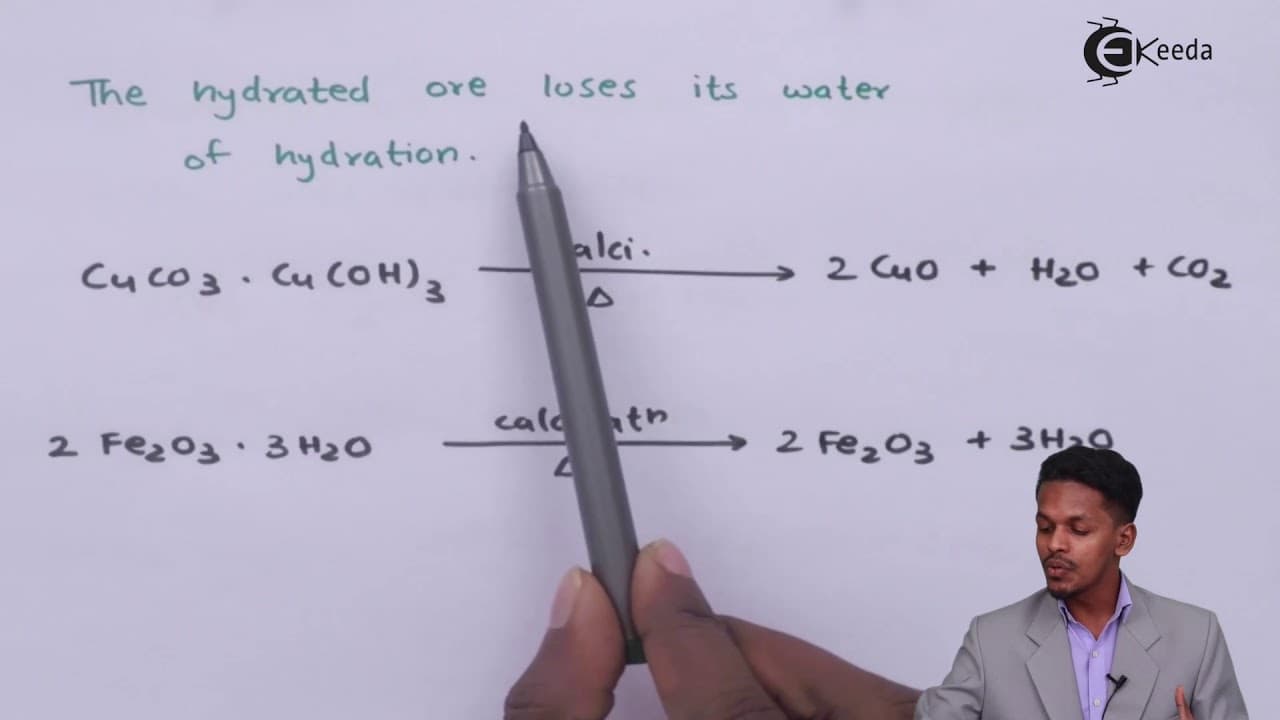
- 💦 Calcination can also remove water of hydration from compounds like malachite.
- 🫢 Limonite can be calcined to form ferric oxide and hydrogen gas.
- 🙈 Calcination is an important chemical process in the extraction and purification of metals from ores.
Install to Summarize YouTube Videos and Get Transcripts
Explore YouTube Video Summarizer or Get YouTube Transcript Extractor
Questions & Answers
Q: What is calcination, and how is it different from roasting?
Calcination is the process of heating ore below its melting point without air or with limited oxygen. It is similar to roasting, but in roasting, air is present.
Q: What are the reactions involved in calcination?
During calcination, carbonates are decomposed to give metal oxides and carbon dioxide as a by-product. For example, zinc carbonate is heated to obtain zinc oxide and carbon dioxide.
Q: How is hydration removed through calcination?
Hydration can be removed through calcination. For example, malachite, which contains CuCO3.Cu(OH)2, when calcined, produces CuO, H2, and CO2 as a by-product.
Q: What happens when limonite is calcined?
Limonite undergoes calcination at high temperature to convert into Fe2O3 plus three moles of H2. This reaction results in the formation of ferric oxide.
Summary & Key Takeaways
-
Calcination is similar to roasting, but without air or with limited oxygen.
-
The process involves heating the ore below its melting point to convert carbonates into metal oxides.
-
Calcination can remove impurities and is an important step in the concentration of ores.
Read in Other Languages (beta)
Share This Summary 📚
Summarize YouTube Videos and Get Video Transcripts with 1-Click
Try YouTube Summary with ChatGPT & Claude or YouTube Transcript Generator
Explore More Summaries from Ekeeda 📚






Summarize YouTube Videos and Get Video Transcripts with 1-Click
Try YouTube Summary with ChatGPT & Claude or YouTube Transcript Generator