io pads and power distribution ii 1080p
TL;DR
This content discusses the requirements, types, and configurations of input buyout circuits and power distribution in integrated circuits.
Transcript
Hello friends today we are going to discuss about input buyout paths and power distribution so in the previous video we have discussed about the packaging so what is package we studied what are the different types of packages and essential requirements of the package have been studied in our previous video in this video let us discuss about input b... Read More
Key Insights
- 😃 Input buyout circuits need to drive big loads, ensure voltage consistency, reduce noise, and provide ESD protection.
- ✋ Different types of input buyout circuits cater to specific needs, including high drive capabilities, analog signal transmission, and power supply provision.
- ♠️ Input buyout pads can be configured inline or staggered, with staggered design allowing for a larger number of pads but also increasing the overall pad height.
- ♠️ Circuit under pad design can substantially reduce the die size by incorporating the bonding pad over the input by output structure.
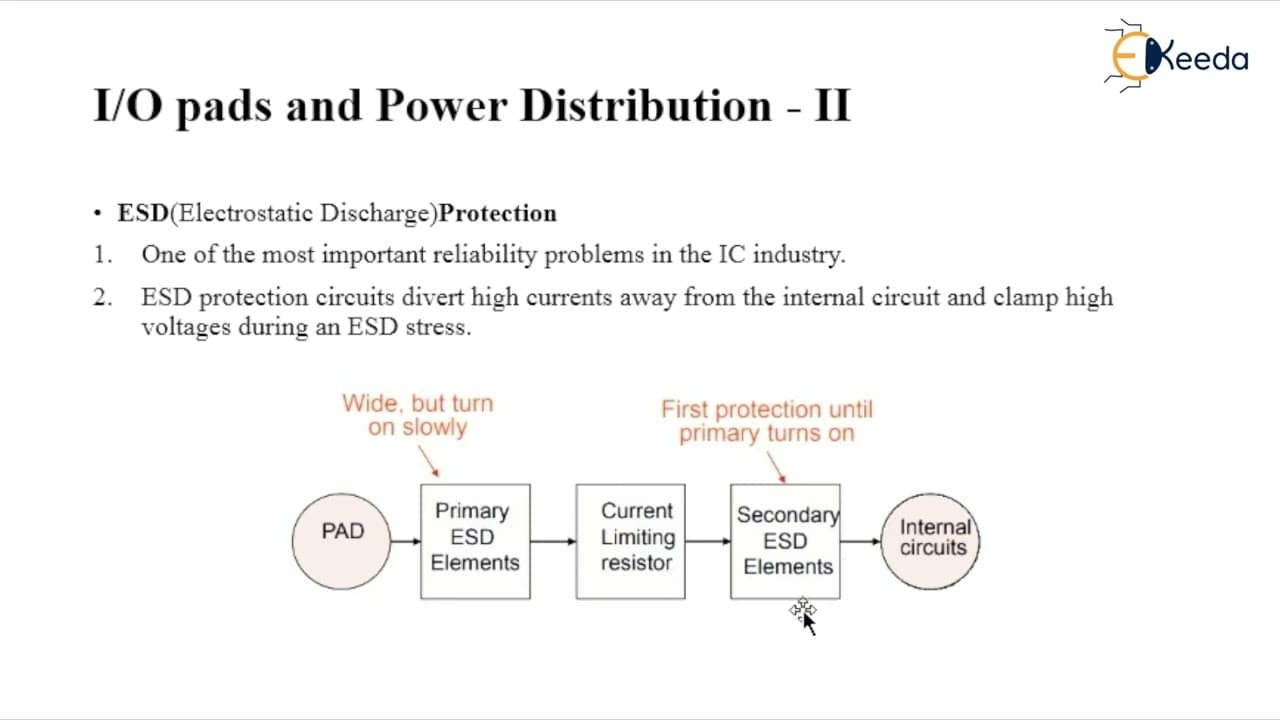
- ☠️ ESD protection is crucial in preventing damage caused by external devices with high potential differences.
- ✊ Power distribution is important for providing power to the input buyout circuits and the core processor.
Install to Summarize YouTube Videos and Get Transcripts
Explore YouTube Video Summarizer or Get YouTube Transcript Extractor
Questions & Answers
Q: What are the essential requirements for input buyout circuits?
Input buyout circuits need to drive big loads, have voltage consistency, reduce noise caused by transmission line inductance, and provide ESD protection.
Q: What are the types of input buyout circuits?
The types include digital input buyout buffers, analog input buyout cells, and power supplies.
Q: What is the purpose of digital input buyout buffers?
Digital input buyout buffers can drive large capacity loads, have increasing fan-out, and protect against short circuit current.
Q: How does electrostatic discharge (ESD) protection work in input buyout circuits?
ESD protection diverts high currents away from the internal circuit and clamps high voltages during ESD stress, preventing damage to the integrated circuit.
Summary & Key Takeaways
-
The content covers the essential requirements of input buyout circuits, including the ability to drive big loads, voltage consistency, noise reduction, and ESD protection.
-
Different types of input buyout circuits are discussed, such as digital input buyout buffers, analog input buyout cells, and power supplies.
-
The content also explains the configuration of input buyout pads, including inline, staggered, and circuit under pad designs.
Read in Other Languages (beta)
Share This Summary 📚
Summarize YouTube Videos and Get Video Transcripts with 1-Click
Try YouTube Summary with ChatGPT & Claude or YouTube Transcript Generator
Explore More Summaries from Ekeeda 📚


Summarize YouTube Videos and Get Video Transcripts with 1-Click
Try YouTube Summary with ChatGPT & Claude or YouTube Transcript Generator