Types of catalysts | Kinetics | AP Chemistry | Khan Academy
TL;DR
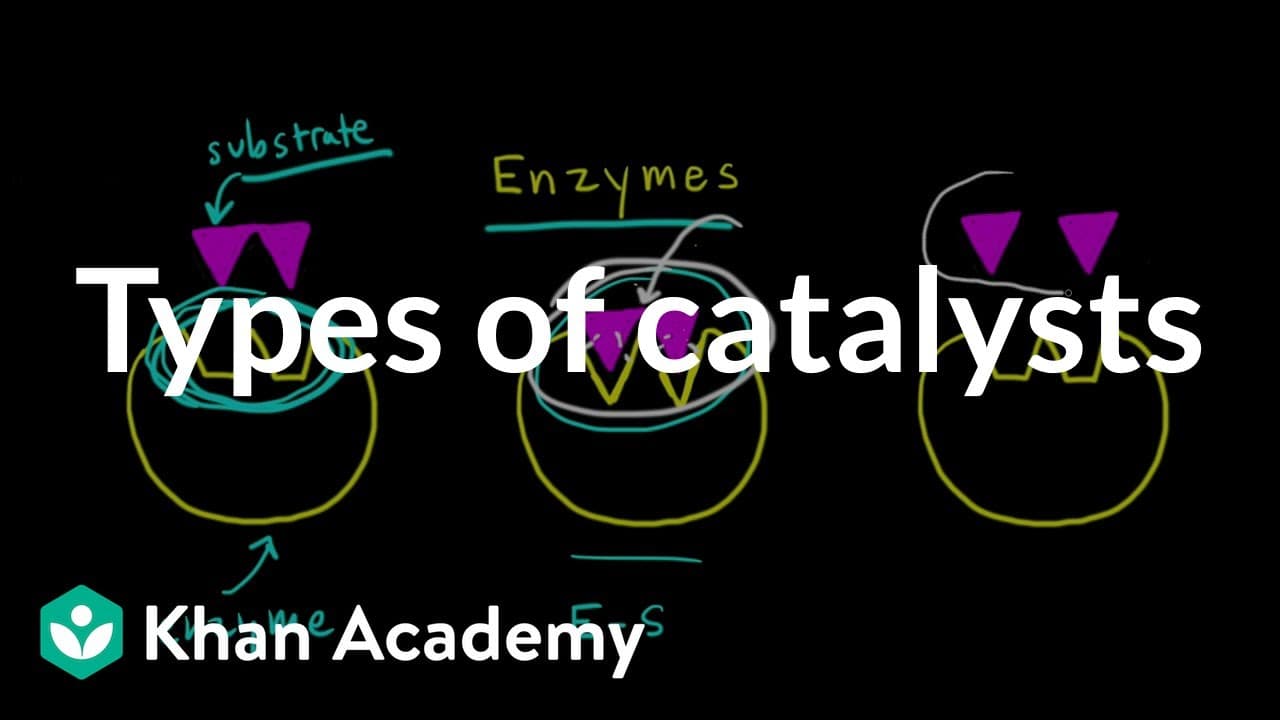
Catalysts, such as enzymes, speed up reactions by lowering activation energy. They can be biological (enzymes), homogeneous (in the same phase), or heterogeneous (in a different phase).
Transcript
- [Instructor] A catalyst speeds up a reaction by lowering the activation energy. And there are many types of catalysts. And first we're going to look at enzymes which are biological catalysts. Let's say that this represents our enzyme, and the place where the reaction occurs is called the active site of the enzyme. So right in here, let's say this... Read More
Key Insights
- 😘 Catalysts, including enzymes, lower activation energy in reactions by providing an active site for substrates to bind.
- ☢️ Enzymes undergo induced fit when the substrate binds, resulting in changes in the shape of the enzyme's active site.
- 🎁 Homogeneous catalysts are present in the same phase as the reactants, while heterogeneous catalysts are present in a different phase.
- ❓ The hydrolysis of substances like sucrose can be catalyzed by acid or enzymes.
- 🐝 Honey bees have enzymes that enable them to convert sucrose into glucose and fructose, making honey sweeter than table sugar.
- ❓ Platinum is an example of a heterogeneous catalyst, commonly used in reactions like hydrogenation.
- ❓ Heterogeneous catalysts adsorb reactant molecules onto their surface, facilitating the reaction.
Install to Summarize YouTube Videos and Get Transcripts
Explore YouTube Video Summarizer or Get YouTube Transcript Extractor
Questions & Answers
Q: How do enzymes speed up reactions?
Enzymes lower activation energy by providing an active site for the substrate to bind, inducing changes in shape that allow for better binding. This results in a more favorable transition state and speeds up the overall reaction.
Q: What is the role of homogenous catalysts?
Homogeneous catalysts, like the hydronium ion, can provide protons to catalyze reactions. They are present in the same phase as the reactants and facilitate the hydrolysis of sucrose by protonating the oxygen in the ether linkage.
Q: How does acid catalyzed hydrolysis of sucrose work?
In the presence of an acid catalyst, such as hydronium ions, a lone pair of electrons on the oxygen in the ether linkage of sucrose takes a proton. This protonation activates the oxygen and allows for the acid catalyzed hydrolysis of sucrose to glucose and fructose.
Q: How do heterogeneous catalysts work?
Heterogeneous catalysts, like platinum, are present in a different phase from the reactants. They adsorb reactant molecules onto their surface, facilitating the breaking of bonds and the formation of new bonds to catalyze the reaction.
Summary & Key Takeaways
-
Enzymes are biological catalysts that work in the active site where the reaction occurs, and the substrate binds to the enzyme to induce changes in shape, facilitating better binding and lowering activation energy.
-
Homogeneous catalysts, like the hydronium ion, are present in the same phase as the reactants and can provide protons to catalyze reactions, such as the hydrolysis of sucrose.
-
Heterogeneous catalysts, like platinum, are present in a different phase from the reactants and can facilitate reactions by adsorbing reactants on their surface.
Read in Other Languages (beta)
Share This Summary 📚
Summarize YouTube Videos and Get Video Transcripts with 1-Click
Try YouTube Summary with ChatGPT & Claude or YouTube Transcript Generator
Explore More Summaries from Khan Academy 📚



Summarize YouTube Videos and Get Video Transcripts with 1-Click
Try YouTube Summary with ChatGPT & Claude or YouTube Transcript Generator