Tools of Foreign Policy
TL;DR
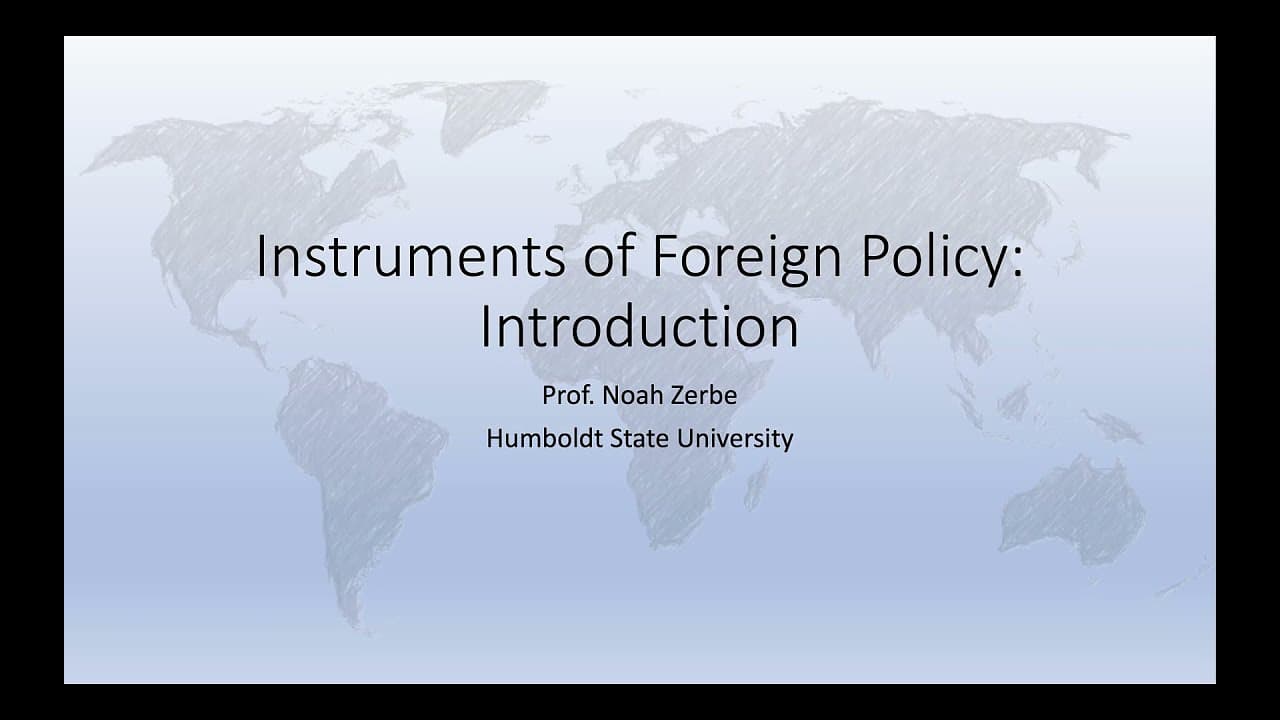
This video introduces the basic framework for understanding foreign policy tools, emphasizing their connection to a state's goals and the spectrum of violence or coerciveness they entail.
Transcript
Hey everyone. Noah Zerbe here. This is one of a series of short videos looking at the instruments or tools of foreign policy. In this video, we'll introduce the basic framework for subsequent videos that consider the variety of ways that states seek to achieve their foreign policy goals. Glenn Krutz offers a definition of foreign policy t... Read More
Key Insights
- 🥅 Foreign policy is a pattern of activity shaped by a state's goals, values, and means.
- 🗯️ US foreign policy is driven by national security, economic interests, strategic objectives, and human rights concerns.
- 🔨 The three sets of foreign policy tools include diplomacy, economic tools, and military options, which vary in the degree of coercion.
- 🥺 Balancing and prioritizing the different foreign policy goals can lead to tensions and conflicts.
- 🗯️ During the Cold War, the US sacrificed support for democracy and human rights to maintain the balance of power.
- 🥅 States can use diplomacy to explain goals, develop shared understandings, or achieve common goals.
- 🦻 Economic tools include aid, preferential trade relations, sanctions, and embargoes.
Install to Summarize YouTube Videos and Get Transcripts
Explore YouTube Video Summarizer or Get YouTube Transcript Extractor
Questions & Answers
Q: What is the definition of foreign policy?
Foreign policy is a state's objectives abroad, the values guiding them, and the instruments used to pursue them. It is a pattern of activity, purposive in nature, and linked to domestic policy.
Q: What are the four broad concerns driving US foreign policy?
The four concerns driving US foreign policy are national security, economic interests, strategic objectives, and human rights promotion. They often compete and vary in priority depending on specific crises.
Q: What are the three sets of foreign policy tools available?
The three sets of foreign policy tools are diplomacy, economic tools, and military options. Diplomacy involves voluntary negotiations, economic tools range from non-coercive aid to sanctions, and military options include security agreements and direct use of force.
Q: How do the foreign policy tools differ in coerciveness?
Diplomacy is the least coercive tool as it relies on voluntary negotiations, while economic tools range from relatively non-coercive measures like aid to sanctions, which are more coercive. Military options, such as military force, are the most coercive instruments.
Summary & Key Takeaways
-
Foreign policy involves a state's goals, values, and means used to achieve them in the international arena.
-
US foreign policy is driven by national security, economic interests, strategic objectives, and human rights concerns.
-
There are three sets of foreign policy tools: diplomacy (least coercive), economic tools (moderately coercive), and military options (most coercive).
Read in Other Languages (beta)
Share This Summary 📚
Summarize YouTube Videos and Get Video Transcripts with 1-Click
Try YouTube Summary with ChatGPT & Claude or YouTube Transcript Generator
Explore More Summaries from Noah Zerbe 📚


Summarize YouTube Videos and Get Video Transcripts with 1-Click
Try YouTube Summary with ChatGPT & Claude or YouTube Transcript Generator