Advance Encryption Standard | Cryptography and System Security (Reshoot)
TL;DR
The Advanced Encryption Standard (AES) is a block cipher developed to replace the Data Encryption Standard (DES) for improved security and efficiency.
Transcript
hello and welcome back to the course of cryptography and assistant security today we are going to see the advanced uh encryption standard uh okay in the last video we have seen the uh data encryption standard as well as the three and third uh level of data encryption standard that is 3d es um in in this section we are going to cover up with the adv... Read More
Key Insights
- 🔒 AES is a block cipher developed to replace DES and improve the security and efficiency of encryption.
- 🚫 AES uses a 128-bit block size and key size variations of 128, 192, or 256 bits.
- 🛝 AES has a different structure than DES, with four separate functions in each round.
- 💨 AES offers stronger security, faster performance, and more design flexibility compared to DES and Triple DES.
- 🉑 AES has been widely accepted as the most symmetric cipher and is implemented in various platforms and programming languages.
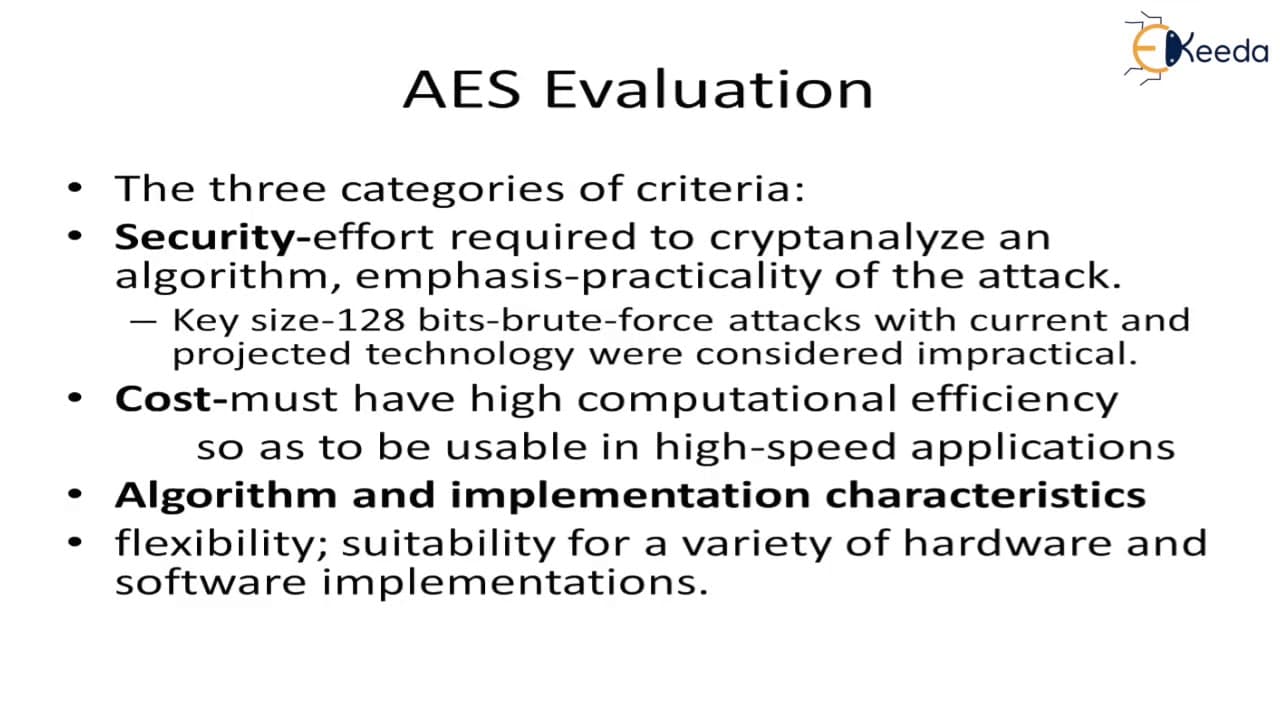
- 🔒 The evaluation criteria for AES include security, cost, and algorithm implementation characteristics.
- 🤩 AES encryption employs several operations, including byte substitution, permutation, mix columns, and XOR with the key.
Install to Summarize YouTube Videos and Get Transcripts
Explore YouTube Video Summarizer or Get YouTube Transcript Extractor
Questions & Answers
Q: What is the purpose of the Advanced Encryption Standard (AES)?
AES was created to overcome the drawbacks of previous encryption standards and provide better security and efficiency in commercial applications.
Q: How does AES differ from the Data Encryption Standard (DES)?
AES uses a larger block size (128 bits) and offers key sizes of 128, 192, or 256 bits, while DES has a 64-bit block size and a key size of 56 bits. AES also uses a different structure, with four separate functions in each round.
Q: How many rounds does AES use?
AES can have 10, 12, or 14 rounds depending on the key size. Each round uses a different 128-bit round key.
Q: What are the advantages of AES over Triple DES (3DES)?
AES offers stronger security, faster performance, and a higher resistance to cryptanalysis compared to 3DES. It also provides a full specification and design details for easier implementation.
Summary & Key Takeaways
-
The Advanced Encryption Standard (AES) is a commercial-grade block cipher that replaces the Data Encryption Standard (DES).
-
AES uses a 128-bit block size and key sizes of 128, 192, or 256 bits, providing stronger security and faster performance compared to DES.
-
AES has a different structure than DES, consisting of four separate functions: byte substitution, permutation, arithmetic operations over a finite field, and XOR with the key.
Read in Other Languages (beta)
Share This Summary 📚
Summarize YouTube Videos and Get Video Transcripts with 1-Click
Try YouTube Summary with ChatGPT & Claude or YouTube Transcript Generator
Explore More Summaries from Ekeeda 📚


Summarize YouTube Videos and Get Video Transcripts with 1-Click
Try YouTube Summary with ChatGPT & Claude or YouTube Transcript Generator