Introduction to the cell | Cells | High school biology | Khan Academy
TL;DR
Cells are the basic units of life, composed of various complex structures and functions.
Transcript
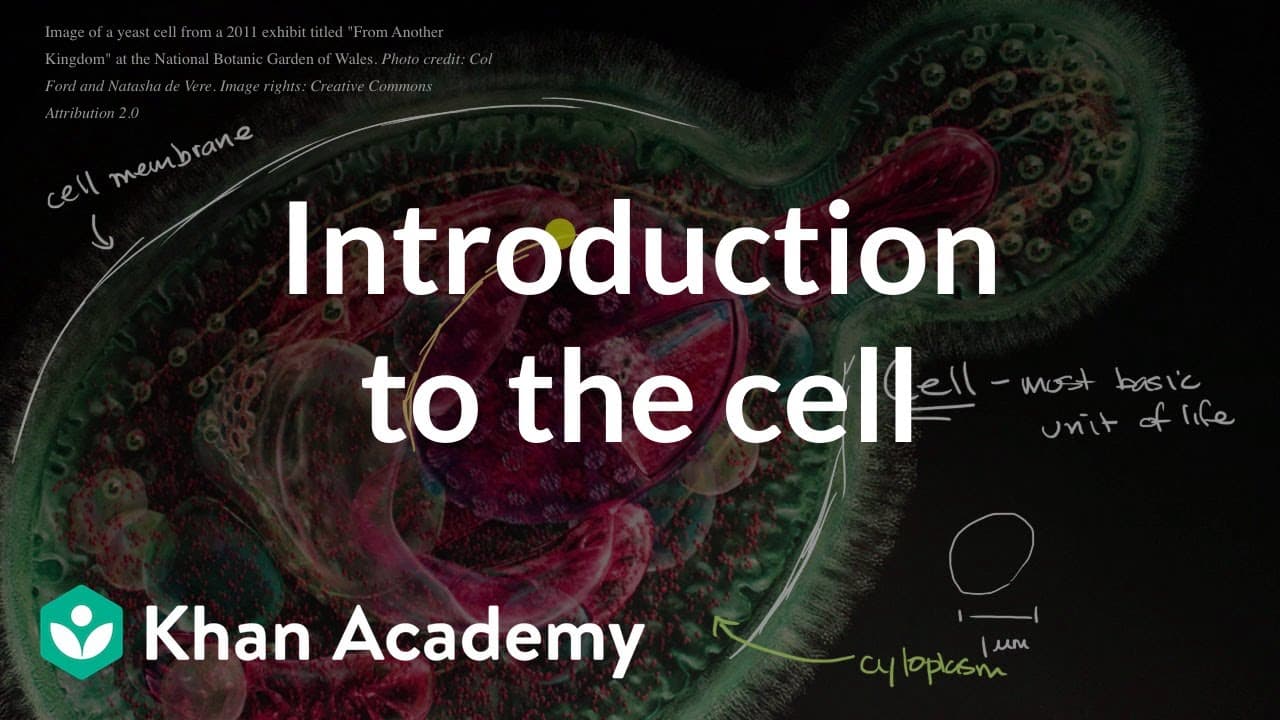
- [Instructor] You might already have some type of a notion of a what a cell is. You might already realize that it is most basic unit of life. Some would argue that maybe viruses are even a more basic unit of life, but the organisms that we consider living, like ourselves, are made up of cells and all living organisms that we for sure consider livi... Read More
Key Insights
- 🫒 Cells are the most basic units of life and are present in all living organisms.
- ✋ Despite their small size, cells exhibit a high degree of complexity and organization.
- ♻️ All cells have a membrane that separates them from the external environment.
- 🖐️ Cells contain various structures, such as ribosomes, which play crucial roles in their functions.
- 👻 Genetic information is stored in DNA within cells, allowing for cell replication and function.
- 🖤 Prokaryotic cells lack a well-defined nucleus and membrane-bound organelles, while eukaryotic cells have a membrane-bound nucleus.
- 🛩️ The scale of cells is incredibly small, with even smaller components and structures that contribute to their complexity.
Install to Summarize YouTube Videos and Get Transcripts
Explore YouTube Video Summarizer or Get YouTube Transcript Extractor
Questions & Answers
Q: What is the basic unit of life?
The basic unit of life is the cell, which forms the building blocks of all living organisms.
Q: Are cells simple in structure?
No, cells are highly complex, as shown by the intricate structures and functions they possess.
Q: What is the difference between cytoplasm and cytosol?
Cytoplasm refers to the fluid and all the contents inside the cell membrane, while cytosol refers specifically to the fluid portion.
Q: What is the role of ribosomes in cells?
Ribosomes are complex structures that produce proteins from genetic information, essentially acting as protein factories in cells.
Summary & Key Takeaways
-
Cells are the most basic units of life and make up all living organisms.
-
Despite their small size, cells are highly complex and contain various structures and functions.
-
All cells have a membrane that separates them from the external environment, and the material inside the membrane is called cytoplasm.
Read in Other Languages (beta)
Share This Summary 📚
Summarize YouTube Videos and Get Video Transcripts with 1-Click
Try YouTube Summary with ChatGPT & Claude or YouTube Transcript Generator
Explore More Summaries from Khan Academy 📚



Summarize YouTube Videos and Get Video Transcripts with 1-Click
Try YouTube Summary with ChatGPT & Claude or YouTube Transcript Generator