Pythagorus' Theorum - Math Lesson 3,4,5 triangle
TL;DR
Learn how to use Pythagoras's Theorem to calculate the length of the unknown sides in a right-angled triangle.
Transcript
good day welcome to the tech math Channel what we're going to be having a look at in this video is we're going to be having a look at how to work out their unknown sides on a right angle triangle okay using this really really great little uh theorem that was discovered by this guy about 2 and a half thousand ideas ago in ancian Greece this guy call... Read More
Key Insights
- 🔺 Pythagoras's Theorem is a mathematical formula used to calculate the lengths of sides in a right-angled triangle.
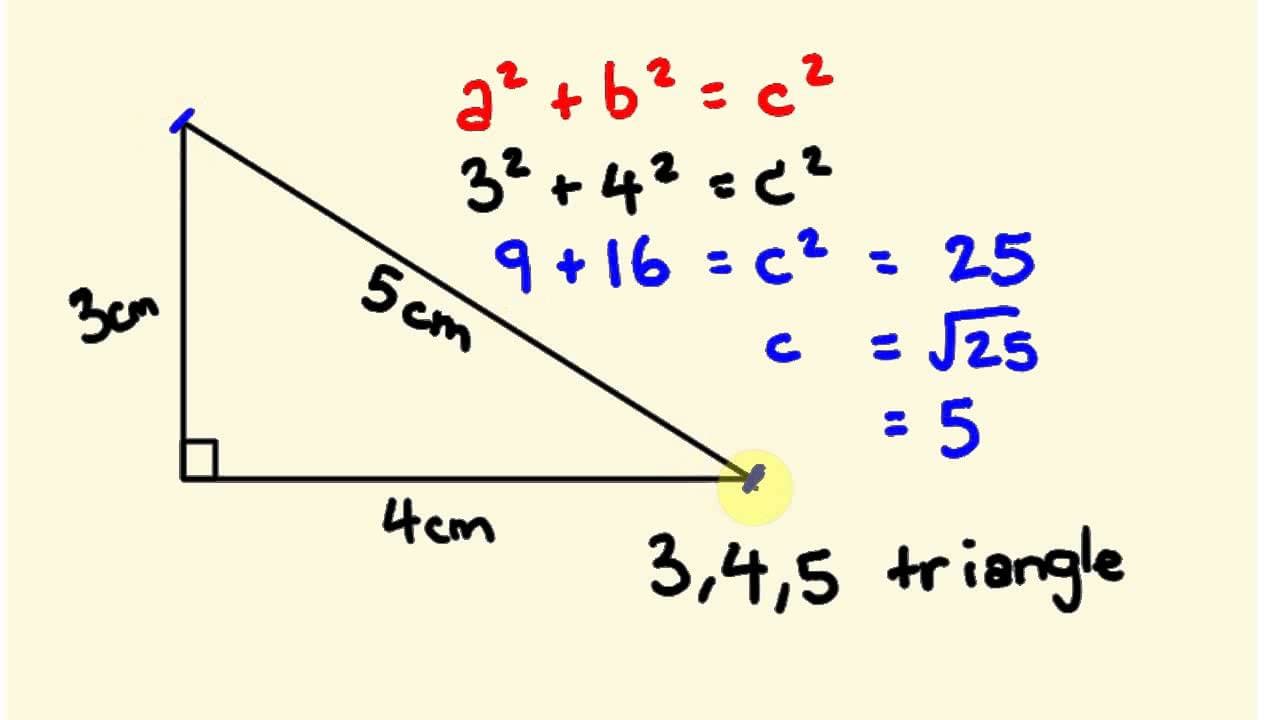
- ❎ The theorem states that in a right-angled triangle, the sum of the squares of the two shorter sides is equal to the square of the hypotenuse.
- 🔺 By rearranging the formula, you can solve for any of the unknown sides in a right-angled triangle.
- 🪚 Pythagoras's Theorem is commonly used in carpentry to ensure that walls and structures are squared up at a 90° angle.
- 🔺 The 3-4-5 triangle is a special right-angled triangle that can be easily identified and used to create right angles in carpentry.
- 🔺 Pythagoras's Theorem is not applicable to triangles that are not right-angled.
- ❓ The formula a^2 + b^2 = c^2 is the basis of Pythagoras's Theorem.
Install to Summarize YouTube Videos and Get Transcripts
Explore YouTube Video Summarizer or Get YouTube Transcript Extractor
Questions & Answers
Q: What is Pythagoras's Theorem?
Pythagoras's Theorem states that in a right-angled triangle, the sum of the squares of the two shorter sides is equal to the square of the longest side (hypotenuse).
Q: How do you use Pythagoras's Theorem to find the length of the hypotenuse?
To find the length of the hypotenuse, square both of the shorter sides, add them together, and then take the square root of the sum.
Q: Can Pythagoras's Theorem be used for triangles that are not right-angled?
No, Pythagoras's Theorem is only applicable to right-angled triangles. For triangles that are not right-angled, you would need different methods to calculate the lengths of the sides.
Q: How can Pythagoras's Theorem be useful in carpentry?
Carpenters can use Pythagoras's Theorem to ensure that walls and structures are squared up at a 90° angle. By measuring the lengths of two shorter sides, they can determine the length of the hypotenuse to create right angles.
Summary & Key Takeaways
-
Pythagoras's Theorem states that in a right-angled triangle, the sum of the squares of the two shorter sides is equal to the square of the longest side (hypotenuse).
-
The formula for Pythagoras's Theorem is a^2 + b^2 = c^2, where a and b are the shorter sides and c is the hypotenuse.
-
By rearranging the formula, you can solve for either of the shorter sides or the hypotenuse.
Read in Other Languages (beta)
Share This Summary 📚
Summarize YouTube Videos and Get Video Transcripts with 1-Click
Try YouTube Summary with ChatGPT & Claude or YouTube Transcript Generator
Explore More Summaries from tecmath 📚


Summarize YouTube Videos and Get Video Transcripts with 1-Click
Try YouTube Summary with ChatGPT & Claude or YouTube Transcript Generator