Energy inputs for tilling a hectare of land | Cosmology & Astronomy | Khan Academy
TL;DR
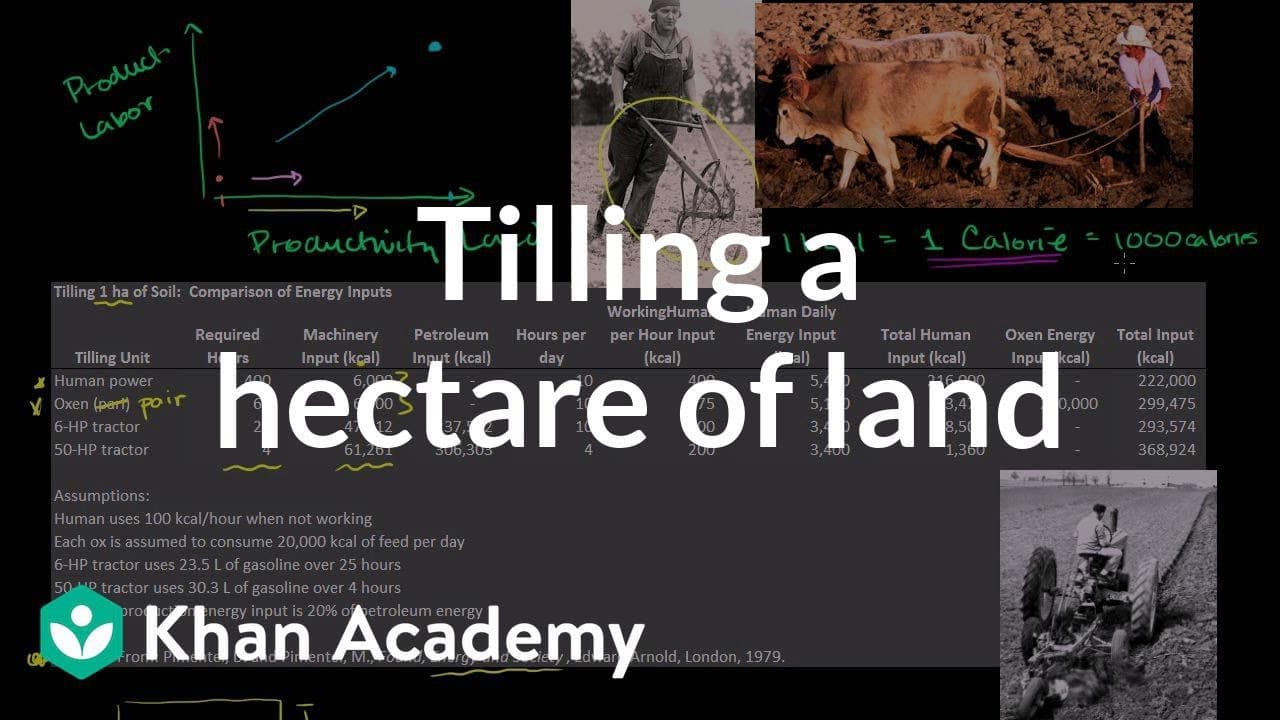
The video discusses the transformation of soil tilling methods over time and compares the energy inputs required for each technique.
Transcript
In the last video, we talked about how humans, over time, have gotten better and better at getting more calories out of a given unit of land. And one thing I do want to emphasize, in the last video, these numbers that I came up with-- I picked these numbers to make the math fairly simple-- and to give you the general idea. I don't want you to think... Read More
Key Insights
- 🏝️ Humans have improved their ability to extract calories from a given unit of land over time.
- 🌱 Soil tilling is essential for agriculture as it prepares the soil for optimal plant growth.
- 🔬 Technological advancements in soil tilling techniques have reduced the labor required by humans.
Install to Summarize YouTube Videos and Get Transcripts
Explore YouTube Video Summarizer or Get YouTube Transcript Extractor
Questions & Answers
Q: How has human ability to extract calories from land improved over time?
The video mentions that humans have become more efficient at extracting calories from a given unit of land over time. While the numbers provided in the video are simplified, they serve to illustrate the concept rather than providing exact figures. Factors such as agricultural practices, land use, and calorie requirements can influence the number of people a square kilometer of land can support.
Q: What is soil tilling, and why is it necessary?
Soil tilling involves churning up the soil to prepare it for the next agricultural cycle. It helps mix nutrients from lower layers with the surface soil, bury remains from previous harvests and weeds, and provides aeration. Tilling is essential to create an optimal environment for plant growth.
Q: How have humans reduced the labor required for soil tilling?
Humans have developed various technologies to reduce the labor involved in soil tilling. They have evolved from manual labor to employing animals, such as oxen, to do the work on their behalf. More recently, tractors have been used, further decreasing the human labor input.
Q: What is the significance of the human energy input compared to other energy sources?
The human energy input decreases significantly as technology advances. While the total energy input, considering both human labor and external sources such as oxen or fuel for tractors, may increase, the human energy contribution reduces. This demonstrates how technological advancements have enabled humans to achieve higher productivity with fewer personal physical exertions.
Summary & Key Takeaways
-
The video explores the history of soil tilling and how humans have developed technologies to reduce labor and increase efficiency.
-
Different soil tilling methods are compared, from manual labor to using oxen and tractors, focusing on the energy inputs required for each.
-
The total energy inputs include both human labor and external energy sources, such as fuel for tractors or feed for oxen.
Read in Other Languages (beta)
Share This Summary 📚
Summarize YouTube Videos and Get Video Transcripts with 1-Click
Try YouTube Summary with ChatGPT & Claude or YouTube Transcript Generator
Explore More Summaries from Khan Academy 📚



Summarize YouTube Videos and Get Video Transcripts with 1-Click
Try YouTube Summary with ChatGPT & Claude or YouTube Transcript Generator